You’re applying for a job. The posting says “submit your CV.”
Do they mean… a resume? Something different? Something longer?
The confusion is real—and it costs people opportunities.
The Short Answer
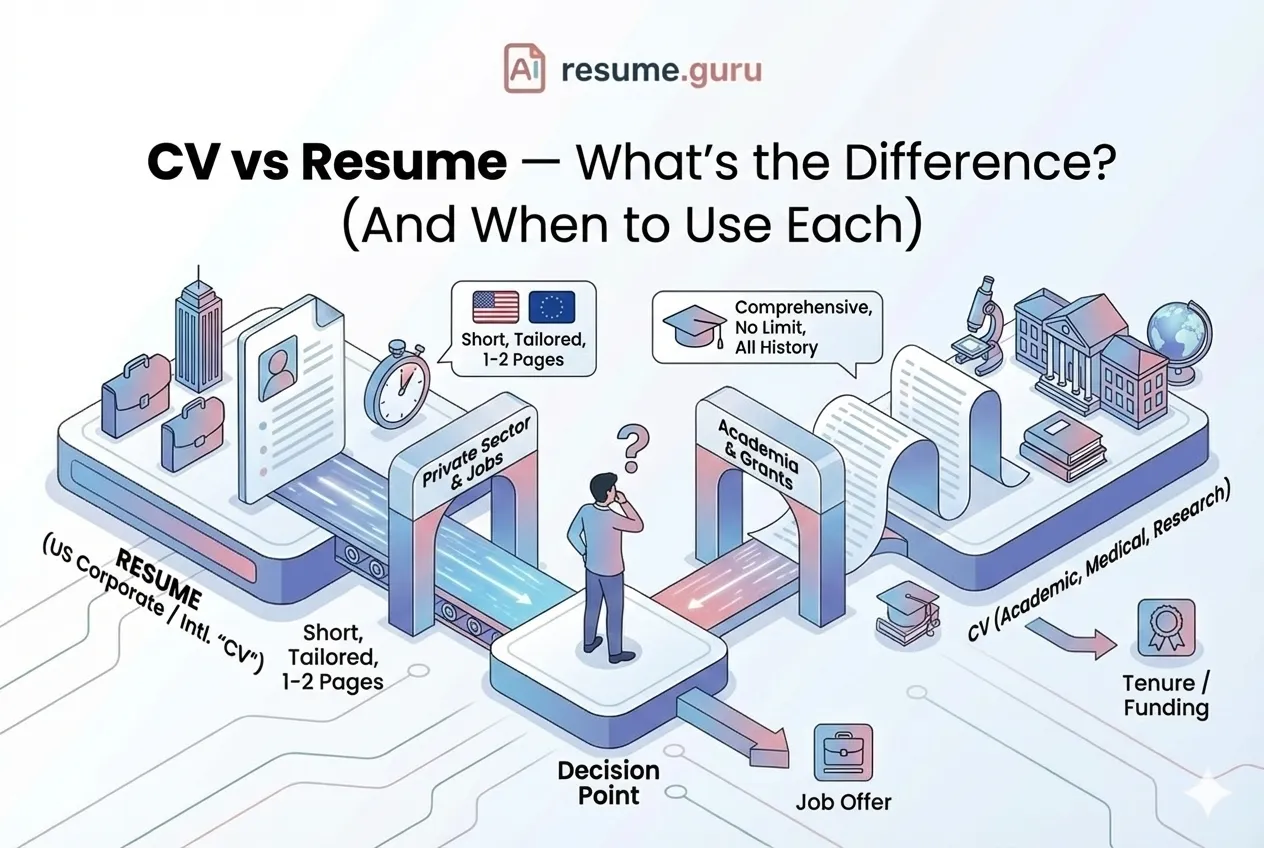
In the US: A CV is different from a resume. CVs are long academic documents; resumes are short career summaries.
In Europe/UK/Australia: “CV” typically means what Americans call a resume—a 1-2 page career summary.
This guide clears up the confusion once and for all.
Quick Summary
- Resume (US definition): 1-2 pages, tailored to the job, used for most positions
- CV (US academic): Comprehensive, no page limit, used for academic/research roles
- CV (international): Often means “resume”—1-2 page job application document
- When in doubt: check the job posting’s country and industry
CV vs Resume: The Core Differences
| Feature | Resume (US) | CV (US Academic) |
|---|---|---|
| Length | 1-2 pages max | No limit (5-10+ pages common) |
| Purpose | Land a specific job | Document full academic career |
| Content | Highlights most relevant experience | Comprehensive: everything included |
| Customization | Tailored for each application | Rarely customized |
| Focus | Achievements and skills | Publications, research, teaching |
| When updated | For each application | Ongoing as career grows |
| Industries | Corporate, most private sector | Academia, research, medicine |
Because a resume trades completeness for impact, it pays to write stronger resume bullets for the space you do have.
What Is a Resume?
A resume is a concise marketing document designed to land a specific job.
Resume Characteristics
Resume Features
- 1-2 pages maximum (1 page preferred for most)
- Tailored to each specific job application
- Highlights most relevant experience and achievements
- Focuses on impact and quantified results
- Uses reverse chronological format
- Optimized for ATS and quick scanning
Resume Sections
- Contact Information
- Professional Summary
- Skills
- Work Experience
- Education
- Optional: Certifications, Projects, Volunteer Work
Tip
In the US, “resume” is standard for almost every job outside academia and medicine. When a US company asks for a CV, they often actually mean resume—unless it’s explicitly academic.
In much of Europe, that same short document follows its own conventions, covered in our European CV format and Europass guide.
What Is a CV (Curriculum Vitae)?
In the US academic context, a CV is a comprehensive record of your entire academic career.
CV Characteristics (US Academic)
CV Features
- No page limit—often 5-10+ pages for senior academics
- Complete record: nothing is left out
- Lists all publications, presentations, grants
- Documents teaching experience in detail
- Includes committee work, awards, memberships
- Rarely tailored—adds to same document over time
CV Sections (US Academic)
- Contact Information
- Education (detailed)
- Research Experience
- Publications (journals, books, chapters)
- Presentations & Conferences
- Teaching Experience
- Grants & Fellowships
- Awards & Honors
- Professional Memberships
- References
The International Difference
Here’s where it gets confusing.
Important
Outside the US, “CV” often means what Americans call a resume—a short, tailored job application document.
| Region | What They Call It | What They Mean |
|---|---|---|
| United States | Resume | 1-2 page job application document |
| United States (academic) | CV / Curriculum Vitae | Long academic document (no page limit) |
| United Kingdom | CV | 1-2 page job application document (= US resume) |
| Europe | CV | 1-2 page document (= US resume) |
| Australia / NZ | CV or Resume | Both terms used for 1-2 page document |
| India | CV or Resume | Both terms used interchangeably |
What This Means for You
- Applying to US company? Submit a resume (unless they specifically say “academic CV”)
- Applying to UK/EU company? They want a CV—which means a short, tailored document
- Applying to academic role anywhere? Submit a comprehensive CV
If the application is in another language as well, you can translate your resume without rebuilding it.
When to Use a CV (US Context)
In the US, use a CV (not a resume) for:
CV Situations
- Academic faculty positions
- Research scientist roles
- Medical positions (physicians, researchers)
- Grants and fellowship applications
- Academic awards and scholarships
- Speaking or presenting at conferences
- Some government scientific positions
Info
Even in these fields, some employers want a shorter “abbreviated CV” or a resume for initial screening. Read the application instructions carefully.
When to Use a Resume
For most jobs in the US (and for international “CV” applications), use a resume:
Resume Situations
- Corporate/private sector jobs
- Startup positions
- Government jobs (non-scientific)
- Nonprofit roles
- Technical positions (engineering, IT)
- Sales, marketing, finance roles
- Any job that doesn't explicitly request an academic CV
How to Convert a Resume to a CV
If you need to create an academic CV from your resume:
- 1
Remove the page limit constraint
CVs grow with your career. Don't cut content to fit pages.
- 2
Expand your education section
Include thesis titles, advisors, research focus, relevant coursework.
- 3
Add academic sections
Publications, presentations, research experience, teaching.
- 4
List everything
Nothing is too minor: conferences attended, guest lectures, committee work.
- 5
Order by importance to academia
Publications and research often go before work experience.
How to Convert a CV to a Resume
If you have an academic CV and need a corporate resume:
- 1
Cut to 1-2 pages
Ruthlessly trim to most relevant experience.
- 2
Remove academic-only sections
Publications lists, conference presentations, teaching usually go.
- 3
Translate academic language
'Conducted research' → 'Analyzed data to identify patterns'
- 4
Add a professional summary
Hook the reader with your value proposition.
- 5
Quantify achievements
Academic CVs often lack metrics—add them for corporate audiences.
Key Formatting Differences
| Element | Resume | CV (Academic) |
|---|---|---|
| Length | Strict (1-2 pages) | No limit |
| Summary | Yes—professional summary | Optional—often omitted |
| Publications | Only if directly relevant | Complete list required |
| References | Not included (available upon request) | Often included directly |
| Photo | No (in US/UK) | Sometimes (varies by region) |
| ATS optimization | Critical | Less relevant (human review) |
For the resume side of that table, browse ATS-safe templates that hold to the 1-2 page limit.
Quick Decision Guide
Use a Resume If...
- The job is in the private sector (US)
- The posting doesn’t specifically mention “Curriculum Vitae”
- You’re applying to a UK/EU company (they call it a “CV” but mean resume)
- Length is limited to 1-2 pages
Use a CV If...
- The position is academic (professor, researcher)
- The role is in medicine or scientific research
- You’re applying for a grant or fellowship
- The posting explicitly requests “Curriculum Vitae” in an academic context
The Bottom Line
The CV vs. resume confusion is mostly terminology:
- US academic CV = comprehensive career document (no page limit)
- US resume = tailored 1-2 page job application
- International CV = usually means the same as a US resume
When in doubt: read the job posting carefully, check the company’s location, and match their terminology.
Need to build a resume?
Our AI-powered builder creates ATS-optimized resumes in minutes. Professional templates, smart suggestions, and easy customization.
Start Building FreeRelated Resources
- European CV & Europass Format — When the European 'CV' means Europass — and when not
- Resume Optimization Guide — Master formatting and keywords
- Resume Templates — Professional, ATS-friendly designs
- Entry-Level Resume Guide — For recent graduates
- Resume Builder — Create your resume or CV
Frequently Asked Questions
Is a CV the same as a resume?
No. In the US, a CV is a comprehensive academic document, while a resume is a concise 1-2 page career summary. In the UK/Europe, 'CV' often means what Americans call a resume.
When should I use a CV instead of a resume?
Use a CV for academic positions, research roles, medical positions, grants/fellowships, and international applications (especially to UK/Europe/Australia). Use a resume for most corporate jobs in the US.
How long should a CV be?
In the US academic context, CVs can be many pages—as long as needed to list all publications, presentations, and research. There's no length limit. In Europe, 'CVs' are typically 1-2 pages.
Can I convert my resume to a CV?
Yes. Add academic sections (publications, research, teaching experience, grants) and expand on education. Remove the length constraint—CVs grow with your career.
What does CV stand for?
CV stands for 'Curriculum Vitae,' Latin for 'course of life.' It's a comprehensive record of your academic and professional history.
Put this into practice
You have the theory. These take a few minutes and work on the resume you already have.