Writing a no experience resume feels impossible—but it’s not. Whether you’re a student, recent grad, or career changer, this guide shows exactly how to build a first job resume that gets callbacks.
You’ve applied to 47 jobs. Heard back from exactly zero. Your resume is a single page of… what, exactly? Your high school job at Subway? That one group project?
Here’s the brutal truth: nearly every entry-level job posting asks for “1-3 years of experience.” It’s the chicken-and-egg nightmare of the job market.
But here’s the plot twist: you already have experience. You just don’t know how to frame it yet.
In this guide, I’m going to show you exactly how to build an entry-level resume that actually works — even if your “experience” section makes you want to crawl under your desk.
TL;DR
- Your resume isn’t empty — you’ve just been looking at it wrong
- Lead with skills and education (not the job history you don’t have)
- Quantify EVERYTHING (yes, even your campus club presidency)
- Use the hybrid format — not chronological
- Create your entry-level resume free →
Why “No Experience” is a Lie You’re Telling Yourself
Let’s reframe this.
You’ve:
- Completed projects (school counts)
- Led teams (clubs, study groups, sports teams)
- Solved problems (literally every assignment ever)
- Worked with deadlines (survived finals week)
- Used software (Excel, Google Docs, Canva, whatever)
That’s experience. It’s just not job experience. And here’s the secret: most entry-level hiring managers know you don’t have job experience. They’re looking for transferable skills and potential.
Your job isn’t to pretend you’ve worked at Goldman Sachs. It’s to show you can learn, adapt, and contribute.
Once you’ve written that first draft, get an AI resume roast to see whether the potential actually comes through.
The Best Resume Format for Entry-Level (Hint: Not Chronological)
Most resume advice tells you to use a chronological format. That works great when you have… a chronology of jobs.
You don’t.
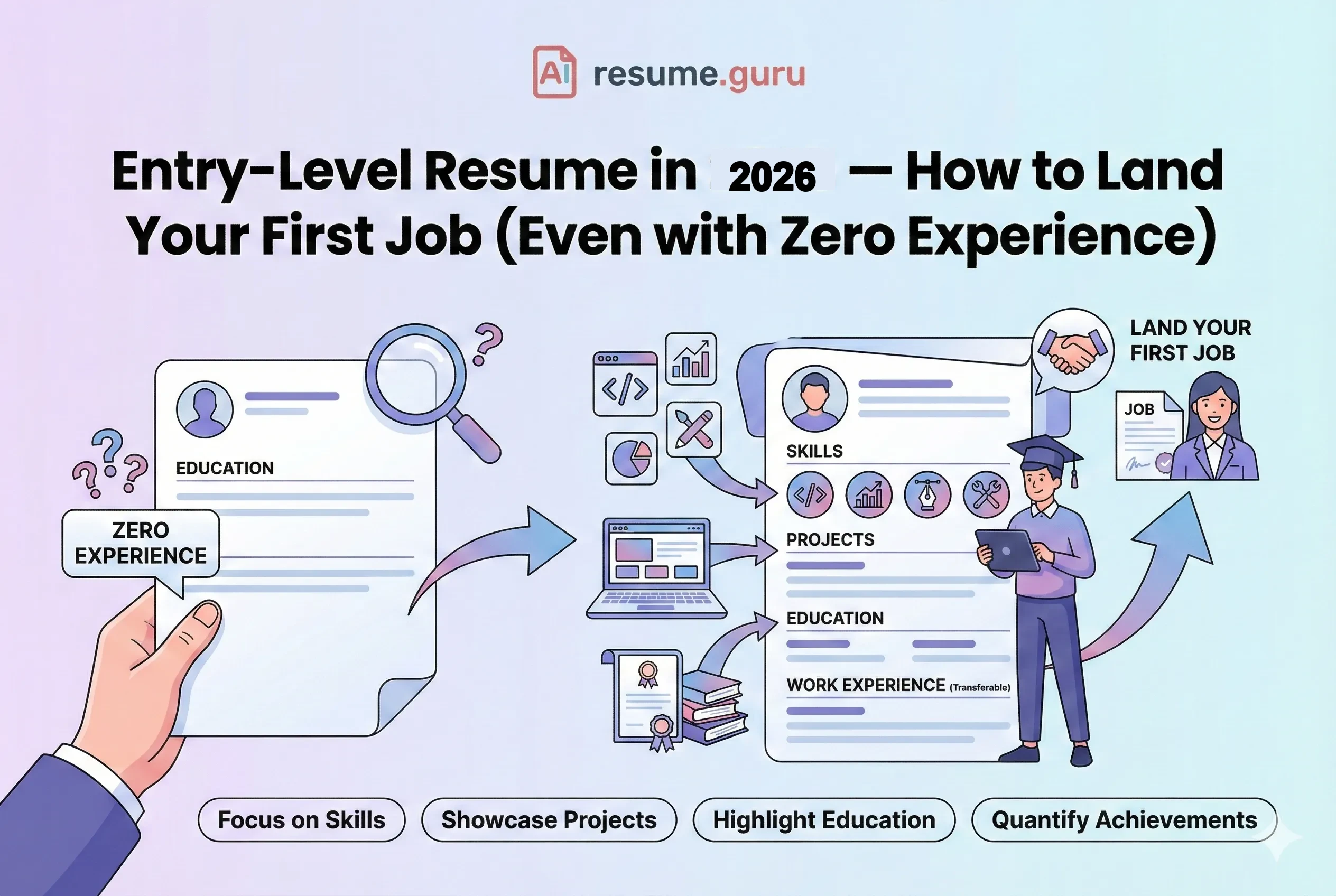
Instead, use a hybrid (combination) format:
┌────────────────────────────────────┐
│  CONTACT INFO                      │
├────────────────────────────────────┤
│  PROFESSIONAL SUMMARY              │
│  (2-3 sentences, skills-focused)   │
├────────────────────────────────────┤
│  SKILLS                            │
│  (Hard skills + soft skills)       │
├────────────────────────────────────┤
│  EDUCATION                         │
│  (This is your crown jewel)        │
├────────────────────────────────────┤
│  PROJECTS / RELEVANT EXPERIENCE    │
│  (Academic, personal, volunteer)   │
├────────────────────────────────────┤
│  WORK EXPERIENCE                   │
│  (Part-time, internships, etc.)    │
└────────────────────────────────────┘
Notice how Education comes before Work Experience? That’s intentional. Lead with your strengths.
Section 1: The Professional Summary (Your 6-Second Pitch)
Average resume scan time
Recruiters spend very little time on initial review. Your summary is the hook.
Source: Eye-tracking study, 2022
What NOT to Write
Don't Do This
“Recent graduate seeking entry-level position where I can learn and grow with a dynamic team.”
That’s everyone. It says nothing.
What TO Write
Do This Instead
“Marketing graduate with hands-on experience in social media management, content creation, and data analysis through 3 academic campaigns. Proficient in Google Analytics, Canva, and HubSpot. Seeking to apply creative problem-solving skills at a growth-focused marketing agency.”
The difference? Specificity. Skills. Tools. Outcomes.
The Entry-Level Summary Formula
[Degree/Field] + [1-2 relevant skills/experiences] + [Tools you know] + [What you're looking for]If the blank page is the problem, generate a resume summary from your degree and skills and edit from there.
Section 2: Skills That Actually Matter in 2026
Here’s where you shine. Entry-level resumes should be skills-forward.
Hard Skills to Include (By Industry)
| Industry | Top Skills to List |
|---|---|
| Tech | Python, JavaScript, SQL, Git, AWS basics, Agile |
| Marketing | Google Analytics, SEO tools, Canva, HubSpot, social media platforms |
| Finance | Excel (advanced), QuickBooks, financial modeling, data visualization |
| Healthcare | EHR systems, HIPAA compliance, patient communication, medical terminology |
| General | Microsoft Office, Google Workspace, project management tools, CRM basics |
Soft Skills (But Make Them Specific)
Don’t just write “communication skills.” Everyone does that.
Instead:
| Generic ❌ | Specific ✅ |
|---|---|
| Communication skills | Delivered 5 presentations to 100+ person audiences |
| Team player | Collaborated with 4-person team to complete project 2 weeks early |
| Problem solver | Identified process inefficiency that saved student org $500/semester |
| Detail-oriented | Proofread 20+ documents weekly for university newspaper |
Section 3: Education (This Is Your Headline Right Now)
For entry-level resumes, your education section is prime real estate.
What to Include
- Degree + Major + University + Expected/Graduation Date
- GPA (if 3.0+, or major GPA if higher)
- Relevant coursework (3-5 courses that relate to the job)
- Academic honors (Dean’s List, scholarships, awards)
- Study abroad (shows adaptability)
Example Education Section
Bachelor of Science in Computer Science
University of Texas at Austin | May 2026
GPA: 3.6/4.0 | Dean’s List (4 semesters)Relevant Coursework: Data Structures, Machine Learning, Database Systems, Software Engineering, Web Development
Tip
If you completed a capstone project or senior thesis, list it here with a brief description of what you built/achieved.
Section 4: Projects (Your Secret Weapon)
This is where “no experience” becomes “look at all this cool stuff I did.”
Projects can include:
- Class projects (especially group projects with real deliverables)
- Personal projects (built a website? automated something? created an app?)
- Hackathons (even if you didn’t win)
- Case competitions (business, consulting, marketing)
- Research (even if unpublished)
How to Write Project Bullets
Use the PAR Method: Problem → Action → Result
E-Commerce Website Redesign | React, Node.js, MongoDB
- Redesigned checkout flow for mock e-commerce site, reducing cart abandonment by 23% in A/B testing
- Built responsive UI serving 500+ simulated daily users
- Collaborated with 3-person team using Agile sprints and Git version control
Notice how it reads like a job? That’s the point.
Section 5: Work Experience (Yes, Even Subway Counts)
Don’t hide your part-time jobs. Just reframe them.
The key: transferable skills + quantification.
Retail/Food Service Example
Team Member | Subway | June 2022 – August 2023
- Served 100+ customers daily while maintaining 95% customer satisfaction scores
- Trained 3 new hires on POS system and food safety protocols
- Managed inventory restocking, reducing waste by 15%
Tutoring Example
Math Tutor | University Learning Center | January 2023 – Present
- Tutored 15+ students weekly in calculus and statistics
- Developed custom study guides that improved average student grades by one letter grade
- Maintained detailed session notes in CRM system for 50+ student profiles
See how “I worked at Subway” becomes “customer-facing experience with quantified outcomes”?
Section 6: Extracurriculars & Volunteer Work (These Count Too)
Leadership in student organizations is real leadership.
Format it like a job:
Vice President of Marketing | Business Student Association | August 2023 – May 2026
- Grew Instagram following from 200 to 1,500 followers (+650%) through targeted content strategy
- Managed $3,000 annual marketing budget for events and promotional materials
- Coordinated marketing for 5 events with 100-300 attendees each
Teen & High-School First-Job Resume (16-19, Zero Work History)
Still in high school and chasing your first-ever part-time job (cashier, fast food, lifeguard)? The rules loosen up. You don’t need internships or a degree section.
- Babysitting, lawn-mowing, dog-walking, tutoring count as experience. Write them like real jobs: “Supervised 3 children for up to 6 hours, managing meals and safety.”
- Clubs and sports are leadership. Team captain, debate, robotics, band, student council all show responsibility and teamwork.
- Half a page is genuinely fine. A tidy half-page beats a stretched, padded page.
- GPA 3.0+ is optional, not required. Honor Roll or AP classes make the same point.
- Lead with a one-line objective, not a summary. You don’t have a career to summarize yet, so state who you are, the role you want, and one strength.
This is a first rung, and employers expect a short resume. Keep it to half a page, lean on babysitting, lawn-mowing, clubs, and sports as your “experience,” and use a one-line objective instead of a summary.
Common Entry-Level Resume Mistakes (Avoid These)
Mistake 1: Using an Objective Statement
“Seeking a challenging position…” is dead. Use a summary instead.
Mistake 2: Listing Duties Instead of Achievements
- Bad: “Responsible for answering phones”
- Good: “Handled 40+ daily customer inquiries, resolving 90% without escalation”
Mistake 3: Including High School (Usually)
If you’re in college or graduated, high school is irrelevant unless:
- You didn’t attend college
- You have zero other content
- There’s something exceptional (valedictorian, national award)
Mistake 4: Making It Two Pages
You don’t have two pages of experience. One page, maximum density, zero fluff.
Mistake 5: Generic Skills Section
“Proficient in Microsoft Office” tells me nothing. “Advanced Excel (VLOOKUP, pivot tables, macros)” tells me everything.
Entry-Level Resume Template (Ready to Use)
Here’s a sample structure you can follow: You can also browse ATS-safe templates if you’d rather start from a formatted file.
ALEX CHEN
(512) 555-0147 | alex.chen@email.com | linkedin.com/in/alexchen | github.com/alexchen

SUMMARY
Computer Science graduate with hands-on experience in full-stack web development
and data analysis. Built 5 applications using React, Python, and SQL. Seeking
software engineering role at a mission-driven tech company.

SKILLS
Languages: Python, JavaScript, Java, SQL
Frameworks: React, Node.js, Flask, Django
Tools: Git, AWS (EC2, S3), Docker, PostgreSQL, MongoDB
Soft Skills: Technical documentation, cross-functional collaboration, Agile methodology

EDUCATION
Bachelor of Science in Computer Science
University of Texas at Austin | May 2026
GPA: 3.6/4.0 | Dean's List (4 semesters)
Relevant Coursework: Data Structures, Machine Learning, Database Systems, Web Dev

PROJECTS
Campus Events Platform | React, Node.js, MongoDB
• Built full-stack web app for university events, serving 2,000+ registered users
• Implemented authentication, event search, and notification system
• Reduced event RSVPs missed by 40% through automated reminder emails

Stock Portfolio Tracker | Python, Flask, SQLite
• Created dashboard tracking real-time stock data via API integration
• Visualized portfolio performance using Chart.js, generating 5+ chart types
• Open-sourced project with 50+ GitHub stars

EXPERIENCE
IT Help Desk Technician | University of Texas | Jan 2024 – Present
• Resolved 200+ support tickets monthly with 95% satisfaction rating
• Created 10 knowledge base articles reducing repeat inquiries by 25%
• Trained 5 new staff on ticketing system and troubleshooting protocols

Barista | Starbucks | May 2022 – Dec 2023
• Served 300+ customers daily during peak hours while maintaining quality standards
• Trained 4 new hires on POS system and drink preparation
• Received "Partner of the Quarter" recognition for customer service excellence
How to Tailor Your Entry-Level Resume (The Secret Sauce)
Generic resumes get generic results (rejection).
For every job application:
- 1
Copy the job description
Paste the full job posting into a document for analysis.
- 2
Highlight keywords
Identify skills, tools, and requirements mentioned in the posting.
- 3
Mirror those keywords
Naturally incorporate them into your resume (don't stuff).
- 4
Adjust your summary
Emphasize what they're specifically looking for.
- 5
Reorder your skills
Put their priorities first in your skills section.
Example
Job posting says: “Looking for someone with experience in data visualization, SQL, and stakeholder communication.”
Your skills section becomes:
Skills: Data Visualization (Tableau, Power BI, Chart.js), SQL (PostgreSQL, MySQL), Stakeholder Presentations, Python…
Same skills. Better order. Exact keyword matches.
Tip
Use AI ResumeGuru’s AI tailoring feature to automatically match your resume to job descriptions. Paste the JD, and the AI highlights what to add.
Final Checklist Before You Submit
Before sending that resume:
Resume Submission Checklist
- One page maximum
- Professional email (not coolgamer420@yahoo.com)
- No typos (read it backwards, seriously)
- Quantified achievements (numbers everywhere)
- Keywords from job description included
- PDF format (unless they specify .docx)
- File named: FirstName-LastName-Resume.pdf
- Summary is specific, not generic
- Contact info includes LinkedIn URL
Your Move
Look, I know job hunting with no experience feels impossible. Like you’re sending applications into the void.
But here’s the thing: you’re more qualified than you think. You just need to show it the right way.
Every project, every club, every part-time job — it all counts. You just have to translate it into a language hiring managers understand.
Ready to build a resume that actually gets callbacks?
Takes 5 minutes. ATS-optimized. No credit card required. Just a resume that finally does you justice.
Create Your Free ResumeFAQ: Entry-Level Resume Questions
Is it okay to have no work experience on my resume?
Absolutely. Most entry-level candidates don’t have traditional work experience. Focus on projects, education, volunteer work, and skills instead. The key is showing potential, not years on the job.
Should I include my GPA on my entry-level resume?
If it’s 3.0 or above, yes. If your major GPA is higher than your overall GPA, you can list that instead (just label it clearly). If it’s below 3.0, leave it off — no one will ask unless it’s required.
How long should an entry-level resume be?
One page. No exceptions. If you can’t fill a page, that’s okay — white space is better than fluff. If you’re struggling to fill it, add more projects or expand your extracurriculars section.
Should I use a resume objective or summary?
Summary. Objectives are outdated and focus on what you want (a job). Summaries focus on what you offer (value). Always lead with value.
Can I include personal projects on my resume?
Yes, in fact, you should! Personal projects show initiative, curiosity, and self-directed learning. Just make sure they’re relevant to the job you’re applying for.
I’m a teen (16-19) applying for my first part-time job. Is this guide for me?
Mostly, but you can go even leaner. If you’re still in high school with zero work history, lean on babysitting, lawn-mowing, clubs, and sports, keep it to half a page, and use a one-line objective instead of a full summary.
Related Resources
Frequently Asked Questions
How do I write a resume with no work experience?
Lead with education and skills instead of work history. Include projects, volunteer work, coursework, and extracurriculars. Use a functional or hybrid resume format that highlights transferable skills over chronological job history.
What should a first job resume include?
Include contact info, a skills-focused summary, education (with GPA if 3.5+), relevant coursework, projects, volunteer work, and any part-time or freelance experience. Certifications and technical skills are valuable additions.
How long should a no experience resume be?
One page maximum. Entry-level resumes should be concise. If you're struggling to fill one page, add relevant coursework, projects, certifications, or expand your skills section.
What's the best resume format for college students in the US?
Use a hybrid (combination) format that leads with skills and education. US employers expect one-page resumes for entry-level roles. Include your GPA if it's above 3.5 and relevant coursework for your target industry.
How do I write a graduate CV for UK jobs?
UK graduate CVs can be 2 pages. Include a personal statement, education with degree classification, skills, and any work experience including part-time jobs. Tailor your CV to each role and include hobbies that demonstrate soft skills.
What should Australian graduates include on their resume?
Australian graduate resumes can be 2-3 pages. Include a career objective, education, skills (both hard and soft), work experience (including casual jobs), volunteer work, and references. Australians often include more detail than US resumes.
Put this into practice
You have the theory. These take a few minutes and work on the resume you already have.