What Is a Europass CV?
The Europass CV is a free, standardised curriculum vitae template created by the European Commission. Available at europass.europa.eu, it provides a consistent format recognised across all 27 EU member states plus Iceland, Norway, Turkey, and several other European countries. It’s designed to make qualifications comparable across borders — not to be the best CV for every situation. If the posting is in the local language, you can translate your resume into it and keep the same structure.
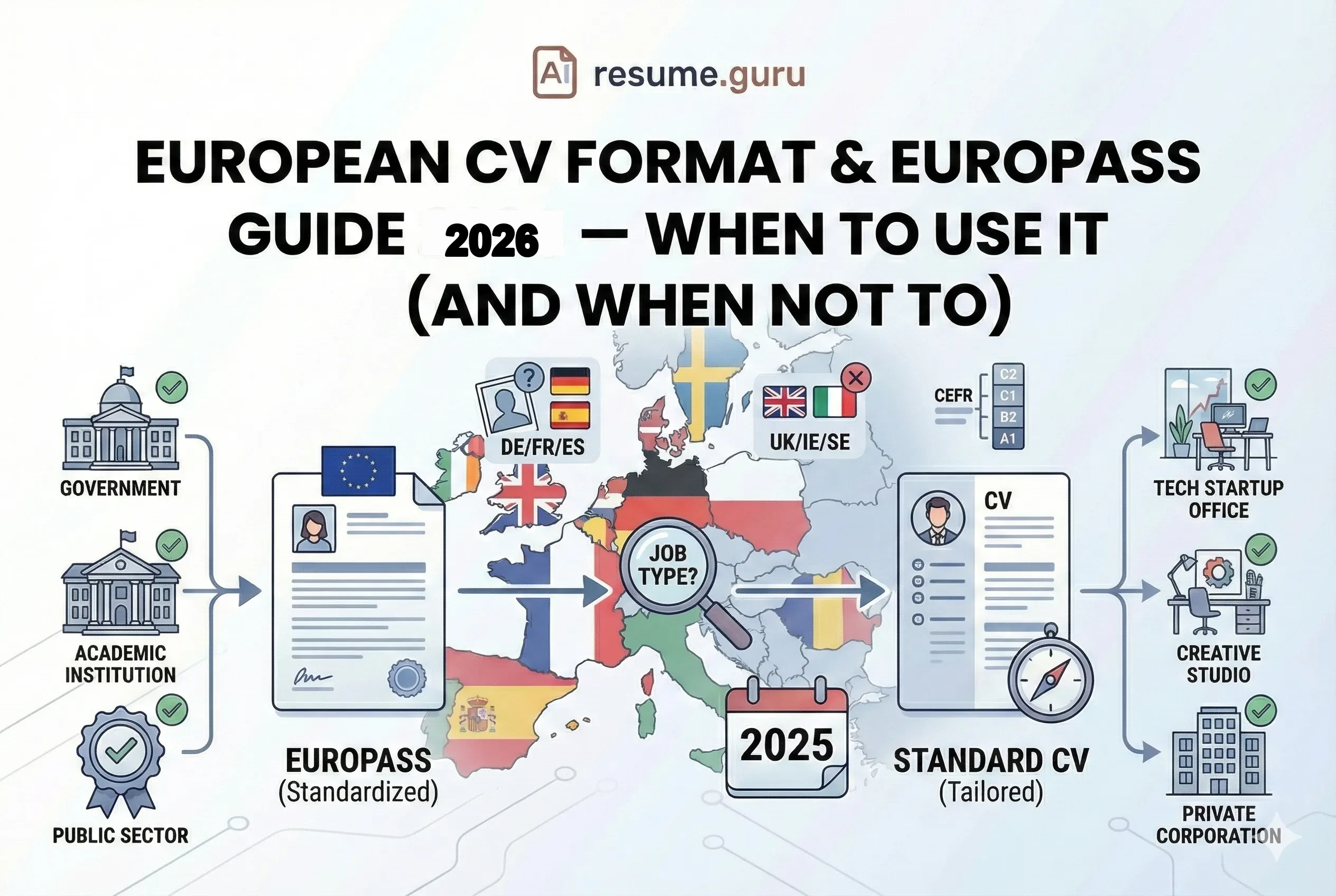
The short answer: The Europass CV is the EU’s free, standardised CV template with fixed sections for personal details, work experience, education, language skills (CEFR levels) and digital skills. Use it when an EU institution, public body or Erasmus+ programme asks for it; for private-sector jobs, a custom one- or two-page European CV usually performs better.
Applying for jobs in Europe? Before you download a Europass template, you need to know: it’s the right choice for some applications and the wrong choice for others. There’s no single “European CV format” — Europe is 40+ countries with very different hiring expectations. (Not sure if you need a CV or a resume? See our CV vs resume guide.)
TL;DR
- Europass = official EU template at europass.europa.eu
- Use Europass for: EU institutions, public sector, academic grants, Erasmus+
- More flexibility for: private sector, competitive industries, creative roles
- Photos expected in: Germany, Austria, Switzerland, France, Southern Europe
- Photos avoided in: UK, Ireland, Scandinavia
- Build a European CV that works → — or use the official Europass tool if an EU institution requires it
Europass by the Numbers
Europass website visits
10.2 million Europass accounts created and roughly 1.5 million new accounts a year. It's the EU's official platform — and the right choice for certain contexts.
Source: European Commission Europass Statistics, 2026
The platform has been running for over 20 years (launched in 2004, revamped in 2020) and is available in 31 languages. Beyond CVs, Europass also offers a cover letter builder, digital skills self-assessment, a course finder for EU learning opportunities, and European Digital Credentials for Learning.
The Europass CV was designed to:
- Make qualifications comparable across 34 EU/EEA countries
- Simplify cross-border applications
- Help employers understand foreign credentials
Important: Europass is the authoritative EU tool for CV creation. This guide helps you decide when it’s the right choice — not to replace it. Applying outside Europe as well? Our asia-pacific resume tips cover a very different set of expectations.
Europass CV Template Structure and Sections
- Standardised sections: Personal info, experience, education, skills, languages
- CEFR language levels: Uses the Common European Framework (A1-C2)
- “About Me” statement: Added in the 2020 redesign — your personal summary
- Comprehensive format: Results in longer documents (2-3+ pages typical)
- Free online tool: Available at europa.eu/europass in 31 languages
What the Europass CV Looks Like
A Europass CV follows the same five blocks in the same order every time. That predictability is the whole point — a hiring committee in Brussels reads it exactly like one in Lisbon. Here’s the layout:
┌─────────────────────────────────────┐
│  PERSONAL INFORMATION               │
│  (Photo optional, Contact, Address) │
├─────────────────────────────────────┤
│  WORK EXPERIENCE                    │
│  (Detailed entries)                 │
├─────────────────────────────────────┤
│  EDUCATION AND TRAINING             │
│  (Qualifications, courses)          │
├─────────────────────────────────────┤
│  PERSONAL SKILLS                    │
│  (Languages, Digital, etc.)         │
├─────────────────────────────────────┤
│  ADDITIONAL INFORMATION             │
│  (Publications, Projects, etc.)     │
└─────────────────────────────────────┘
A Europass CV Example, Section by Section
Here’s exactly what goes in each block, with realistic example entries you can adapt:
1. Personal Information
Anna Kowalski · Warsaw, Poland · anna.kowalski@email.com · +48 600 123 456 Date of birth: 14/03/1992 · Nationality: Polish · (Photo top-right — optional, country-dependent)
2. About Me (added in the 2020 redesign — your professional summary)
Marketing specialist with 6 years’ experience growing B2B SaaS pipelines across the EU. Fluent in Polish, English, and German, with a track record of running multilingual campaigns end to end.
3. Work Experience (reverse-chronological, most recent first)
Senior Marketing Specialist — TechCorp Sp. z o.o., Warsaw · 09/2021–Present • Grew qualified leads 38% in 12 months by restructuring the demand-gen funnel. • Managed a €450K annual budget across paid, content, and events.
4. Education and Training
MSc Marketing Management — University of Warsaw · 10/2014–06/2016 · Final grade: 4.8/5.0
5. Personal Skills
Languages: Polish (Native) · English (C1) · German (B2) — always rated on the CEFR scale Digital skills: HubSpot, Google Analytics 4, SQL (intermediate) Additional: Driving licence (B) · Publications · Volunteering
The biggest difference from a US-style resume: Europass expects personal details (date of birth, nationality), a standardised section order you can’t restructure freely, and CEFR-rated languages rather than vague “fluent / conversational” labels. Get those three right and your CV reads as native to any European recruiter.
When to Use Europass (Yes, Really)
Despite its reputation for being boring, Europass is genuinely useful in these contexts:
Use Europass For
- EU institutions (European Commission, Parliament, agencies)
- Public sector positions across EU member states
- Government grants and tenders — often required
- Erasmus+ and EU academic programs
- Applications where it’s explicitly requested
- Entry-level roles when you lack design skills
- Southern/Eastern Europe where it has higher acceptance
If the job posting says “Please submit a Europass CV,” use it. Don’t try to be clever.
When to Skip Europass (Most of the Time)
Avoid Europass For
- Private sector jobs — especially at competitive companies
- Tech, startups, and creative industries
- Senior executive positions — you need to stand out
- UK applications — rarely expected
- Anywhere design and differentiation matter
Why Skip Europass for Private-Sector Jobs
When I see a Europass CV for a product designer role, I assume they didn’t put much effort into the application. We want to see creativity, not a government template.
Europass prioritises standardisation over differentiation. In competitive job markets, that’s a disadvantage.
Europass Pros
- Universally understood structure
- No design skills needed
- Language skills clearly formatted (CEFR)
- Works for cross-border applications
- ATS-friendly (simple format)
Europass Cons
- Looks generic — everyone has the same template
- Limited room for personal branding
- Often results in overly long documents
- Seen as 'basic' in competitive industries
- No personal statement/profile section
The Alternative: A Modern European CV
For most private sector applications, you’re better off with a tailored CV that follows European norms but allows differentiation. If you want that layout without building it from scratch, start from an ATS-safe European CV template and edit it in the free editor, which keeps the sections Europass readers expect.
Standard European CV Structure
┌─────────────────────────────────────┐
│  HEADER                             │
│  (Name, Contact, LinkedIn, Photo?)  │
├─────────────────────────────────────┤
│  PROFESSIONAL PROFILE               │
│  (3-4 sentences, targeted)          │
├─────────────────────────────────────┤
│  WORK EXPERIENCE                    │
│  (Reverse chronological, detailed)  │
├─────────────────────────────────────┤
│  EDUCATION                          │
│  (Degrees, certifications)          │
├─────────────────────────────────────┤
│  SKILLS                             │
│  (Technical, languages, tools)      │
├─────────────────────────────────────┤
│  ADDITIONAL                         │
│  (Languages, interests if relevant) │
└─────────────────────────────────────┘
Key Differences from Europass
- Includes a profile statement — Your 6-second pitch (see our summary vs objective guide)
- More flexible layout — Design can match your industry. Use ATS-safe fonts and proper margins and spacing
- Shorter — 2 pages is ideal
- Customisable — Tailored to each application using keywords from the job description
- Room for personality — While staying professional
Country-Specific Variations
Europe isn’t monolithic. Here’s what varies by region:
Germany, Austria, Switzerland (DACH)
| Element | Expectation |
|---|---|
| Photo | Expected (professional headshot) |
| Length | 2 pages, detailed |
| Language | German preferred, English accepted for international roles |
| Format | Conservative, formal |
| Special | "Lebenslauf" format with timeline is common |
German employers almost never expect Europass — they want a traditional Lebenslauf. See our complete German resume guide for photo rules, tabular format, and free templates.
France: CV Rules and Expectations
| Element | Expectation |
|---|---|
| Photo | Common but becoming optional |
| Length | 1-2 pages |
| Language | French required for most roles |
| Format | Clean, professional, attention to aesthetics |
| Special | Include age/date of birth (though declining) |
For cross-border applications between France and other EU countries, our French resume translator can help adapt your CV content while preserving professional tone.
UK & Ireland
| Element | Expectation |
|---|---|
| Photo | Not expected (discrimination concerns) |
| Length | 2 pages maximum |
| Language | English (check British vs. American spelling) |
| Format | Flexible, achievement-focused |
| Special | Personal statement expected |
The UK has its own distinct format — read our UK CV format guide for the full breakdown. For a broader comparison of how US, European, and Asian formats differ, see our international resume formats guide.
Scandinavia (Sweden, Norway, Denmark, Finland)
| Element | Expectation |
|---|---|
| Photo | Generally not included |
| Length | 1-2 pages |
| Language | English widely accepted, local languages valued |
| Format | Modern, clean, sometimes creative |
| Special | Flat hierarchy = focus on collaboration skills |
Southern Europe (Spain, Italy, Portugal, Greece)
| Element | Expectation |
|---|---|
| Photo | Often expected |
| Length | 2-3 pages acceptable |
| Language | Local language typically required |
| Format | Europass more common than elsewhere |
| Special | Personal details more common (age, nationality) |
Eastern Europe (Poland, Czech Republic, Romania, Hungary, Bulgaria)
| Element | Expectation |
|---|---|
| Photo | Common in most countries |
| Length | 1-2 pages |
| Language | Local language for domestic roles; English for international companies |
| Format | Europass widely used and accepted — higher adoption than Western Europe |
| Special | Europass is often the default for graduates and public sector roles |
Europass has the highest adoption rates in Eastern and Southern Europe. In countries like Romania, Bulgaria, and Greece, many recruiters actively expect the Europass format — especially for entry-level and public sector positions.
Benelux (Belgium, Netherlands, Luxembourg)
| Element | Expectation |
|---|---|
| Photo | Netherlands: uncommon. Belgium/Luxembourg: sometimes included |
| Length | 1-2 pages |
| Language | Varies — Belgium has three official languages (Dutch, French, German). Match the job posting. |
| Format | Modern, concise CVs preferred over Europass in the private sector |
| Special | Belgium: language proficiency is critical due to linguistic communities |
The Photo Question
This is the most confusing part for international applicants.
Countries Where Photos Are Common
- Germany ✓
- Austria ✓
- Switzerland ✓
- France ✓ (declining)
- Spain ✓
- Italy ✓
- Portugal ✓
- Belgium ✓
Countries Where Photos Are Uncommon
- United Kingdom ✗
- Ireland ✗
- Netherlands ✗ (usually)
- Sweden ✗
- Norway ✗
- Denmark ✗
- Finland ✗
Photo Guidelines (If Including)
- Professional headshot (not a selfie)
- Neutral background
- Business attire appropriate to industry
- Friendly but professional expression
- Recent photo (within 2 years)
- Size: approximately 35mm x 45mm (passport-style)
For a deeper dive on CV photo rules by country, read our photo on resume guide.
Language Skills: The CEFR Framework
All European CVs should use the Common European Framework of Reference (CEFR) for language proficiency:
| Level | Description |
|---|---|
| A1 | Beginner — Basic phrases |
| A2 | Elementary — Simple interactions |
| B1 | Intermediate — Independent use |
| B2 | Upper-Intermediate — Complex texts, fluent conversation |
| C1 | Advanced — Nuanced language, professional proficiency |
| C2 | Mastery — Near-native fluency |
CEFR Language Level Example
Languages
- English: C2 (Native)
- German: B2 (Upper-Intermediate)
- French: A2 (Elementary)
Pro Tip
If you’re uncertain of your level, take a quick placement test online. Many are free and give you a CEFR estimate. For more on how to list languages effectively, see our languages on resume guide. You can also use our Skills Finder to extract relevant keywords from job postings.
How to Create and Download a Europass CV (Free, Step by Step)
If you need a Europass CV, here’s the complete process on the official platform:
- 1
Go to europass.europa.eu
Visit the official EU Europass portal. Don't use third-party Europass generators — the official tool is free and produces the recognised format.
- 2
Create a free account
Register with your email. This saves your profile so you can create multiple CV versions later without re-entering everything.
- 3
Build your Europass profile
Fill in your work experience, education, skills, and languages. Be thorough here — you'll select which items to include in each CV version.
- 4
Write your 'About Me' statement
This is your personal summary. Tailor it for each application: explain what you bring, not what you want.
- 5
Rate your languages using CEFR
The platform walks you through self-assessment for each language. Be honest — inflating levels is easily caught in interviews.
- 6
Create a CV from your profile
Select which experience, education, and skills to include. Choose a design template. The platform offers several clean layouts.
- 7
Download as PDF or share directly
Export in any of the 31 available languages. You can also share your CV via a Europass link or upload it to EURES (the EU job portal).
Making the Most of the Europass Editor
The Europass editor has improved significantly since its 2020 overhaul. A few things worth knowing:
- Multiple CVs from one profile. Create different versions for different roles — a research-focused CV for academic applications, a skills-focused one for industry roles.
- Reorder sections freely. You can drag sections to change order. For academic roles, put education first. For industry, lead with experience.
- The “About Me” section matters. This was added in the 2020 redesign. Treat it like a professional summary — 3-4 sentences explaining your value proposition for the specific role.
- Digital credentials. If your university or training provider issues European Digital Credentials, link them directly in your Europass profile for instant verification.
- Cover letter integration. Create a matching cover letter on the same platform. It auto-fills your contact details and lets you reference your CV experience directly.
Beyond the CV: Other Europass Tools Most People Miss
The Europass platform is more than just a CV builder. Most applicants don’t realise they can also use:
- Cover Letter Builder — Create a matching cover letter directly on the platform. It pulls data from your Europass profile, so you don’t have to re-enter work history.
- Digital Skills Self-Assessment — A quick test that maps your digital competencies to the European Digital Competence Framework (DigComp). Useful for roles that require specific tech skills.
- European Digital Credentials — Digital diplomas and certificates that employers can verify instantly. Some universities and training providers now issue credentials through Europass.
- Course Finder — Search learning opportunities across EU countries. Particularly useful if you need to upskill before applying.
- EURAXESS Integration — Since late 2025, researchers can import their Europass profile directly into EURAXESS (the EU’s researcher mobility portal).
If You're Applying to EU Institutions
EU institution applications (EPSO competitions) often accept Europass CVs alongside their own application forms. Having a complete Europass profile also makes it faster to fill in the EPSO application since you can copy sections directly.
Common Mistakes When Using Europass
Even when Europass is the right format, applicants often undermine themselves with these errors:
1. Leaving Sections Empty
Europass shows every section by default. If you leave “Volunteering” or “Publications” blank, it looks like you forgot rather than chose to omit. Either fill the section or remove it from your export.
2. Using Vague Language Levels
Don’t write “Good” or “Fluent” — use the CEFR scale (A1-C2). Europass is built around CEFR, and vague terms stand out negatively. If you’re unsure of your level, take a free placement test before filling this in.
3. Not Tailoring Per Application
Europass lets you create multiple CV versions from one profile. Take advantage of this — select different skills, reorder experience sections, and adjust your “About Me” statement for each application. A generic Europass CV performs significantly worse than a tailored one.
4. Ignoring the “About Me” Section
The current Europass platform includes an “About Me” section — a personal statement that many users skip. This is where you explain why you’re the right person for the role. Leaving it blank wastes your best opportunity to make an impression.
5. Exporting Without Checking Formatting
Always download and review your exported PDF. Europass occasionally introduces awkward page breaks, especially with longer work histories. Check that sections aren’t split across pages and that your contact info is visible on every page.
6. Using Europass When It’s Not Expected
Sending a Europass CV to a Berlin startup or a London agency signals that you didn’t research the company culture. Europass is for contexts where standardisation is valued — government, EU institutions, academia. For private sector roles, a tailored CV shows more effort and gets better results. If you’re unsure which of these mistakes you’re making, roast your CV before you send it.
7. Forgetting to Update Your Profile
Europass stores your data in a profile. If you created an account two years ago and apply using it now, make sure your experience, skills, and language levels are current. Outdated profiles lead to CVs with gaps that raise red flags.
Europass CV vs. Custom CV: How to Decide
Not sure which route to take? Use this decision guide:
Use the official Europass format if:
- The job posting specifically requests it
- You’re applying to EU institutions (European Commission, Parliament, agencies)
- It’s a public sector role in Southern or Eastern Europe
- You’re applying for Erasmus+, EU grants, or academic programs
- You’re a recent graduate without strong design skills
Use a custom European CV if:
- You’re applying to private sector companies
- The role is in tech, startups, or creative industries
- You’re a senior professional who needs to differentiate
- You’re targeting UK, Netherlands, or Scandinavian employers
- Design and personal branding matter for the role
Still unsure? Check the job posting. If it mentions “Europass” or “EU format,” use the official template. If it says “CV” without specifying a format, you have flexibility. And if you’re applying to multiple countries simultaneously, consider maintaining two versions — a Europass for institutional applications and a custom CV for private sector roles.
In either case: Focus on strong content first. Achievement-driven bullet points, relevant keywords, and proper CEFR language levels matter more than which template you choose. The format gets your CV through the door; the content gets you the interview.
European CV Checklist
Before Submitting Your European CV
- Europass used only when required/appropriate
- Length is 2 pages (or industry-appropriate)
- Photo included if expected in target country
- Language skills use CEFR levels
- Local language or English used based on role
- Spelling matches target country (UK vs US English)
- A4 paper format (not US Letter)
- Personal profile/summary included (non-Europass)
- Work experience shows achievements, not just duties
- Contact information includes country code for phone
Your Next Steps
The European job market is diverse — and your CV strategy should match.
For EU institutions, public sector, and academic grants: Go to europass.europa.eu and build your CV on the official platform. It’s free, it’s the expected format, and the editor has improved significantly since 2020.
For private sector roles: Follow European norms (CEFR language levels, appropriate personal details, country-specific photo rules) while using a format that lets you differentiate. Strong content matters more than which template you choose — achievement-driven bullet points and relevant keywords are what get you interviews.
Moving abroad for work? Our expat resume guide covers the practical challenges of adapting your CV for a new country — from translating qualifications to explaining career gaps caused by relocation. If you speak multiple languages, see our bilingual resume guide for how to present that advantage effectively.
Applying outside Europe too? Resume conventions vary widely by region. See our guides for Australian resume format, Canadian resume format, and the Asia-Pacific resume guide.
Whichever route you choose: Prepare your content first. Write strong bullet points, identify the right keywords from the job description, and draft a clear professional summary. Then drop that content into Europass or any other format.
Build a European CV that gets interviews
Draft achievement-focused bullet points, rate your languages on the CEFR scale, and apply the right country rules — then export an ATS-friendly European CV. Use Europass when an EU institution requires it; use ours when you want to stand out.
Build My European CV FreeRelated Resources
- UK CV Format Guide — Specific guidance for British applications
- German Resume (Lebenslauf) Guide — Photo rules, tabular format & templates
- International Resume Formats — US vs European vs Asian differences
- Australian Resume Format — Another English-speaking market
- CV vs Resume Explained — When to use each format
- Photo on Resume Guide — Country-by-country photo rules
- Expat Resume Guide — For international job seekers
- ATS-Friendly Resume Fonts — Fonts that work across EU ATS systems
- Resume Translator — Translate your CV to 30+ languages
- Resume Summary Generator — Create compelling profile statements
- Bullet Point Generator — Write achievement-focused experience bullets
- Resume Templates — ATS-optimized professional designs
Frequently Asked Questions
Is Europass CV required for EU job applications?
No, it's not required for most private sector jobs. Europass is mainly expected for EU institutions, public sector roles, academic grants, and some government positions. Private companies usually prefer tailored CVs.
Should I include a photo on my European CV?
It depends on the country. Photos are common in Germany, Austria, Switzerland (DACH region), France, and Southern Europe. They're less common in the UK, Ireland, and Scandinavian countries. Research your target country.
How long should a European CV be?
Typically 2 pages for most roles. Academic CVs can be longer. The Europass template often results in 3+ pages due to its comprehensive format.
What's the difference between Europass and a regular CV?
Europass is a standardized EU template designed for cross-border recognition. Regular CVs allow more flexibility in design and content. Europass is rigid but universally understood; custom CVs let you stand out.
Do I need a Europass CV for jobs in Germany?
No, German private employers prefer a traditional German Lebenslauf with a professional photo. Europass is only needed for EU institution jobs or cross-border public sector roles. German CVs should be 1-2 pages with reverse chronological format.
What CV format do French employers expect?
French employers prefer a 1-page CV with a professional photo, personal details (age, marital status), and education before experience. Europass is accepted but a tailored French CV performs better for private sector jobs.
Should I use Europass for jobs in the Netherlands?
Dutch employers prefer concise, modern CVs over Europass. Skip the photo (uncommon in Netherlands), keep it to 1-2 pages, and focus on achievements. Only use Europass for EU institution applications.
How do I download a free Europass CV template?
Visit europass.europa.eu and create a free account. You can build your CV directly on the platform and download it as PDF or Word. The official Europass editor includes all standard sections and language options.
Should I translate my CV into the local language for EU jobs?
For most EU countries, yes — especially if the job posting is in the local language. Exceptions: Scandinavian countries, the Netherlands, and international companies that work primarily in English. Match the language of the job posting.
Can I use the same CV across all EU countries?
No. A CV that works in Germany (formal, photo, detailed) would feel overdone in Sweden (concise, no photo, collaborative focus). Always research the specific country's expectations before applying.
Is the Europass CV ATS-friendly?
Yes. Europass uses simple, clean formatting with standard section headers — exactly what ATS systems parse well. The tradeoff is design flexibility, not ATS compatibility.
Is Europass relevant for UK jobs after Brexit?
No. The UK never widely adopted Europass even as an EU member. Post-Brexit, use a standard British CV format instead: 2 pages, no photo, personal statement, achievement-focused.
Is the Europass CV free?
Yes, completely free. The Europass CV builder runs on the official EU platform at europass.europa.eu with no cost, no premium tier, and no watermark. You create an account, build your CV, and download it as PDF or Word in any of 31 languages.
Is Europass good or bad — does it look unprofessional?
It's neither — it's the right tool for the wrong audience if you misuse it. Europass looks credible and is expected for EU institutions, public-sector, and academic applications. For private-sector or competitive roles it can look generic and templated, so a tailored CV usually performs better. Match the format to who's reading it.
Europass CV vs LinkedIn — which should I use?
They serve different purposes. LinkedIn is your always-on professional profile for networking and recruiter discovery; a Europass (or custom) CV is the tailored document you submit for a specific application. Use both: keep LinkedIn current, and send a focused CV per role. Don't paste your whole LinkedIn into a CV — recruiters want a targeted, one-to-two-page document.
What is the Europass CV used for?
Europass standardises CVs so qualifications are comparable across 27 EU countries plus Iceland, Norway, and others. It's used most for EU institution jobs, public-sector and government roles, academic grants, Erasmus+, and EURES job-portal applications — anywhere a cross-border, instantly-recognisable format helps.
Put this into practice
You have the theory. These take a few minutes and work on the resume you already have.