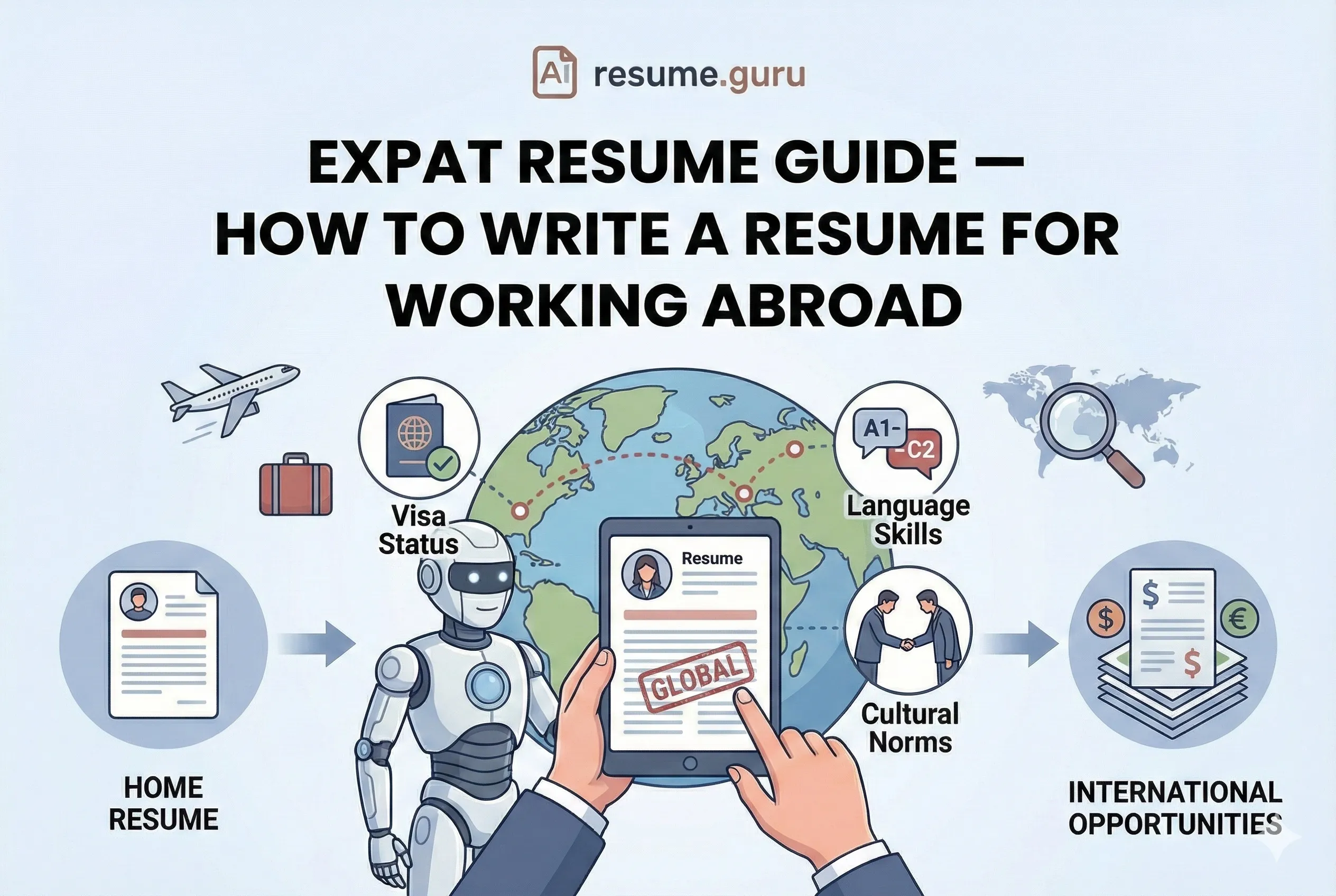
You've decided to take the leap: work abroad.
Maybe it's a dream destination. Maybe it's where the opportunities are. Maybe you just want an adventure.
But here's the thing — your resume needs to travel with you. And the resume that worked at home might not work overseas.
Different countries have different expectations. Different formats. Different cultural norms. What impresses a recruiter in New York might confuse one in Singapore or bore one in Berlin.
Let's fix that.
TL;DR
- Research your target country's resume norms first
- Clarify your visa status / work eligibility upfront
- Use CEFR levels for language skills (A1-C2)
- Include international dialing codes for phone numbers
- Highlight cross-cultural and remote work skills
- Tailor for each market, not one "global" resume
- Build your international resume →
The #1 Filter: Visa Status
Expat application filter
Before looking at qualifications, employers check: Can this person legally work here?
Source: International recruitment data
Let's address this immediately: your work eligibility is often the first thing international employers check.
If you bury it or leave it ambiguous, you might get filtered out before anyone reads your experience.
Where to Include Work Status
Option 1: Header/Contact Section
John Smith
john.smith@email.com | +1 555 123 4567 | London, UK
Work Status: UK Tier 2 Visa (valid through 2027)
Option 2: Professional Summary Ending
...seeking a senior marketing role in Singapore.
Currently based in London; eligible for Singapore Employment Pass.
Option 3: Dedicated Section
Work Authorisation
US Citizen with valid ESTA for travel; open to visa sponsorship for permanent roles.
What to Include
Be Specific About
- Your current visa type (if applicable)
- Visa validity / expiration date
- Whether you need employer sponsorship
- Your right to work (PR, citizenship)
- Your availability to relocate
Avoid Vague Statements Like
- "Eligible to work internationally"
- "Will obtain necessary visas"
- "Legal to work anywhere"
Examples
| Situation | How to Write It |
|---|---|
| Need sponsorship | "Eligible for [Country] work visa sponsorship. Willing to relocate immediately." |
| Have valid visa | "Current holder of Australia Subclass 482 visa (valid until March 2026)." |
| Permanent resident | "Singapore Permanent Resident — no visa sponsorship required." |
| Citizen of target country | "UK Citizen — full work rights in the UK and EU/EEA." |
| Dual citizenship | "US/UK dual citizen — authorized to work in both countries." |
Language Skills: Be Honest and Specific
Multinational employers care deeply about language abilities — and they often test them in interviews.
The CEFR Scale (European Standard)
Most professional contexts recognise this scale:
| Level | What It Means | Practical Description |
|---|---|---|
| A1 | Beginner | Basic greetings, simple questions |
| A2 | Elementary | Routine tasks, simple conversations |
| B1 | Intermediate | Travel, work discussions, understand main points |
| B2 | Upper-Intermediate | Fluent conversation, complex texts, professional work |
| C1 | Advanced | Nuanced language, native-like in professional settings |
| C2 | Mastery | Near-native, any topic, any register |
Alternative Descriptions
| Term | Equivalent CEFR |
|---|---|
| Native | C2 (or note as first language) |
| Fluent / Bilingual | C1-C2 |
| Professional Working | B2-C1 |
| Limited Working | B1 |
| Elementary | A1-A2 |
Example Language Section
Languages
- English: Native
- French: C1 (Professional working proficiency)
- Spanish: B1 (Intermediate — conversational)
- Mandarin: A2 (Elementary — basic phrases)
Don't Overstate
Claiming "Fluent French" when you're actually B1 will backfire when the interviewer switches languages.
Adapting for Different Markets
There's no universal "international resume." You need to adapt for each target country.
Quick Reference: Major Markets
| Country | Length | Photo | Key Notes |
|---|---|---|---|
| USA | 1 page | No | Achievement-focused, concise |
| UK | 2 pages | No | Personal statement, British spelling |
| Germany | 2 pages | Yes | Formal, detailed, structured |
| France | 1-2 pages | Common | Clean design, French language often required |
| Australia | 2-3 pages | No | Detailed, British spelling, references included |
| Canada | 2 pages | No | Similar to US but more detail accepted |
| Singapore | 2 pages | Optional | Conservative, highlight APAC experience |
| UAE/Gulf | 2 pages | Yes | Include nationality, visa status, religion optional |
Pro Tip
We have detailed guides for major markets: Australian format, UK format, Canadian format, European format.
What International Employers Look For
Beyond your technical skills, global employers screen for specific qualities:
1. Cross-Cultural Competence
Include Evidence Of
- Living or studying abroad
- Working with international teams
- Managing stakeholders across time zones
- Language abilities
- Navigating different business cultures
How to show it:
"Coordinated product launches across 12 EMEA markets, adapting messaging for local cultures and regulatory requirements."
"Led remote team spanning US, UK, and Singapore time zones (16-hour spread)."
2. Adaptability
Relocating for work requires flexibility. Show you've adapted before:
"Relocated from Paris to Singapore for market expansion role; achieved local market leadership within 18 months."
"Pivoted from finance to tech during career transition, securing product role within 6 months of upskilling."
3. Remote/Distributed Work Experience
Many international roles start as remote positions before relocation. If you've worked remotely across time zones, highlight it:
"Managed fully remote team of 8 across 4 continents, maintaining 95% project delivery rate through asynchronous communication practices."
Resume Structure for International Applications
Here's a structure that works across most international markets:
┌─────────────────────────────────────┐
│  NAME & CONTACT                     │
│  (Email, Phone with country code,   │
│   LinkedIn, Location, Work Status)  │
├─────────────────────────────────────┤
│  PROFESSIONAL SUMMARY               │
│  (3-4 sentences, globally focused)  │
├─────────────────────────────────────┤
│  KEY SKILLS / COMPETENCIES          │
│  (Technical + soft skills)          │
├─────────────────────────────────────┤
│  PROFESSIONAL EXPERIENCE            │
│  (Reverse chronological)            │
│  → Emphasise international scope    │
├─────────────────────────────────────┤
│  EDUCATION                          │
│  (Degrees, relevant certifications) │
├─────────────────────────────────────┤
│  LANGUAGES                          │
│  (CEFR levels or equivalent)        │
├─────────────────────────────────────┤
│  ADDITIONAL                         │
│  (Publications, global affiliations)│
└─────────────────────────────────────┘
Contact Information for International Applications
Phone Number Format
Always include country code:
- ✅ +1 555 123 4567 (US)
- ✅ +44 7700 123456 (UK)
- ✅ +65 9123 4567 (Singapore)
- ❌ (555) 123-4567 (unclear)
Location
Be clear about where you are and your willingness to relocate:
Location: Currently London, UK (relocating to Singapore Q2 2026)
Location: Toronto, Canada (open to relocation within EU)
Location: Remote (US Eastern timezone, travel-ready)
Ensure your URL is clean and your profile is optimized for international visibility. Our LinkedIn Bio Generator can help you craft a compelling headline and summary.
linkedin.com/in/yourname
Not:
linkedin.com/in/john-smith-12345abc-67890
Handling Job Titles Across Countries
Job titles don't translate directly. A "Vice President" at a US bank might be equivalent to a "Senior Manager" elsewhere.
- 1
Use global English titles
Write in clear English that translates across markets.
- 2
Add context when needed
If the title is unusual, add a brief description.
- 3
Match the target market
Research equivalent titles in your destination country.
- 4
Focus on seniority indicators
Team size, budget, reporting line matter more than title.
Examples
| Original Title | Clarified Version |
|---|---|
| Associate Vice President | Associate Vice President (equivalent to Senior Manager) |
| Specialist | Marketing Specialist (Individual Contributor, 3+ years) |
| Deputy General Manager | Deputy General Manager (C-minus-1, P&L responsibility) |
The Cover Letter (Often More Important Abroad)
In many European and Asian markets, the cover letter carries more weight than in the US.
Use it to:
- Explain your motivation for working in that country
- Address your visa/relocation situation
- Demonstrate language ability (write in local language if appropriate)
- Show cultural awareness
Tip
For international applications, our Cover Letter Generator can help you craft tailored letters for different markets.
Common Expat Resume Mistakes
Mistake 1: Same Resume for Every Country
A one-size-fits-all "international resume" doesn't exist. Photo requirements, length expectations, and content emphasis vary significantly.
Mistake 2: Ignoring Visa Status
If recruiters can't tell whether you can legally work there, they'll often assume you can't. Be explicit.
Mistake 3: Overstating Language Skills
"Fluent" gets tested. Don't claim C1 French if you're B1. Interviewers will switch languages to verify.
Mistake 4: US-Centric Formatting
One-page resumes, no photos, and US Letter paper size look out of place in most markets. Adapt to local norms.
Mistake 5: Forgetting Country Codes
A phone number without a country code is useless to an international recruiter. Always include +XX.
Expat Resume Checklist
Before You Apply Internationally
- Visa/work status clearly stated
- Phone includes country code
- Location includes country
- Language skills with CEFR levels
- Format adapted to target country
- Photo included if expected (or omitted if not)
- Spelling matches target market (UK vs US English)
- Job titles translated/clarified if needed
- International experience highlighted
- LinkedIn profile updated for international visibility
Your Move
Working abroad is an incredible opportunity — professionally and personally.
But it starts with getting your resume right. The right format for the right market. Clear work eligibility. Demonstrated international capability.
Get those elements in place, and you're already ahead of most applicants who just blast their home-country resume everywhere.
Build your international-ready resume
Our AI Resume Builder helps you create properly formatted resumes for any market. Adapt for different countries, highlight international skills, and clarify your work status — all in minutes.
Create My ResumeRelated Resources
- Australian Resume Format — A4, British spelling, detailed
- UK CV Format Guide — Personal statement, no photo
- European CV & Europass — When to use Europass
- Canadian Resume Format — US-style with more detail
- Asia-Pacific Resume Tips — Singapore, Hong Kong, and more
- Cover Letter Generator — For international applications
- LinkedIn Bio Generator — For international networking
- Resume Templates — A4-formatted, professional designs
- Resume Examples — See international formatting in context
Frequently Asked Questions
Should I mention my visa status on my resume?
Yes, if you're targeting a specific country. Be clear about your work rights — whether you need sponsorship, have a work visa, or are a permanent resident. This helps employers filter appropriately.
How do I list language skills on an international resume?
Use the CEFR scale (A1-C2) for European applications, or describe proficiency as Native, Fluent, Professional, Working, or Basic. Be honest — you may be tested in interviews.
Should I translate my job titles?
Use English job titles for English resumes, but ensure they convey the same seniority. 'Vice President' in US banking is different from 'VP' in European companies. Add context if needed.
Do I need different resumes for different countries?
Yes. Format, length, photo expectations, and content emphasis vary significantly by country. Research each target market and adapt your resume accordingly.
Build Your Perfect Resume
Create an ATS-optimized resume with our AI-powered builder.
No signup required.Start Building FreeExplore Resources
Enjoyed this article?
Share it with your network