Let’s settle this right now.
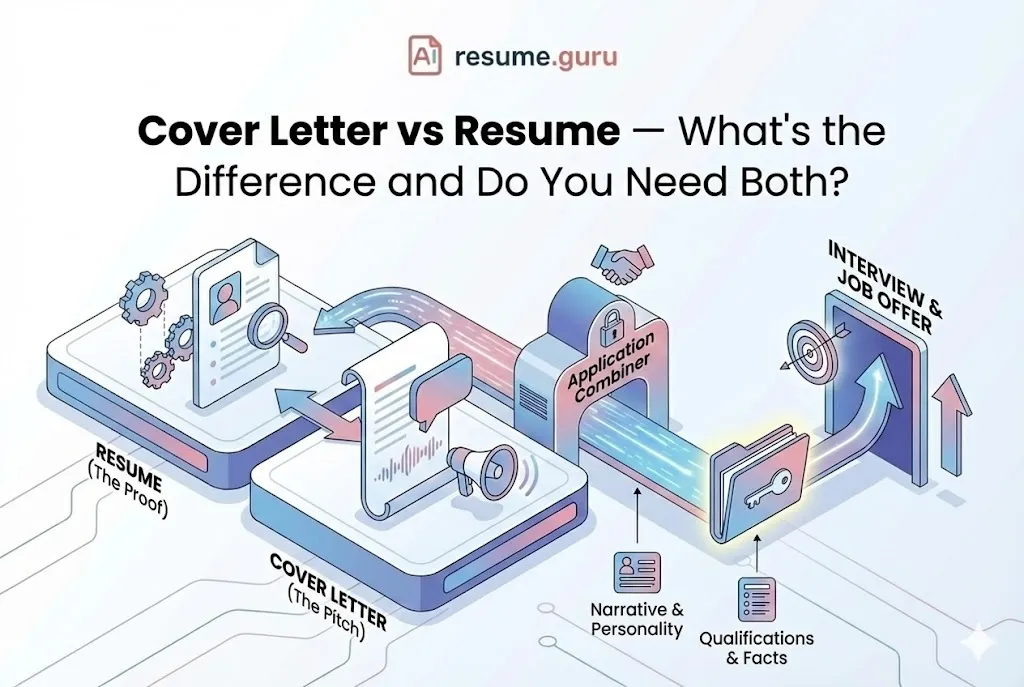
A resume is a list. A cover letter is a pitch.
They’re not interchangeable. They’re not redundant. They’re a team—and when used together correctly, they’re more powerful than either alone.
Of hiring managers
Read cover letters they receive
Source: ResumeGenius Survey, 2024
Despite the internet’s recurring “cover letters are dead” hot takes, the data tells a different story. Most recruiters still read them. And a well-crafted cover letter can be the thing that gets you pulled from the interview pile when your resume alone wouldn’t.
Here’s how these two documents work together—and exactly what to put in each.
The Core Difference
- Resume = The facts (who you are, what you’ve done)
- Cover Letter = The story (why you want this role, why you’re the fit)
- Together = A complete application that answers both “can they do this job?” and “do they actually want it?”
The Quick Comparison
Before we go deeper, here’s the side-by-side. Both documents should point at the same posting, so it helps to tailor your resume to the job before you write the letter:
| Resume | Cover Letter |
|---|---|
| Bulleted, structured format | Paragraph-form narrative |
| 1-2 pages | Half to one page (~300 words) |
| Lists experience, education, skills | Explains motivation and fit |
| Sent for every application | Sent when requested/expected |
| Scanned in 7-30 seconds | Read in 30-60 seconds |
| Answers: 'What have you done?' | Answers: 'Why do you want this?' |
| Same structure, tailored keywords | Customized for each company |
What Goes in a Resume (The Facts)
Your resume is evidence. It’s structured, scannable, and optimized for one purpose: proving you have the qualifications listed in the job description.
Resume Structure
A standard resume includes:
- Contact Information — Name, email, phone, LinkedIn, location
- Professional Summary — Two to four sentences summarizing your value proposition
- Work Experience — Reverse-chronological list of jobs with achievements
- Skills — Technical and soft skills relevant to the role
- Education — Degrees, certifications, relevant coursework
- Optional Sections — Projects, volunteer work, awards
The Resume's Job
The resume gets you past the first filter—both the ATS software and the recruiter’s 7-second scan. It answers: Can this person do the job?
What the Resume Can’t Do
Resumes are bad at storytelling. They can’t explain:
- Why you’re excited about this company
- Why you left your last job (or have a gap)
- What draws you to this specific role
- Your personality and communication style
That’s where the cover letter comes in.
What Goes in a Cover Letter (The Story)
A cover letter is a half-page introduction that answers the questions a resume can’t.
Think of it this way: if the resume is a trailer, the cover letter is the pitch meeting where you explain why the movie is worth making.
Cover Letter Structure
- 1
Opening Hook (1-2 sentences)
Grab attention—mention the role, how you found it, or a compelling reason you're applying.
- 2
Why This Company (1 paragraph)
Show you've researched them. What about their mission, product, or culture resonates with you?
- 3
Why You (1-2 paragraphs)
Highlight one or two key experiences or achievements that make you a fit. Expand on what the resume only summarizes.
- 4
The Close (1-2 sentences)
Express enthusiasm. Include call to action ('I'd welcome the chance to discuss...').
What the Cover Letter Should Do
Effective Cover Letter
- Explains WHY you want this role (not just any role)
- Demonstrates you've researched the company
- Provides context your resume can't (gaps, relocations, career changes)
- Shows personality and communication ability
- Feels specific—not a template sent to 100 companies
- Complements the resume without repeating it
Don't Do This
Don’t restate your resume in paragraph form. “I have 5 years of experience in marketing and a degree from State University” is a waste of cover letter real estate. They can see that on your resume.
Do Recruiters Actually Read Cover Letters in 2026?
Yes. The data is clear:
Read most cover letters
Even when not required
Source: ResumeLab Survey
Read cover letter first
Before looking at the resume
Source: ResumeGenius
Say cover letters influence
Their interview decisions
Source: ResumeLab
The narrative that “nobody reads cover letters” is outdated. While some hiring managers skip them, the majority still use them as a decision-making tool—especially for roles that require strong communication.
The Optional Paradox
When a job posting says cover letter is “optional,” 72% of hiring managers still expect one. “Optional” often means “we’re testing to see who puts in extra effort.”
When to Skip the Cover Letter
There’s exactly one scenario where you can confidently skip the cover letter:
Skip It Only If
The job posting explicitly says “Do not include a cover letter” or the application portal has no option to upload one.
In all other cases—especially for competitive roles, career changes, or jobs at companies you genuinely want—a tailored cover letter helps you stand out.
The “Team” Strategy: How They Work Together
Think of your resume and cover letter as a tag team:
| The Resume’s Job | The Cover Letter’s Job |
|---|---|
| Lists the facts | Tells the story |
| Proves qualifications | Proves motivation |
| Passes the ATS | Wins the human |
| Answers “Can they?” | Answers “Will they?” |
The best applications create a consistent narrative. Your cover letter introduces a theme (“I’m passionate about making data useful for non-technical teams”), and your resume provides the evidence (three data analyst roles where you did exactly that).
Common Mistakes to Avoid
Not sure which of these you’re making? Roast your resume and compare the findings to the list below.
Mistake #1: The Generic Template
“I’m excited to apply for [Position] at [Company]…” copied into every application. Recruiters can smell a template.
Fix: At minimum, reference something specific about the company—recent news, their mission, or a feature of the product.
Mistake #2: The Resume Restate
“As you can see on my resume, I have 5 years of experience…”
Fix: Use the cover letter for what the resume can’t show—motivation, soft context, cultural fit.
Mistake #3: The Life Story
A two-page cover letter that chronicles your entire career from high school.
Fix: 250-400 words. Focus on 1-2 key points. Respect their time.
Mistake #4: The Self-Centered Pitch
“I’m looking for a role where I can learn and grow…”
Fix: Focus on what you can do for them, not what they can do for you.
Quick Templates
For the resume half, you can browse ATS-safe templates instead of building the structure from scratch.
Cover Letter Opening Lines (Good vs. Bad)
| Weak Opening ❌ | Strong Opening ✅ |
|---|---|
| I am writing to apply for the position of... | When I saw [Company] is building toward [goal], I knew I had to reach out. |
| I would like to express my interest in... | After driving 40% revenue growth at [Previous Company], I'm ready to bring that same energy to [Target Company]. |
| Dear Hiring Manager, I am a... | The way [Company] approaches [problem] is exactly how I think about [topic]—which is why I'm applying. |
File Format and Submission
Both your resume and cover letter should be:
- Saved as PDF (unless the job posting requests Word)
- Named clearly:
FirstName_LastName_Resume.pdfandFirstName_LastName_CoverLetter.pdf - Styled consistently (same fonts, header design if applicable)
Pro Tip
If the application only has one upload field, combine them into a single PDF with the cover letter as page one.
When You Need Extra Help
Writing a cover letter from scratch is time-consuming—especially if you’re applying to multiple roles.
For the resume side, our Resume Builder handles structure, formatting, and ATS optimization so you can focus on content.
For cover letters, our Cover Letter Generator creates personalized, role-specific drafts based on your background and the job description—then lets you edit to make it yours.
Build both, faster
Create your resume in minutes, then generate a matching cover letter—tailored to any job.
Start Building FreeThe Bottom Line
Resume = Proof. It’s a structured document that answers “Can this person do the job?”
Cover Letter = Pitch. It’s a narrative that answers “Does this person actually want the job—and why?”
Most applications need both. When done right, they work together: the cover letter hooks interest, and the resume provides the evidence to back it up.
Don’t treat the cover letter as an afterthought. For 83% of hiring managers, it’s still part of the decision.
Need both documents fast?
Build your ATS-optimized resume, then generate a tailored cover letter—all in one place.
Create Resume & Cover LetterRelated Resources
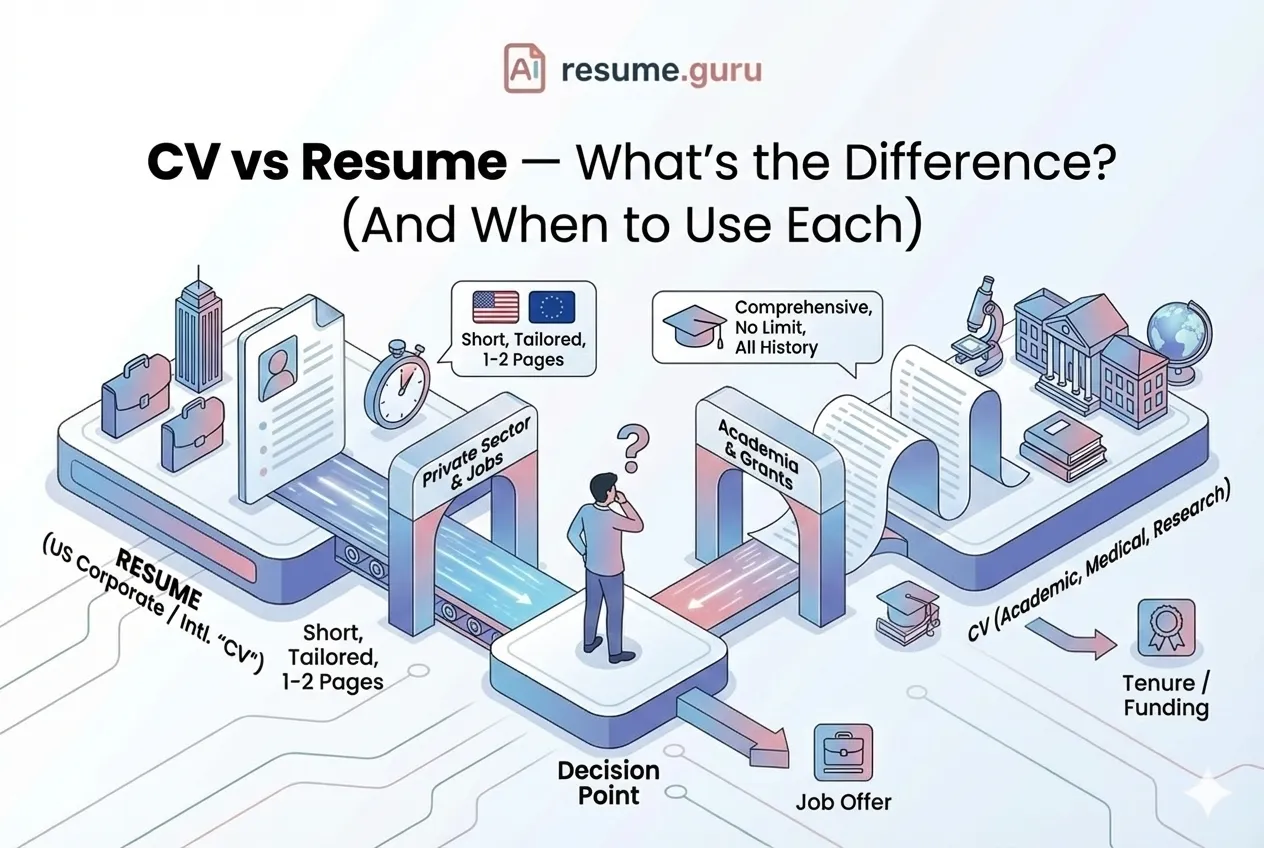
- CV vs Resume — Different document, different context
- Professional Summary Examples — For your resume's top section
- Tailoring Resume to Job Description — Apply the same strategy to cover letters
- Cover Letter Generator — AI-powered drafts in seconds
- Resume Examples — See how they pair with cover letters
- Resume Templates — Start with proven designs
Frequently Asked Questions
What's the main difference between a cover letter and resume?
A resume is a factual document listing your experience, education, and skills. A cover letter is a narrative that explains why you want this specific job, what makes you a good fit, and adds personality that a resume can't convey.
Do I really need a cover letter in 2026?
Yes—83% of hiring managers still read cover letters. Even when marked as 'optional,' 72% of recruiters expect one. The only time to skip it: when a job posting explicitly says 'no cover letter needed.'
Should my cover letter repeat what's on my resume?
No. Your cover letter should expand on one or two key experiences, explain your motivation, and address things your resume can't—like career gaps, relocations, or why this specific company interests you.
How long should a cover letter be?
250-400 words, or about half to three-quarters of a page. Hiring managers spend 60 seconds or less reading them—make every sentence count.
Which do you send first, cover letter or resume?
Typically both are submitted together. But 45% of hiring managers read the cover letter first, which makes your opening line critically important.
Put this into practice
You have the theory. These take a few minutes and work on the resume you already have.