AI resume score with recruiter insights
See your resume the way a recruiter does. The score reads your document across 6 categories — one of them a recruiter pass that skims for the red flags a hiring manager catches in six seconds — and grounds every point in a line it can quote back to you.
- A recruiter-read pass — timeline gaps, seniority mismatches, thin roles
- 24 AI issue types plus 27 instant checks, each tied to a real line
- Every number is computed in code, never guessed by the AI
Your AI resume score rates your resume across 6 categories — one of them a recruiter pass that reads it the way a hiring manager skims — and quotes the exact line behind every issue. 27 checks run instantly and free; a deeper AI scan flags 24 issue types. The number is computed in code, never guessed by the model.
Check your resume right here, free
The same instant checks the editor runs, in your browser. No account, no upload stored, no AI credits — paste your resume or drop in a PDF and see the score plus every issue we can find without a model.
Your result
Add your resume and run the check. Results appear here in seconds — nothing is uploaded when you paste.
- Local checks25 run here
- AI recruiter scanNot run
- Job matchNeeds a job post
How does the AI resume score work?
Instant checks run the moment you open the editor; one deeper scan reads your resume like a recruiter and shows you exactly where — and why — it loses points.
- Step 01
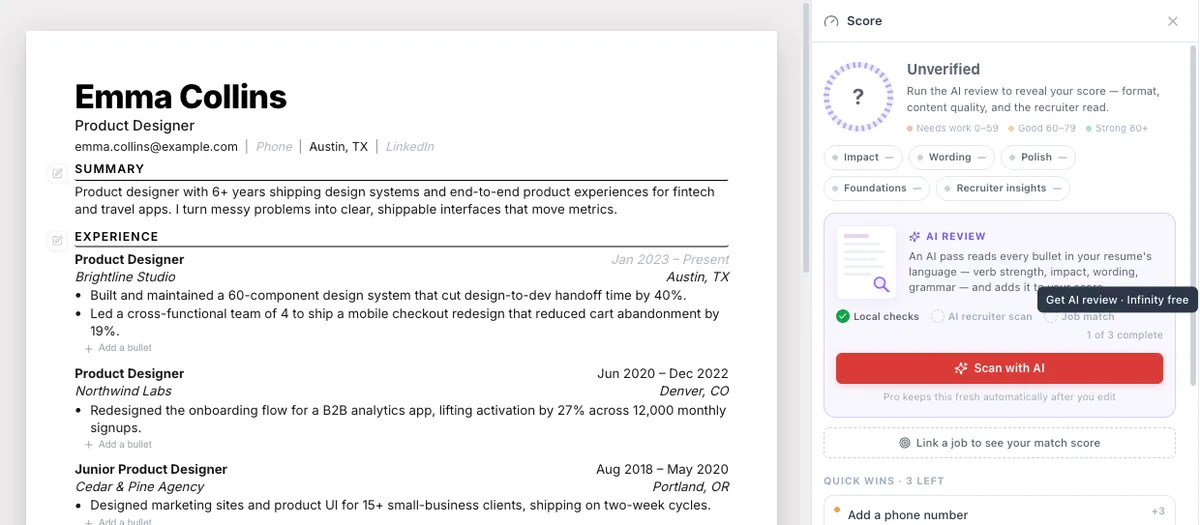
Get an instant score
The moment your resume has enough content, 27 deterministic checks run with no AI — contacts, dates, placeholders, quantification, and structure — for a starting score in real time. These are language-agnostic and false-positive-free, so nothing is flagged that isn't actually there.
- Step 02
Run the recruiter scan
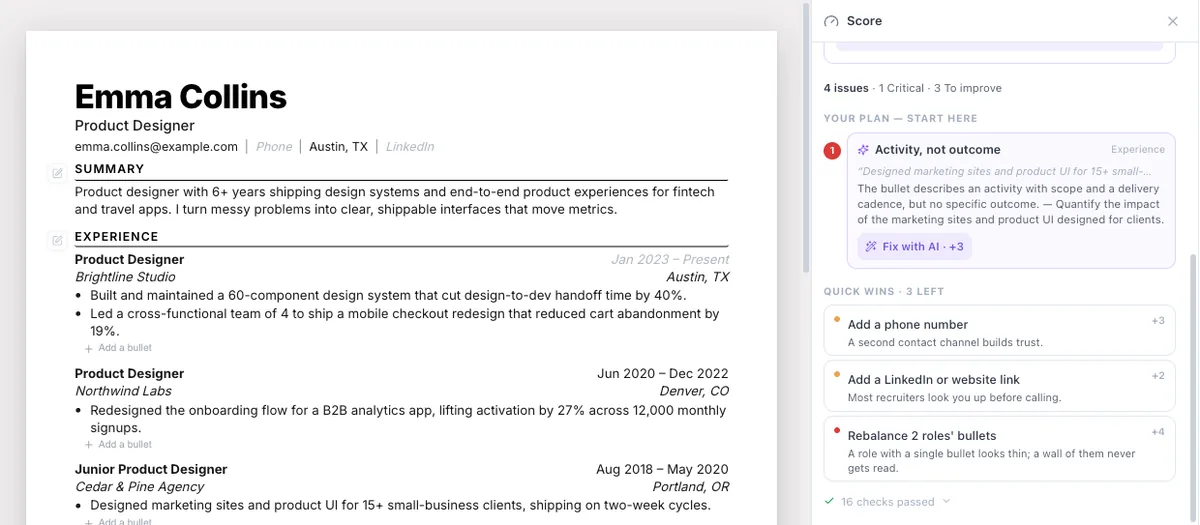
Trigger the AI scan and specialist passes read your resume for 24 issue types — weak or vague impact, wording and polish problems, and a recruiter pass that catches timeline gaps, seniority mismatches, and thin roles. Every finding quotes the offending line and names the specific problem.
- Step 03
See where you lose points
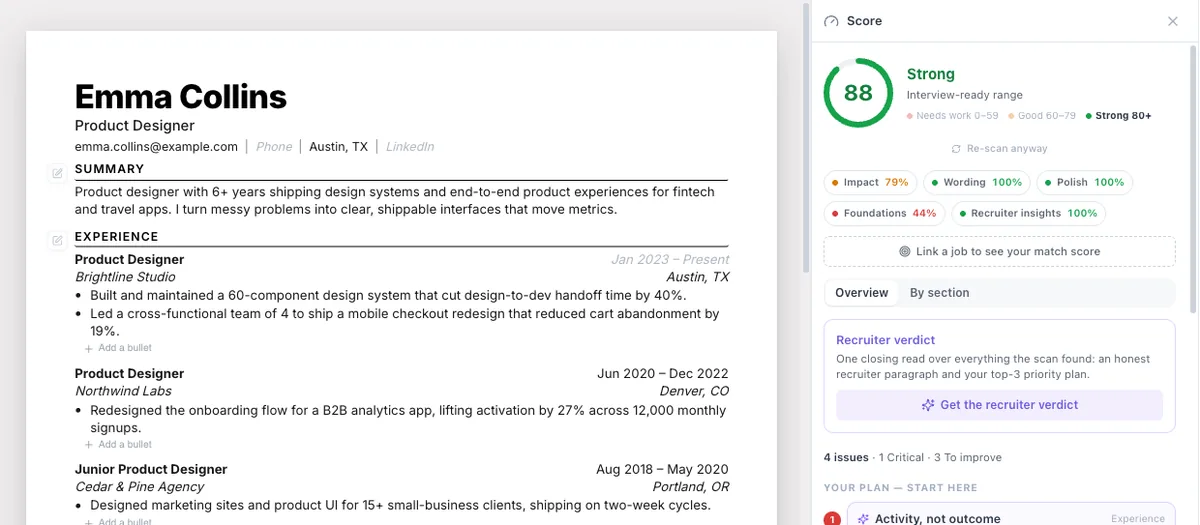
Your issues group into 6 categories so you can see at a glance whether the weakness is impact, wording, polish, foundations, or the recruiter read. The overall number is folded in code from a fixed weight table — the AI only judges, it never emits the score you see.
- Step 04Pro
Fix and re-score
On Pro, Fix with AI rewrites the offending line from your own facts — never inventing a number — and applying it releases exactly the points that finding cost. A recruiter verdict then synthesizes your top priorities into one honest plan.
Why it works
A recruiter read, not just an ATS number
One scan pass reads your resume the way a recruiter skims it — surfacing timeline gaps, seniority mismatches, and roles that look thin. It's the judgment a six-second glance makes, not a keyword tally.
Every point is grounded in your document
No finding is generic. Each one quotes the exact line it's about and names the specific problem, so you're never left guessing which sentence lost you points or why.
The number is computed, never guessed
The AI only returns discrete judgments; the score is folded in code from a fixed weight table across 6 categories. Same resume, same score, every time — a model's mood never moves your number.
See the problem free, fix it with Pro
27 instant checks and one AI scan a month are free, so you see every issue and where it costs you. One-click Fix with AI and the recruiter verdict are Pro — the honest split is that free shows the problem, Pro resolves it.
AI resume score vs. a bare ATS score number
| Comparison criteria | AI ResumeGuru | Bare ATS score tool |
|---|---|---|
| What you get back | A breakdown across 6 categories | A single number out of 100 |
| Recruiter read | Yes — a pass that skims like a human | No — keyword matching only |
| Grounded in your resume | Every finding quotes your line | Generic, unattributed tips |
| One-click fixes | Fix with AI from your own facts (Pro) | You rewrite everything yourself |
| How the score is made | Computed in code from real findings | Opaque, often a guessed number |
What is a good resume score — and what score do you actually need?
Most tools treat around 80+ as good and below roughly 70 as needing work — a useful directional guide, not a verdict. The honest caveat: no score is standardized across tools, and a high number doesn't guarantee interviews. It clears fixable mistakes and automated filters, but recruiters still judge relevance and fit. What matters more than the number is which specific lines cost you points — which is why every finding here quotes the offending line. Use the score to fix real problems before you apply, not to chase a perfect 100.
Are resume scores accurate, and do recruiters see them?
No third-party checker replicates a real ATS — each parses differently, and there's no universal score recruiters see. Anyone claiming to match a hidden recruiter number is overselling. What our score is: internally consistent, computed in code from a fixed weight table, so the same resume scores the same every time, and every point maps to a specific finding you can read. It's a pre-application self-check, not something submitted with your resume — which is exactly why we ground each point in a quoted line.
Can I check my resume score without creating an account?
Yes — the free ATS resume checker runs the same deterministic layer described here entirely in your browser. Drop in a PDF or paste the text and you get the score, the six category readings, and every failing check with the same plain-language fix the editor shows, in seconds, with no signup and nothing stored. It stops where judgment starts: whether a bullet shows real impact, whether your timeline reads oddly to a recruiter. That is what the AI review on this page adds, and why the instant number is capped until you run it.
What is the difference between the free checker and the AI resume score?
They are the same deterministic engine, stopping at different points. The free ATS resume checker runs 27 local checks entirely in your browser — no account, nothing uploaded or stored, no AI — and it is capped below 100 on purpose, because it prices in the AI pass it hasn't run. The AI resume score adds what code cannot judge: whether a bullet shows real impact, whether your timeline reads oddly to a recruiter, the 24 issue types only a model can see. That scan needs a free account — signed-out visitors get zero scans, a free account gets one full scan every 30 days, and Pro is unlimited. So: the checker tells you what is mechanically wrong, free and anonymously; the score tells you whether the resume is actually good.
Resume score vs. ATS score — what's the difference?
An ATS score is really a keyword match rate — how well your resume's terms line up with a job posting. Our resume score is broader: a recruiter read plus quality categories like impact, wording, and polish, with every issue tied to a quoted line. The two answer different questions — one is "does this posting's vocabulary appear?", the other is "is this resume actually strong?" Use a keyword scanner for the first and this for the second.
A generous free tier gives you the instant checks and one full AI scan each month, so you see every problem and where it costs you points; one-click Fix with AI and the recruiter verdict are Pro — free is to see the problem, Pro is to fix it.
Frequently asked questions
Is the AI resume score free?
Yes. The 27 instant checks run free the moment your resume has content, and every account gets one full AI scan each month — with all its findings, quotes, and category breakdown. One-click Fix with AI and the recruiter verdict are Pro. The honest split: free shows you every problem, Pro fixes it.
What do the score categories cover?
Your issues group into 6 categories: impact (are your bullets showing results?), wording, polish (spelling, grammar, consistency), foundations (contacts, structure, length), a recruiter read, and — when a job is linked — job match. The bars show at a glance where your resume is weakest.
What is the recruiter insight?
One scan pass reads your resume the way a recruiter skims it in a few seconds. Instead of counting keywords, it looks for the human red flags — unexplained timeline gaps, a title that outpaces the experience under it, and roles too thin to earn their space — and tells you what a hiring manager would notice.
How is this different from an ATS score checker?
A typical ATS tool hands you one number and a keyword list. This scores your resume across 6 categories, adds a recruiter read no keyword tally can do, quotes the exact line behind every issue, and lets you fix each one in a click — with the number computed in code from real findings, not guessed.
Can it fix the issues for me?
Yes, on Pro. Fix with AI rewrites the flagged line using only your own facts — it never invents a metric, inserting an [X] placeholder for you to fill instead — and a fix only shows if it passes validation. Applying it releases exactly the points that finding cost, so the score moves by what the button promised.
Is the score accurate, or does the AI make it up?
The AI never emits the number you see. It only returns discrete judgments about your resume; the score is folded entirely in code from a fixed weight table. That means the same resume always scores the same, and every point maps to a specific, checkable finding you can read.
What is a good resume score?
Most tools treat around 80+ as good and below roughly 70 as needing work — a directional guide, not a pass/fail. Scores aren't standardized across tools, so use the number to fix real, quoted problems rather than to chase a perfect 100.
What resume score do I need to get interviews?
A good score clears automated filters and catches fixable mistakes, but it doesn't guarantee interviews — recruiters still judge relevance and fit, and once you clear the phone screen the score is irrelevant. Treat it as a pre-application self-check, not a promise.
Do recruiters see my resume score?
No. There's no universal resume score hiring teams see; an ATS may rank resumes by keyword match, but recruiters don't see the percentage you see. Our score is a private pre-application self-check, not something submitted with your application.