Let’s start with the good news:
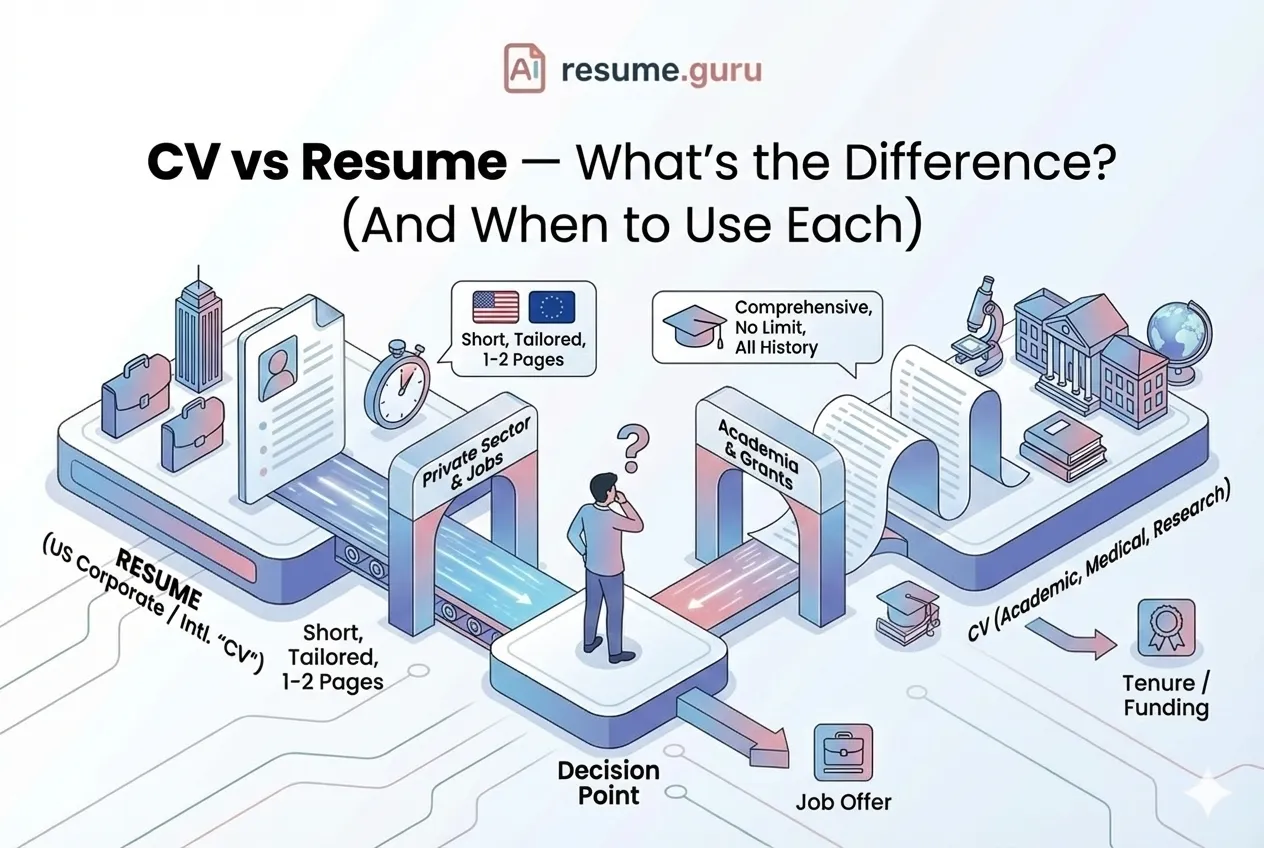
If you already have a solid US-style resume, you’re 90% of the way to a Canadian one. If you’re still untangling the terminology, our guide on CV vs resume explains when each term applies in Canada.
Now the catch:
That last 10% matters. Canadian employers have specific expectations around spelling, format, and content. Get those details right, and you’ll look like you understand the market. Get them wrong, and you’ll immediately stand out as someone who didn’t do their homework.
Here’s everything you need to know.
TL;DR
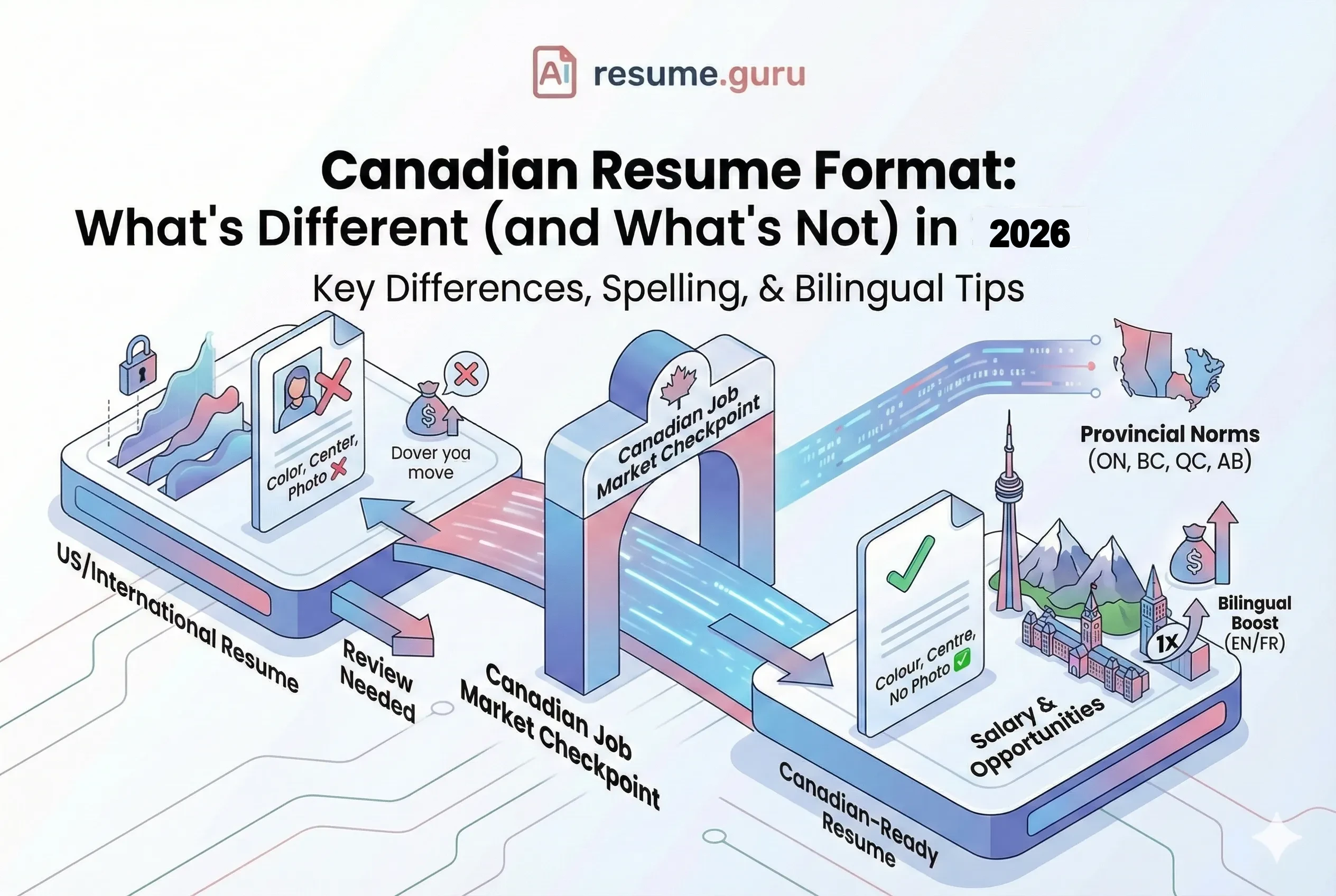
- Very similar to US format: reverse-chronological, 1-2 pages, ATS-friendly
- No photos — Strongly discouraged (anti-discrimination norms)
- Use Canadian English spelling (colour, centre, programme)
- Address: City, Province only (Toronto, ON)
- Paper size: US Letter (8.5 x 11 inches)
- Bilingual French/English often valuable
Canadian vs US Resume: Quick Comparison
| Element | Canada 🇨🇦 | United States 🇺🇸 |
|---|---|---|
| Term Used | Resume (or CV for academic) | Resume |
| Length | 1-2 pages (3 for senior) | 1-2 pages |
| Photo | ❌ Never | ❌ Never |
| Address | City, Province | City, State |
| Paper Size | US Letter (8.5 x 11”) | US Letter (8.5 x 11”) |
| Spelling | Canadian English | American English |
| DOB/Age | ❌ Never | ❌ Never |
| Work Authorization | Optional (mention if relevant) | Optional |
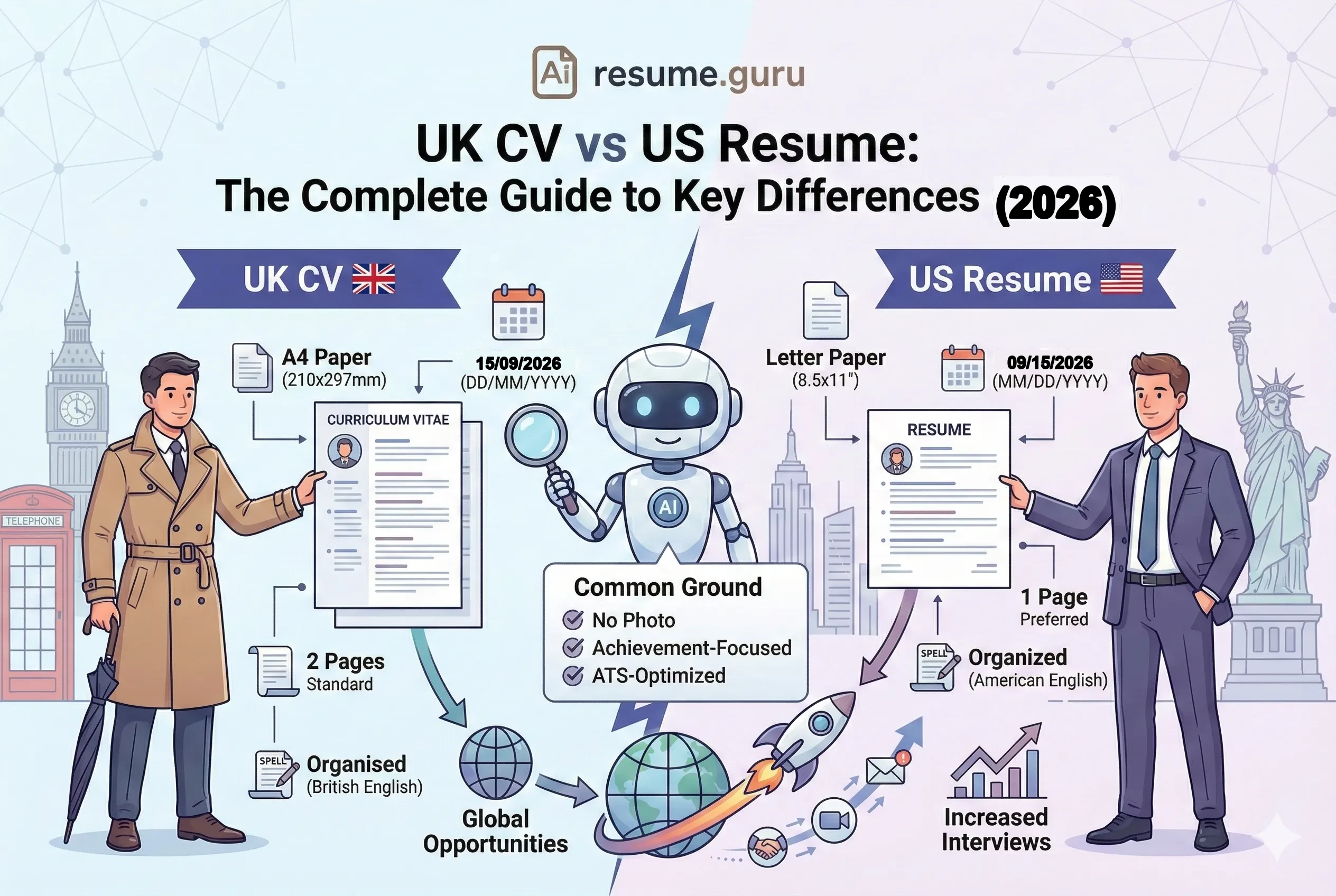
The format is essentially the same. The differences are in the details. For a wider Commonwealth comparison, the Australian resume format shares many of the same conventions, and uk cv vs us resume covers where the two diverge most.
What Canadian Employers Expect
initial scan time
Same as US—Canadian recruiters scan quickly too
Source: Workopolis Hiring Survey
Canadian hiring managers want:
- Clean, professional formatting — No flashy designs unless you’re in creative industries
- Quantified achievements — Results, metrics, impact
- Tailored content — Customized for each job posting
- ATS compatibility — Most large Canadian employers use applicant tracking systems, so it helps to understand how an ATS works before formatting your resume
- Proper Canadian English — Spelling and terminology that match the market
I can spot an imported resume immediately. It’s not a dealbreaker, but attention to Canadian conventions shows you’ve done your research.
Canadian English Spelling
This is the most common mistake. Use Canadian spelling throughout:
| American English ❌ | Canadian English ✅ |
|---|---|
| color | colour |
| center | centre |
| organization | organisation (or organization—both accepted) |
| program | programme (context-dependent) |
| analyze | analyse |
| criticize | criticise |
| behavior | behaviour |
| labor | labour |
| traveled | travelled |
Pro Tip
Set your word processor to “English (Canada)” before writing. It’ll catch spelling variants automatically.
Important note: Canadian English is closer to British English in spelling but follows American conventions in other areas (like date formatting preferences). Some organizations accept either spelling as long as it’s consistent.
Photo Policy: Absolutely Not
No Photos in Canada
Including a photo on your Canadian resume is a red flag.
Why? Canadian human rights laws prohibit employment discrimination based on appearance, age, ethnicity, or other protected characteristics. Many employers will immediately reject resumes with photos to avoid any perception of bias.
Exception: Acting, modeling, or other roles where appearance is a genuine job requirement.
If you’re coming from a country where resume photos are standard (Germany, France, many Asian countries), remove it for Canadian applications. The same no-photo norm applies in the US and UK, as we cover in our guide on whether to put a photo on your resume.
Contact Information Format
What to Include
- Full name
- Phone number (Canadian format preferred if you have one)
- Professional email
- LinkedIn profile URL
- City and province (not full address)
- Personal website or portfolio (if relevant)
What NOT to Include
- Full street address
- Date of birth
- Age
- Marital status
- Social Insurance Number (SIN)
- Photo
Example Header
Sarah Thompson
Toronto, ON | (416) 555-0147 | sarah.thompson@email.com
linkedin.com/in/sarahthompson | sarahthompson.dev
For International Applicants
If applying from outside Canada, add a note about work authorization:
Available for immediate relocation | Open Work Permit Holder
or
Relocating to Vancouver, BC in March 2026
Resume Length Guidelines
| Experience Level | Recommended Length |
|---|---|
| New graduate | 1 page |
| 3-10 years experience | 1-2 pages |
| 10+ years experience | 2 pages |
| Executive/Director | 2-3 pages |
| Academic CV | As long as needed |
The Two-Page Standard
Two pages is perfectly acceptable and often preferred for experienced professionals in Canada. Don’t artificially squeeze everything onto one page if you have legitimate content.
The Canadian Resume Structure
Use this format for most Canadian applications — you can build your Canadian resume in the editor with this structure and no photo:
┌────────────────────────────────────┐
│  NAME & CONTACT INFO               │
├────────────────────────────────────┤
│  PROFESSIONAL SUMMARY              │
│  (2-4 sentences, tailored)         │
├────────────────────────────────────┤
│  SKILLS / CORE COMPETENCIES        │
│  (Hard skills + soft skills)       │
├────────────────────────────────────┤
│  WORK EXPERIENCE                   │
│  (Reverse chronological)           │
├────────────────────────────────────┤
│  EDUCATION                         │
│  (Degrees, certifications)         │
├────────────────────────────────────┤
│  ADDITIONAL (Optional)             │
│  Languages, Volunteer, Projects    │
└────────────────────────────────────┘
For new graduates, move Education above Work Experience.
Experience Section Formatting
Standard Format
JOB TITLE
Company Name | City, Province | Month Year – Month Year

• Achievement bullet with quantified results
• Achievement bullet demonstrating skills
• Additional context if needed
Example Entry
Marketing Manager
Shopify | Ottawa, ON | January 2021 – Present
- Led rebranding initiative that increased brand awareness by 34% across Canadian and US markets
- Managed $500K annual marketing budget, achieving 22% under-budget while exceeding KPIs
- Grew email subscriber base from 45K to 120K (+167%) through targeted campaign strategy
- Collaborated with 4-person team to launch French-language marketing materials for Quebec market
Notice: Canadian province abbreviations (ON, BC, AB, QC, etc.) and Canadian city names. If you’d rather not build the layout by hand, browse ATS-safe templates that already follow this structure.
Bilingualism in Canada
official languages
English and French are both official languages of Canada
When French Matters
- Federal government jobs — Often require English-French bilingualism
- Jobs in Quebec — French is typically required
- Customer-facing roles — Bilingualism is often preferred
- Pan-Canadian companies — Value employees who can work across regions
How to List Languages
LANGUAGES
English: Native
French: Professional Working Proficiency
Mandarin: Conversational
For bilingual roles, mention language skills in your summary:
“Bilingual (English/French) marketing professional with 8 years of experience in Canadian consumer goods…”
If you need a French version of your resume for Quebec or federal applications, our French resume translator can produce a polished second-language draft to refine. You can also translate your resume into any other language you claim on the page.
Provincial Considerations
Different provinces may have different norms:
| Province | Industry Focus | Language Notes |
|---|---|---|
| Ontario (ON) | Finance, Tech, Manufacturing | English predominant; Toronto diverse market |
| British Columbia (BC) | Tech, Film, Resources | English; Vancouver is international hub |
| Quebec (QC) | Aerospace, Gaming, Arts | French required for most roles |
| Alberta (AB) | Energy, Agriculture | English predominant |
| Atlantic Canada | Fisheries, Tourism, Education | English; some Acadian French |
For New Immigrants
If you’re new to Canada, address potential employer concerns proactively. If you’re weighing offers in more than one country, it’s worth comparing conventions across international resume formats before you adapt your document:
- 1
Include work authorization
If you have a valid work permit, mention it: 'Authorized to work in Canada'
- 2
Translate foreign credentials
Get international degrees assessed by WES or IQAS
- 3
Localize job titles
Use Canadian-equivalent job titles employers will recognize
- 4
Add 'Canadian experience'
Even volunteer work or courses taken in Canada help
- 5
Network strategically
Many Canadian jobs are filled through referrals
Credential Assessment
Foreign degrees should be evaluated by recognized organizations (e.g., World Education Services). Include both original and assessed equivalents if applicable.
Common Mistakes for International Applicants
Mistake 1: Including Personal Information
Date of birth, marital status, nationality, religion—none of these belong on a Canadian resume.
Mistake 2: Using Non-Canadian References
Try to include at least one Canadian reference if possible. If all references are international, note that they’re available upon request.
Mistake 3: Lengthy Resumes
Don’t submit a 5-page resume. Canadian employers expect 1-2 pages for most roles.
Mistake 4: American Spelling Throughout
“Organize” vs “organise” won’t get you rejected, but consistent Canadian spelling shows attention to detail.
Not sure how many of these you’re making? Roast your CV and check the list against what comes back.
Cover Letter Expectations
Canadian employers often expect cover letters—especially for competitive roles.
Key points:
- Address specific job requirements
- Show knowledge of the company
- Explain why you want to work in Canada (if relevant)
- Keep to one page
- Match the formality level of the organization
Quick Checklist for Canadian Resumes
Before Submitting to Canadian Employers
- Removed photo from resume
- Used Canadian English spelling (colour, centre)
- City and Province format for locations (Toronto, ON)
- No personal information (DOB, marital status)
- 1-2 pages maximum (unless academic)
- PDF format for submission
- Work authorization noted (if applicable)
- Languages section included (especially if bilingual)
Your Move
Whether you’re immigrating to Canada, applying for Canadian remote positions, or just want to make your resume Canada-ready:
- Switch your spell-check to Canadian English
- Remove any photos or personal details
- Use Canadian location formatting
- Highlight bilingual skills if you have them
- Target specific provinces based on your industry
Build your Canadian-ready resume
Our AI Resume Builder creates ATS-friendly resumes that work for the Canadian job market. Start with a professional foundation in minutes.
Build My ResumeRelated Resources
- European CV & Europass Format — EU CV rules and the Europass standard by country
- UK CV Format — Another Commonwealth comparison
- Bilingual Resume Tips — Maximize French/English skills
- Resume Summary Generator — Create compelling Canadian summaries
- Resume Examples — See Canadian-style formatting
- Resume Templates — ATS-friendly templates
- Keyword Scanner — Optimize for Canadian job postings
Frequently Asked Questions
What's the difference between a Canadian resume and a US resume?
They're very similar. Both use reverse-chronological format, 1-2 pages, and no photos. Key differences: Canadian English spelling (colour, centre), city/province vs city/state, and some industries prefer the term 'CV' for academic roles.
Should I include a photo on my Canadian resume?
No. Photos are strongly discouraged in Canada due to anti-discrimination laws. Including one may actually hurt your chances, as many employers will reject resumes with photos on principle.
How long should a Canadian resume be?
1-2 pages for most roles. New graduates: 1 page. Experienced professionals: 2 pages. Senior executives or academic CVs: up to 3 pages. Avoid going longer unless specifically requested.
Do I need to include my address on a Canadian resume?
City and province are sufficient (e.g., 'Toronto, ON'). Full street address is not required and takes unnecessary space. If you're applying from outside Canada, note your expected relocation or work authorization.
Put this into practice
You have the theory. These take a few minutes and work on the resume you already have.