What Is the UK CV Format?
A UK CV (curriculum vitae) is a 2-page document used for all job applications in Britain. Unlike the US where “resume” is standard, “CV” is the only term used in the UK — for every role from graduate to executive. The standard UK CV format includes a personal statement, 2 A4 pages, British English spelling, no photo, and reverse-chronological work experience.
Whether you’re writing your first UK CV or converting an American resume for British employers, this guide covers every formatting rule, content expectation, and common mistake — with specific guidance for ATS systems used by UK employers.
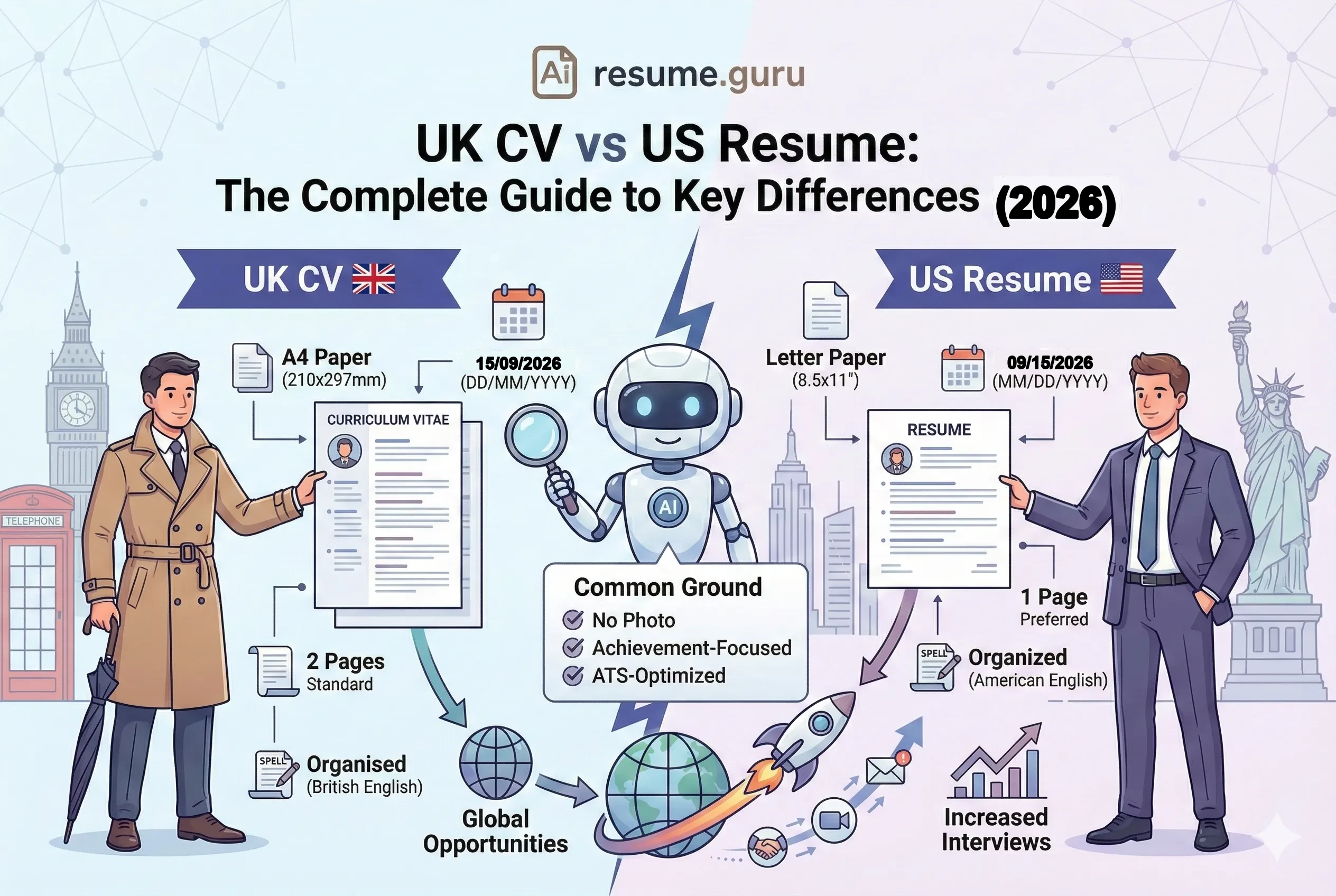
TL;DR
- UK uses “CV” for all applications; US uses “resume”
- Paper size: UK = A4 (210 x 297mm); US = Letter (8.5 x 11”)
- Length: UK = 2 pages standard; US = 1 page preferred for juniors
- Dates: UK = DD/MM/YYYY; US = MM/YYYY
- Both: No photos, no personal data, achievement-focused content
Quick Comparison Table
| Element | UK CV 🇬🇧 | US Resume 🇺🇸 |
|---|---|---|
| Terminology | CV (Curriculum Vitae) | Resume |
| Paper Size | A4 (210 x 297mm) | Letter (8.5 x 11”) |
| Standard Length | 2 pages | 1 page (junior); 2 pages (senior) |
| Date Format | DD/MM/YYYY or Month YYYY | Month YYYY |
| Spelling | British English | American English |
| Photo | ❌ Never | ❌ Never |
| DOB/Age | ❌ Never (now) | ❌ Never |
| Personal Statement | Common at top | Summary (optional) |
| References | ”Available on request” or omit | Usually omit |
The Terminology Confusion
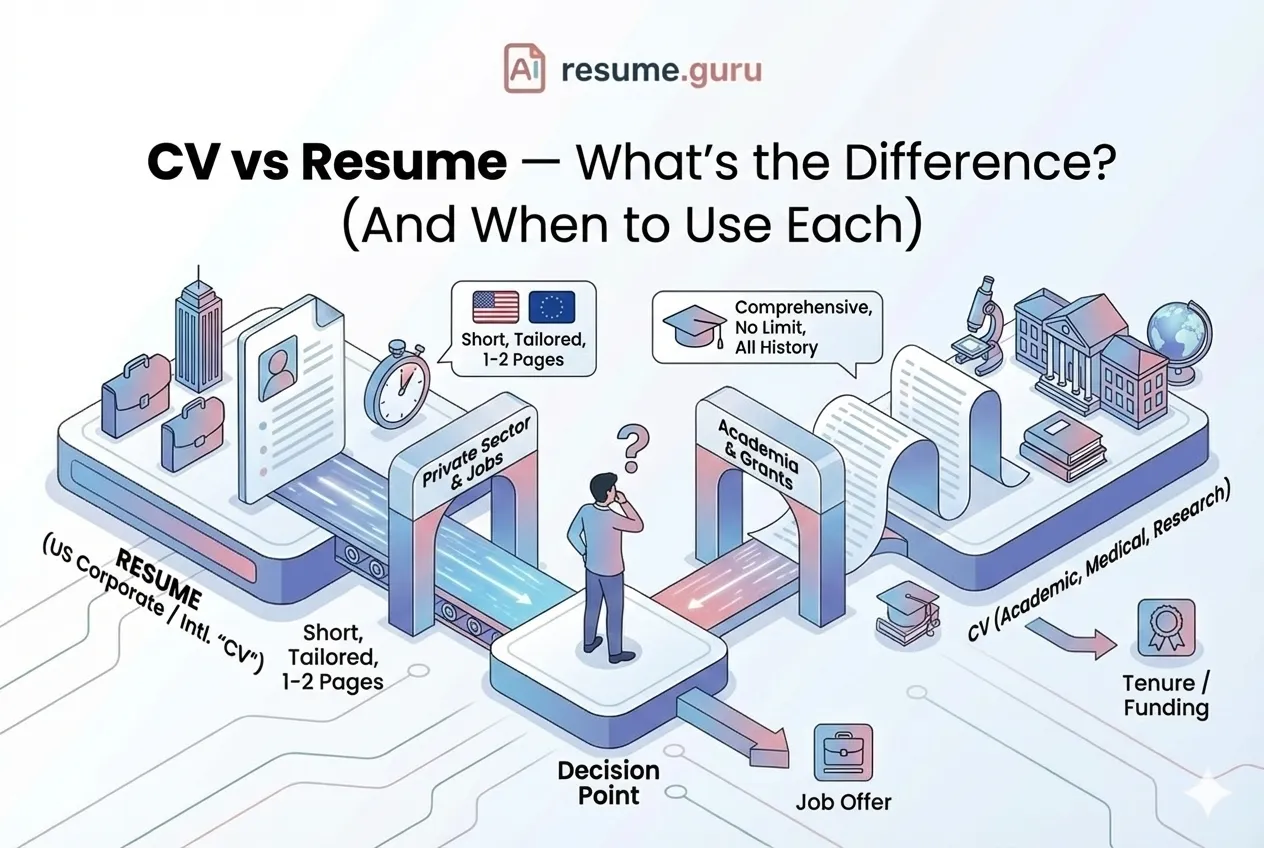
Let’s clear this up once and for all (for the full breakdown, see our CV vs resume guide):
In the UK
CV (Curriculum Vitae) = The standard document for all job applications—corporate, retail, executive, everything.
There’s no distinction between “CV” and “resume” in British English. They just call it a CV.
In the US
Resume = The standard 1-2 page document for most jobs.
CV = A longer, detailed document used specifically for academic, medical, and scientific research positions. Can be 5-10+ pages.
Important Distinction
If an American employer asks for a “CV,” they usually want an academic-style long document. If a UK employer asks for a “CV,” they want the equivalent of a US resume.
Context matters. When in doubt, ask or look at typical job postings in that market.
Paper Size (This Actually Matters)
UK standard paper size
210 x 297mm — slightly taller and narrower than US Letter
US standard paper size
8.5 x 11 inches — shorter and wider than A4
Why does this matter?
- Margins and formatting look different between A4 and Letter
- If you print a Letter-formatted resume on A4 paper, you get weird spacing
- Digital PDFs mostly solve this, but if an employer prints your CV, formatting may shift
Best practice: Set your document to the paper size of the country you’re applying in.
Length Expectations
UK: Two Pages is Standard
Most UK employers expect a 2-page CV. One page can look sparse for experienced candidates.
- Graduate/Entry-level: 1-2 pages
- Mid-career: 2 pages
- Senior/Executive: 2-3 pages
- Academic: As long as needed
US: One Page is Preferred (But Not Mandatory)
The “one-page rule” is stronger in the US, especially for early-career candidates.
- Entry-level/New grad: 1 page strongly preferred
- 5-10 years: 1-2 pages
- Senior/Executive: 2 pages
- Academic CV: As long as needed
Pro Tip for Cross-Border Applications
If you’re applying from the US to the UK, don’t artificially condense everything to one page. UK recruiters may think you’re underexperienced.
If you’re applying from the UK to the US (entry-level), try to fit key content on one page. Two pages for a new grad may look padded.
Date Formatting
This is a subtle but important difference.
Date style is easier to hold consistently on a layout built for it — browse ATS-safe templates that follow one format throughout.
UK Format
September 2022 – Present
15/09/2022 (if specific dates needed)
Day comes first: DD/MM/YYYY
US Format
September 2022 – Present
09/2022 (if abbreviated)
Month comes first: MM/YYYY
On resumes/CVs, you typically just use Month Year format in both countries, so this rarely causes confusion. But avoid ambiguous formats like “09/12/2022” which means September 12 in the US but December 9 in the UK.
British vs American English
Spelling differences are real. Use the appropriate version:
| British English 🇬🇧 | American English 🇺🇸 |
|---|---|
| organised | organized |
| behaviour | behavior |
| colour | color |
| centre | center |
| programme | program |
| specialise | specialize |
| favour | favor |
| analyse | analyze |
| travelling | traveling |
| licence (noun) | license (noun & verb) |
Set your spell-check to the correct locale and be consistent throughout.
UK CV Personal Statement: Examples by Experience Level
The personal statement (also called “profile” or “personal profile”) sits at the top of your UK CV and is the first thing recruiters read. It should be 3-4 sentences summarising your experience, key skills, and career goals.
Graduate/Entry-Level Personal Statement
“A recent Business Management graduate from the University of Leeds with strong analytical and communication skills. Completed a 12-month placement at Deloitte in the advisory team. Keen to begin a career in management consulting, bringing data analysis skills and client-facing experience.”
Mid-Career Personal Statement
“A marketing professional with 6 years’ experience in B2B SaaS, specialising in content strategy and performance marketing. Led a team of 4 content writers, increasing organic traffic by 150% over 18 months. Seeking a senior marketing role at a growth-stage technology company.”
Senior/Executive Personal Statement
“A commercially-driven operations director with 15 years’ experience scaling logistics and supply chain functions across the UK and EMEA. Track record of reducing operational costs by 30%+ while improving delivery KPIs. Looking to join a FTSE 250 board in a COO or VP Operations capacity.”
Need help writing yours? Our Resume Summary Generator creates professional personal statements tailored to your experience level — just input your background and target role.
Personal Statement (UK) vs Summary (US)
UK personal statements tend to be slightly more personal in tone — describing who you are and what you’re looking for. US summaries are more achievement-focused, leading with measurable results. Both are acceptable in either market, but match the tone to where you’re applying.
References
UK: “References available upon request” is sometimes included at the bottom. Often omitted entirely (assumed available).
US: References are almost never included on the resume. Provide separately only when requested.
What to Include (and Exclude)
✅ Include in Both
- Contact information (name, phone, email, LinkedIn URL)
- Professional summary or personal statement
- Work experience with achievements
- Education and qualifications
- Skills (technical and relevant soft skills)
❌ Exclude from Both (in 2026)
| Don’t Include | Why |
|---|---|
| Photo | Discrimination prevention |
| Date of birth/Age | Age discrimination laws |
| Marital status | Irrelevant and potentially discriminatory |
| Nationality/Visa status | Disclose only if specifically relevant |
| Religion | Not relevant |
| Full address | City/region is sufficient |
Historical Note
UK CVs historically included date of birth and sometimes nationality. This is now outdated. Modern UK CVs follow the same anti-discrimination principles as US resumes.
Formatting Differences
UK CV Structure
Formatting also decides whether clickable links survive, which is covered in our guide to hyperlinks in resume PDFs.
┌────────────────────────────────────┐
│  NAME                              │
│  Contact Details                   │
├────────────────────────────────────┤
│  PERSONAL STATEMENT / PROFILE      │
│  (3-4 sentences)                   │
├────────────────────────────────────┤
│  KEY SKILLS                        │
│  (Bullet list)                     │
├────────────────────────────────────┤
│  WORK EXPERIENCE                   │
│  (Reverse chronological)           │
├────────────────────────────────────┤
│  EDUCATION                         │
├────────────────────────────────────┤
│  ADDITIONAL INFO                   │
│  (Languages, interests, etc.)      │
└────────────────────────────────────┘
US Resume Structure
┌────────────────────────────────────┐
│  NAME & CONTACT                    │
├────────────────────────────────────┤
│  PROFESSIONAL SUMMARY (optional)   │
├────────────────────────────────────┤
│  WORK EXPERIENCE                   │
│  (Reverse chronological)           │
├────────────────────────────────────┤
│  SKILLS                            │
├────────────────────────────────────┤
│  EDUCATION                         │
└────────────────────────────────────┘
Both are valid; the UK format often gives more up-front prominence to the personal statement and skills summary.
Converting Your CV for the Other Market
US → UK Conversion Checklist
Adapting for UK Applications
- Change document size to A4
- Switch spell-check to British English
- Expand to 2 pages if content warrants
- Add a 'Personal Statement' at the top
- Use DD/MM/YYYY date format if specific dates needed
- Remove any 'references available' line (optional to add back)
- Ensure consistent British terminology
UK → US Conversion Checklist
Adapting for US Applications
- Change document size to Letter (8.5 x 11)
- Switch spell-check to American English
- Condense to 1 page if early-career (2 OK for senior)
- Make summary more achievement-focused
- Use Month YYYY date format
- Remove 'references available' line
- Quantify achievements more aggressively
Industry-Specific Notes
Finance/Legal
Both UK and US tend toward conservative, traditional formatting. The UK may expect more formal language.
Tech/Startups
Both markets are fairly similar—achievements and skills trump formality. UK tech is heavily influenced by US norms.
Academic
In both countries, academic CVs are longer and more detailed. The UK uses “CV” for this naturally; the US distinguishes between “CV” (academic) and “resume” (industry).
Creative Industries
Portfolio links matter more than CV format in both markets. UK may be slightly more open to creative formatting.
ATS Systems in the UK: What You Need to Know
Most large UK employers and recruitment agencies use Applicant Tracking Systems. The most common ATS platforms in the UK are:
- Workday — used by many FTSE 100 companies, banks, and large corporates
- Oleeo (formerly WCN) — popular with UK public sector, NHS, and universities
- Tribepad — widely used by UK recruitment agencies
- Taleo (Oracle) — enterprise employers across the UK
Before you submit to any of them, score your resume now to see how your CV parses.
- Greenhouse / Lever — UK tech companies and startups
How to Make Your UK CV ATS-Friendly
-
Use standard section headings: “Work Experience,” “Education,” “Skills” — not creative alternatives like “My Journey” or “What I Bring.” ATS systems look for standard labels.
-
Avoid tables, columns, and text boxes. Many UK ATS systems parse single-column layouts much better than multi-column designs. Stick to a clean, linear format.
-
Include keywords from the job description. If the role asks for “stakeholder management” and “budget oversight,” use those exact phrases. Our Keyword Scanner can check your CV against a specific job posting to identify missing keywords.
-
Use an ATS-friendly font: Arial, Calibri, or Helvetica in 10-12pt. Avoid decorative fonts that ATS systems may not recognise.
-
Save as PDF unless the application specifically asks for Word. UK employers increasingly accept PDF, and it preserves your formatting. See our PDF vs Word guide for edge cases.
-
Set proper margins and spacing: 2-2.5cm margins on A4, 1.15-1.5 line spacing. This keeps your CV readable for both ATS and human reviewers.
UK CV Mistakes That Get You Rejected
Avoid these errors that are specifically common on UK CVs:
-
Using American spelling. “Organized” instead of “organised” tells a UK recruiter you didn’t bother tailoring. Set your spell-checker to English (UK).
-
Writing “resume” instead of “CV.” In any UK-facing application, always call it a CV — even in your cover letter and email subject line.
-
Including personal data. Date of birth, marital status, nationality, and driving licence status are no longer expected on UK CVs. The Equality Act 2010 discourages anything that could enable discrimination.
-
Skipping the personal statement. UK recruiters expect it. A CV without one feels incomplete. Use our Resume Summary Generator if you’re stuck.
-
Using US Letter paper size. Set your document to A4 before writing. The margin and line-break differences between A4 and Letter can cause awkward formatting when printed.
-
Padding with irrelevant interests. “Reading, travelling, socialising” adds nothing. Include hobbies only if they demonstrate relevant skills — e.g., “Captain of university rugby team” shows leadership.
-
Not quantifying achievements. UK CVs are increasingly achievement-focused, not just duty-focused. “Managed a team” is weaker than “Managed a team of 8, reducing project delivery time by 25%.” See our guide on how to quantify achievements for examples.
International Application Strategy
Applying to both UK and US jobs simultaneously? Here’s the practical approach:
- 1
Maintain two versions
Keep a UK CV (A4, British English, personal statement) and a US resume (Letter, American English, summary) as separate files.
- 2
Start with strong content
Write achievement-focused bullet points once, then adapt terminology and formatting for each market.
- 3
Tailor for each application
Use our Keyword Scanner to match your CV to each specific job description — keywords differ between UK and US job postings even for the same role.
- 4
Note work authorisation
If applying from another country, address visa/sponsorship status. UK uses 'right to work'; US uses 'work authorization'.
- 5
Use the right file name
Name your file 'FirstName-LastName-CV.pdf' for UK applications and 'FirstName-LastName-Resume.pdf' for US.
If you’re also applying outside the English-speaking world, translate your resume rather than submitting the English version.
If you’re relocating to the UK from another country, our expat resume guide covers the full process of adapting your application documents. For multilingual professionals, see the bilingual resume guide.
Our Resume Translator can also help adapt CV content between markets while preserving professional tone — useful when switching between British and American English conventions.
Bottom Line
The differences between UK CVs and US resumes are real — but not dramatic. Get the fundamentals right and you’ll be competitive in either market:
- Achievement-focused bullet points with quantified results
- Clean, ATS-friendly formatting with standard section headings
- No photos or personal data (both markets)
- Tailored content for each role — use our Keyword Scanner to match your CV to specific job descriptions
- Proper spelling for the target market (British English for UK, American for US)
If you’re applying to both UK and US roles, keep two versions of your CV. Start with strong content — action verbs, measurable results, and relevant keywords — then adjust formatting for each market.
For a wider view of how international formats differ beyond UK and US, see our international resume formats guide covering 12 regions, or specific guides for Australian, Canadian, German (Lebenslauf), and European (Europass) formats.
Build a UK-ready CV in minutes
Our AI tools help you write a strong personal statement, generate achievement-focused bullet points, and check ATS compatibility — then export as A4 PDF for UK applications.
Try Our Free CV ToolsRelated Resources
- CV vs Resume Explained — When to use each term
- European CV & Europass Guide — EU format rules by country
- International Resume Formats — US vs European vs Asian differences
- ATS-Friendly Resume Fonts — Fonts that pass UK ATS systems
- Resume Margins & Spacing — Proper A4 formatting settings
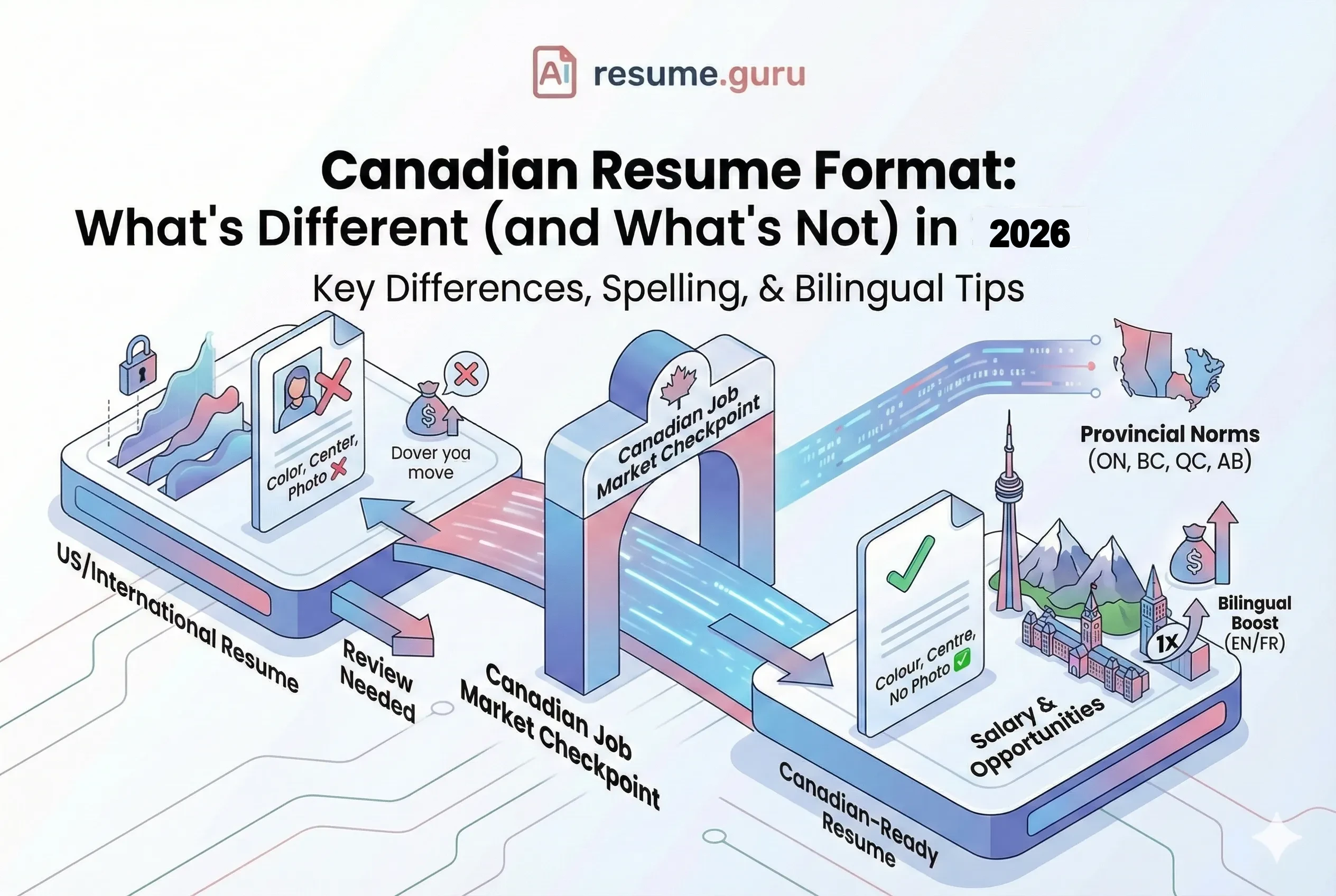
- Canadian Resume Format — Another Commonwealth format
- Australian Resume Format — Commonwealth comparison
- Resume Summary Generator — Create UK-style personal statements
- Keyword Scanner — Check ATS compatibility
- Resume Translator — Adapt your CV for any market
- Resume Templates — ATS-optimised professional designs
Frequently Asked Questions
What's the main difference between a UK CV and a US resume?
Terminology: 'CV' is standard in the UK for all jobs; 'resume' is the US term. UK CVs are typically 2 A4 pages, while US resumes favor 1 page for junior roles. UK uses day/month/year dates; US uses month/year.
Should I include a photo on a UK CV?
No. UK CVs should not include photos. This helps prevent discrimination and is standard practice across all industries, including the Equality Act 2010.
What paper size should I use for a UK CV?
A4 (210 x 297 mm). US resumes use Letter size (8.5 x 11 inches). Set your document to A4 before writing — it affects margins and line breaks.
Do I need to include my date of birth on a UK CV?
No. Modern UK CVs should not include age, DOB, marital status, or nationality. The Equality Act 2010 protects against age discrimination in hiring.
How long should a UK CV be?
2 pages is the standard for most roles. Graduates may use 1-2 pages, senior professionals 2-3 pages. Unlike US resumes, a 1-page UK CV can look sparse for experienced candidates.
What is a personal statement on a UK CV?
A 3-4 sentence paragraph at the top of your CV summarising your experience, skills, and career goals. It's standard on UK CVs and equivalent to a US 'professional summary' but slightly more personal in tone.
Do UK employers use ATS systems?
Yes. Major UK employers and recruitment agencies use ATS systems like Workday, Oleeo, and Tribepad. Use standard section headings, avoid tables and graphics, and include keywords from the job description.
Should I use British or American spelling on my CV?
Use British English spelling for UK applications (organised, behaviour, centre). Set your spell-checker to 'English (UK)' and be consistent throughout. Using American spelling signals you didn't tailor the document.
Put this into practice
You have the theory. These take a few minutes and work on the resume you already have.