Here’s a mistake that tanks qualified candidates every day:
Sending the same resume everywhere.
That one-page, achievements-focused, photo-free resume that kills in the US? It might get you rejected in Germany for being “incomplete.” And that detailed German CV with your photo and date of birth? It goes straight in the HR “risk” pile in America.
One size does not fit all.
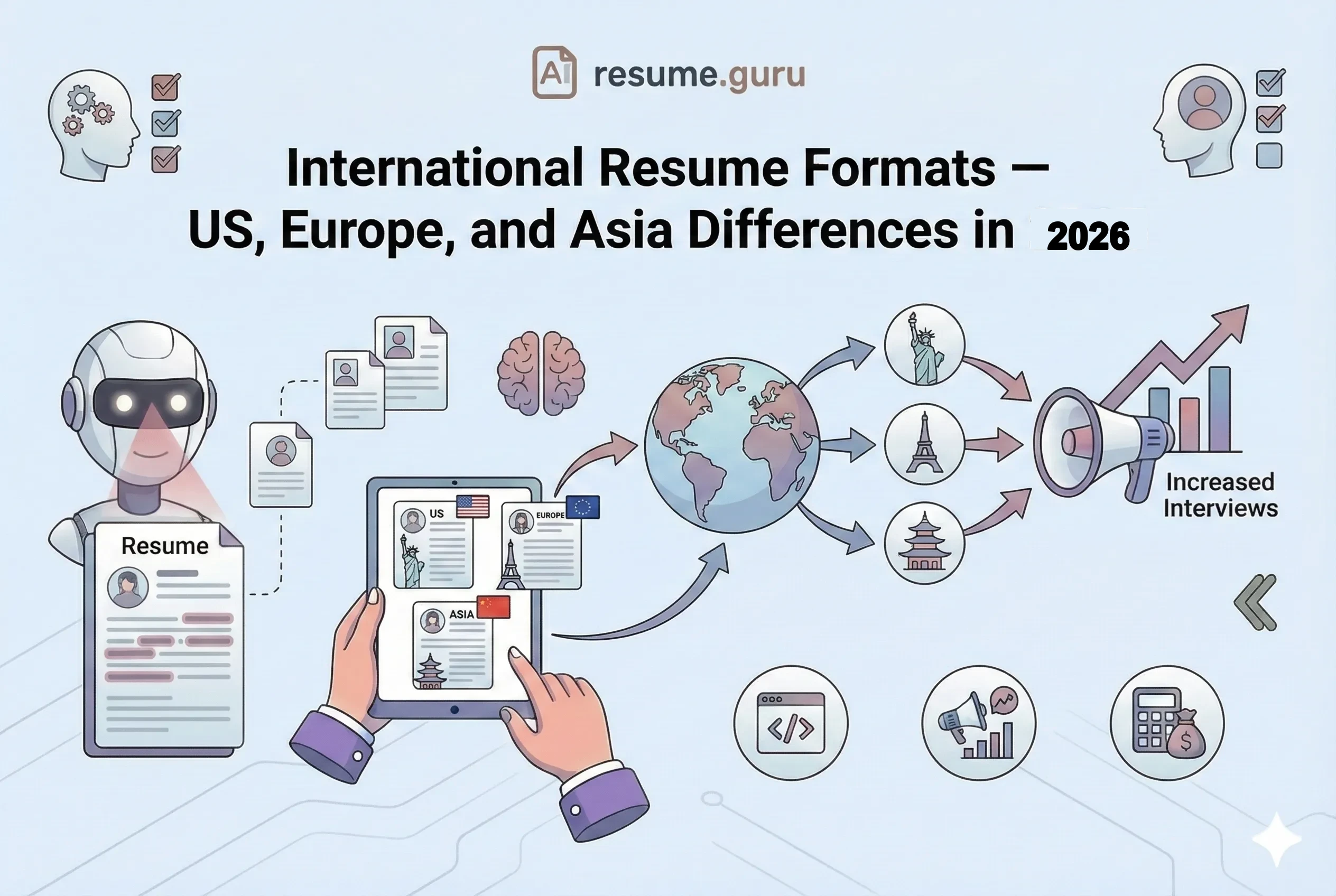
The short answer: international resume formats differ on five things — terminology (resume in the US, CV across Europe and the UK), photos (never in the US or UK, often expected in Germany and much of Asia), personal details such as date of birth, length (one page in the US, two elsewhere), and paper size (Letter versus A4). Match the destination country’s convention, not your own.
International applications
Rejected for format mismatches, not qualifications
Source: TopResume Survey
If you’re applying internationally—or to multinational companies—you need to understand how expectations vary by region. The document is called different things (read our full breakdown of CV vs resume terminology), looks different, and includes different information.
Let’s break it down.
The Core Differences
- Terminology: Resume (US) = CV (Europe/UK) for most jobs
- Photos: Never in US/UK, often required in Europe/Asia
- Personal details: Taboo in US, expected in Germany
- Length: 1 page in US, 2 pages acceptable elsewhere
- Paper size: Letter (US) vs A4 (everywhere else)
The Terminology Trap: Resume vs CV
The same words mean different things depending on where you are:
| Region | Term Used | What It Means |
|---|---|---|
| USA/Canada | Resume | 1-2 page job application document |
| USA/Canada | CV | Detailed academic/research document (5+ pages) |
| UK/Ireland | CV | Same as US resume (1-2 pages) |
| Continental Europe | CV (Curriculum Vitae) | Standard job document (1-2 pages) |
| Asia/Middle East | CV or Resume | Used interchangeably, typically 1-2 pages |
| India | Biodata/Resume/CV | Often used interchangeably |
The Exception
Everywhere in the world, academic, medical, and research positions typically require a full CV—a comprehensive document listing all publications, research, teaching experience, and grants. This can run 5-10+ pages.
Region-by-Region Guide
🇺🇸 United States & Canada
Philosophy: Privacy-focused, results-driven, concise.
US/Canada Resume Expectations
- 1 page (2 pages only for senior/executive roles)
- NO photo — ever
- NO personal details (age, marital status, nationality)
- Focus on quantified achievements, not just duties
- Professional summary at top (not an objective)
- Reverse-chronological format preferred
- Paper size: Letter (8.5 × 11 inches)
Key point: Including a photo or personal details can actually hurt you—it opens the employer to discrimination liability, so many HR teams immediately reject such resumes. For the full country-by-country rundown, see our guide on whether to put a photo on your resume. For the Canadian specifics, follow our Canadian resume format guide.
🇬🇧 United Kingdom & Ireland
Philosophy: Similar to US, but with subtle differences.
UK/Ireland CV Expectations
- 2 pages standard (1 page for entry-level)
- NO photo
- NO personal details (age, marital status)
- British spelling: colour, organise, programme
- Education section often more prominent than US
- References: 'Available upon request' or list 2
- Paper size: A4
Key point: The UK calls it a “CV” but it’s functionally identical to a US resume—see our UK CV vs US resume comparison for the subtle differences. Don’t confuse this with the academic CV format.
🇩🇪 Germany, Austria & Switzerland
Philosophy: Thorough, formal, and personal information is expected. For the complete guide, see our German Resume (Lebenslauf) Guide.
German-Speaking CV Expectations
- 2 pages standard
- Professional photo — essential (passport-style, formal)
- Personal details included: date of birth, nationality, sometimes marital status
- Chronological format (often oldest to newest, unlike US)
- Education highly valued — list details including grades
- Handwritten signature at bottom (traditional, sometimes still expected)
- Paper size: A4
Photo Requirements
In Germany, CVs without photos are often seen as incomplete. Invest in a professional headshot—casual selfies don’t cut it. Place the photo in the top-right corner of the first page.
🇫🇷 France
Philosophy: Formal, detailed, personal details included.
French CV Expectations
- 1-2 pages
- Professional photo expected
- Personal details: date of birth, nationality, sometimes address
- Education section prominent (grandes écoles highly valued)
- Hobbies and interests section common
- Handwritten signature and handwritten cover letters (rarely now, but traditional)
- Paper size: A4
🇪🇺 Nordic Countries (Sweden, Denmark, Norway, Finland)
Philosophy: Blend of US efficiency and European detail.
Nordic CV Expectations
- 1-2 pages
- Photo optional (becoming less common)
- Personal details: less formal, but date of birth sometimes included
- Emphasis on work-life balance and cultural fit
- Hobbies/interests section common (shows personality)
- Reference list often attached separately
- Paper size: A4
🇯🇵 Japan
Philosophy: Highly standardized format with specific conventions.
Japanese Resume (Rirekisho) Expectations
- Standardized printed forms available at convenience stores
- Often handwritten (shows character, though digital is becoming acceptable)
- Photo required — formal, passport-style
- Personal details: date of birth, age, gender, marital status, number of dependents
- Education history in detail
- Work history (shokumu keirekisho) as separate document
- Paper size: B5 or A4
Two Documents
Japan often requires two documents: the rirekisho (standardized resume) and the shokumu keirekisho (detailed career history). Many companies provide their own application forms. For Singapore, Hong Kong, and the wider region, see our Asia-Pacific resume format guide.
🇨🇳 China
Philosophy: Detailed, photo required, personal information expected.
Chinese CV Expectations
- 1-2 pages
- Photo required — professional headshot
- Personal details: date of birth, age, gender, ethnicity, marital status, political affiliation (sometimes)
- Education listed prominently (often first)
- Highlights: awards, certifications, and party membership (if applicable)
- Paper size: A4
🇮🇳 India
Philosophy: Detailed, often longer than Western formats.
Indian Resume/Biodata Expectations
- 2-3 pages acceptable
- Photo increasingly common
- Personal details: date of birth, marital status, father's name (traditional)
- Declaration at bottom: 'I hereby declare...' signed
- Education and certifications highly emphasized
- Skills-based format often preferred
- Paper size: A4
🇦🇪 UAE & Middle East
Philosophy: Detailed, formal, personal information expected.
UAE/Middle East CV Expectations
- 2-3 pages
- Professional photo common
- Personal details: nationality (important for visa), date of birth, marital status, visa status
- References often included directly on CV
- Education and international experience highly valued
- Paper size: A4
Quick Reference Table
| Element | US/Canada | UK | Germany | France | Japan | China | India |
|---|---|---|---|---|---|---|---|
| Preferred Length | 1 page | 2 pages | 2 pages | 1-2 pages | Standard forms | 2 pages | 2-3 pages |
| Photo | ❌ Never | ❌ No | ✅ Required | ✅ Yes | ✅ Required | ✅ Required | ⚠️ Common |
| Date of Birth | ❌ No | ❌ No | ✅ Yes | ✅ Yes | ✅ Yes | ✅ Yes | ✅ Yes |
| Marital Status | ❌ No | ❌ No | ⚠️ Sometimes | ⚠️ Sometimes | ✅ Yes | ✅ Yes | ✅ Yes |
| Paper Size | Letter | A4 | A4 | A4 | B5/A4 | A4 | A4 |
Paper size and photo slots are layout decisions, so browse ATS-safe templates that handle both Letter and A4 cleanly.
The “Global Safe” Strategy
If you’re applying to multinational companies or don’t know the regional preference — and if the posting is in another language, you can produce a localized version without rebuilding the layout rather than maintaining two documents by hand:
- 1
Research the headquarters location
Multinationals often default to their home country's conventions.
- 2
Check the job posting language
If it says 'resume,' lean US style. If it says 'CV,' lean European.
- 3
When in doubt, create two versions
One US-style (no photo), one European-style (with photo).
- 4
Use PDF to preserve formatting
PDF prevents paper size issues and font substitution.
- 5
Match the language exactly
'Color' for US, 'colour' for UK. 'Organize' for US, 'organise' for UK.
For one more English-speaking market with its own rules, see the Australian resume format guide.
Common Mistakes to Avoid
Mistake #1: Using Europass When Not Required
While standardized, Europass is often seen as rigid and outdated. Many European recruiters prefer a traditional well-designed CV—our Europass and European CV format guide explains when each makes sense. Only use Europass if specifically requested by the employer.
Mistake #2: Including a Photo for US/UK Jobs
This can trigger legal concerns (discrimination) and may get your resume rejected on sight. When in doubt for English-speaking countries, leave the photo off.
Mistake #3: Using the Wrong Paper Size
Designing for Letter and printing on A4 (or vice versa) creates awkward margins or cuts off content. Design specifically for the target region’s paper standard.
Mistake #4: Mixing British and American English
Consistency matters. If you use “organised” once and “organized” later, you look careless. Pick one and stick to it.
If you’re not sure which of these four your CV trips over, roast your CV before you send it abroad.
The Bottom Line
The global job market isn’t one-size-fits-all—and neither is your resume.
Before you hit submit, research the specific expectations of your target country. What’s professional in one region can be disqualifying in another.
When in doubt: create multiple versions, default to the regional standard, and always save as PDF to preserve your formatting. If you’re adapting a resume into another language, our resume translator keeps the formatting intact while you localize the content for the target market — each language has a page of its own covering local conventions, so you can translate your resume to Spanish, translate your resume to Arabic, or translate your resume to Russian and start from the right norms.
Build for any region
AI ResumeGuru's templates work globally—export in multiple formats and customize for any market.
Start Building FreeRelated Resources
- German Resume Guide — Complete Lebenslauf format for Germany
- European CV Format — Europass and EU standards
- Canadian Resume Format — North American format with Canadian specifics
- Australian Resume Format — A4, British spelling, detailed
- UK CV Format — British CV conventions
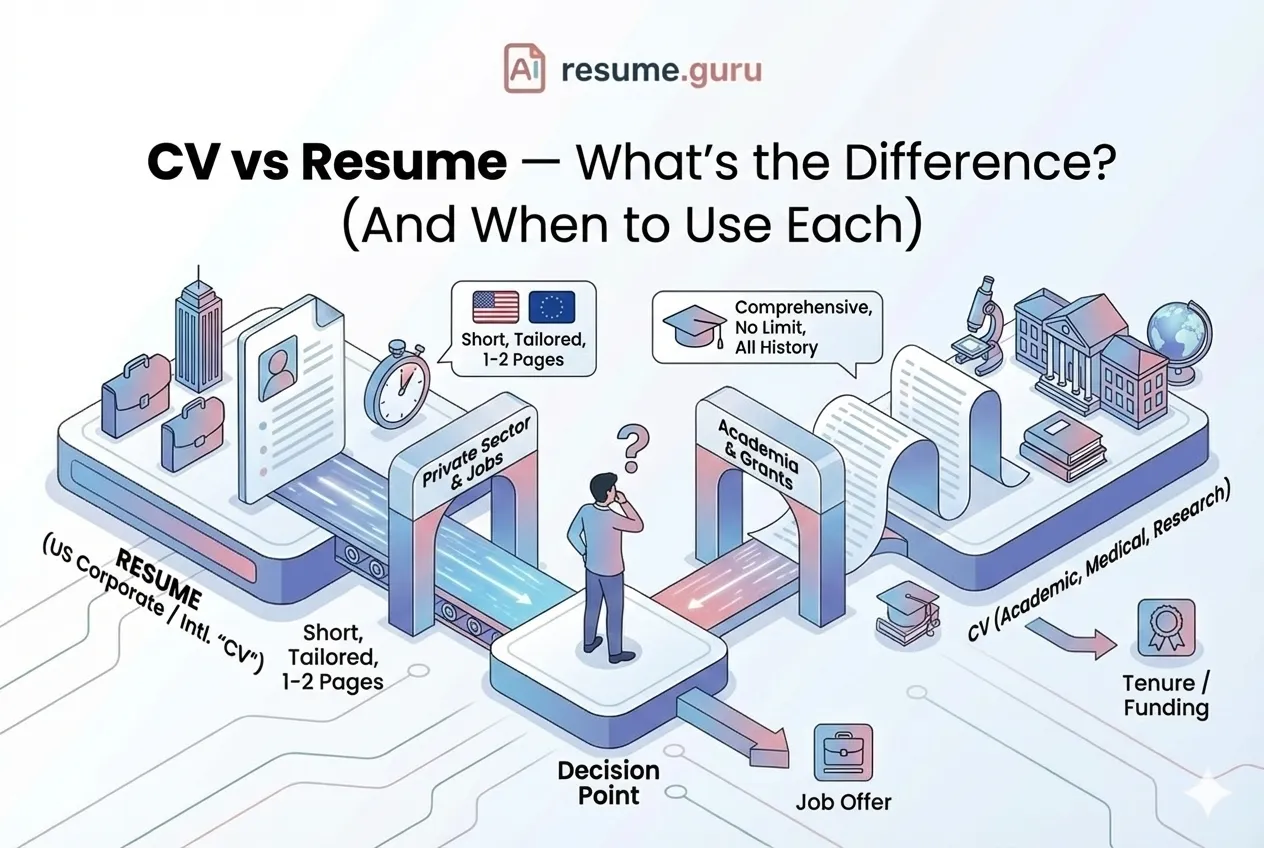
- CV vs Resume — Full breakdown of the terminology
- Resume Templates — Globally compatible designs
- Translate Your Resume — Localize your resume without losing the layout
- Resume Translator — Convert your resume into the target language
Frequently Asked Questions
What's the difference between a resume and a CV internationally?
In the US, a resume is 1-2 pages for most jobs, while CV is reserved for academic/medical fields and can be much longer. In Europe and much of Asia, 'CV' refers to what Americans call a resume—a 1-2 page job application document.
Should I include a photo on my international resume?
It depends entirely on the country. In the US, UK, Canada, and Australia—never include photos (discrimination concerns). In Germany, France, much of Europe, and most of Asia—photos are expected or even required.
Do I need to include personal information like age or marital status?
In the US/UK: No—it's seen as potential discrimination risk. In Germany, France, and parts of Asia: Yes—personal details including date of birth, nationality, and sometimes marital status are commonly included.
What paper size should my international resume be?
US uses Letter size (8.5×11 inches). Nearly everywhere else uses A4 (slightly taller and narrower). Sending the wrong size can cause formatting issues when printed. PDF helps preserve layout, but design accordingly.
Should I use Europass for European applications?
Only if specifically required. While Europass is a standardized EU format, many recruiters find it outdated and restrictive. A well-crafted traditional European CV often performs better—and is more ATS-compatible.
Put this into practice
You have the theory. These take a few minutes and work on the resume you already have.