Here’s something most English-only speakers don’t realize:
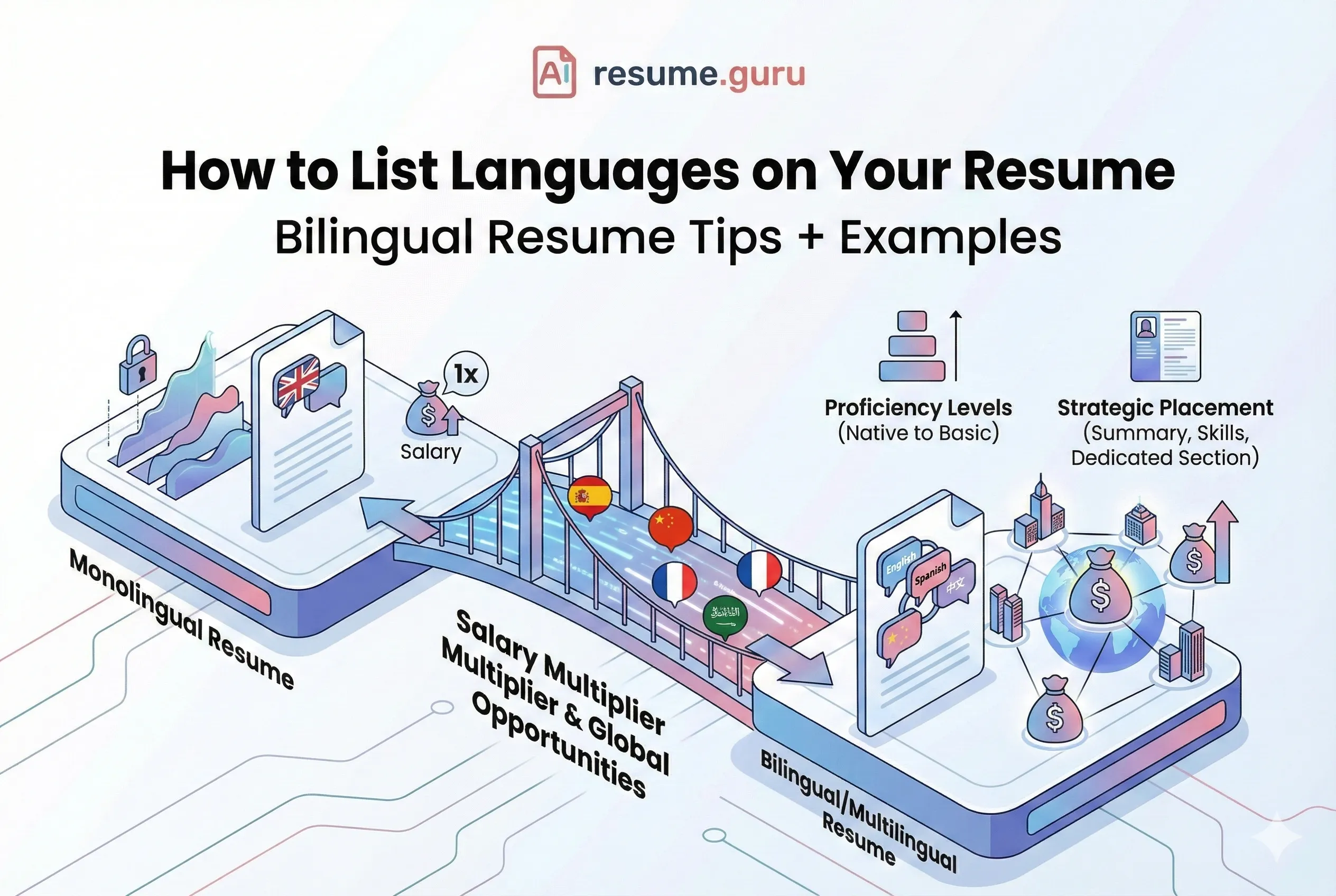
Your second language is a salary multiplier.
Not a soft skill. Not a “nice to have.” An actual, quantifiable advantage in the job market.
But only if you present it right.
A resume that says “Spanish: Good” tells employers nothing. A resume that says “Spanish: Professional Working Proficiency (ILR Level 3)” opens doors.
TL;DR
- Bilingual workers earn 5-20% more than monolingual peers
- Use standardized proficiency levels (Native, Fluent, Conversational)
- Create a dedicated “Languages” section
- Place prominently for language-critical roles
- Consider submitting two resume versions for international markets
The Bilingual Advantage (By the Numbers)
higher salaries
For bilingual workers compared to monolingual peers
Source: New American Economy, 2024
surge since 2020
In remote multilingual job postings
Source: LinkedIn Workforce Data
of employers
Predict increased demand for bilingual workers in the next 5 years
Source: Forbes Business Survey
The global economy runs on multiple languages. If you speak more than one, you’re more valuable. Full stop.
That international framing raises other formatting questions too, like whether to include a photo on your resume.
Most In-Demand Languages (2026)
| Language | Why It’s In Demand |
|---|---|
| Spanish | 41M native speakers in US; essential for healthcare, retail, construction |
| Mandarin Chinese | Growing trade relationships; tech, finance, supply chain |
| Arabic | Government, defense, oil/gas, international relations |
| French | Luxury goods, diplomacy, Canadian market, African expansion |
| Japanese | Tech partnerships, gaming, automotive, manufacturing |
| Portuguese | Latin American markets, Brazil expansion |
| German | Engineering, manufacturing, European business |
| Korean | K-pop/entertainment industry, tech partnerships, Samsung/LG ecosystem |
Every language you speak opens a new market. In a globalized economy, bilingual candidates aren’t just preferred—they’re often required.
How to Describe Language Proficiency
This is where most people mess up. “Fluent” means different things to different people.
Use Standardized Proficiency Levels
| Level | What It Means |
|---|---|
| Native | First language; full cultural and linguistic mastery |
| Bilingual | Equal to native speaker; learned from birth or early childhood |
| Fluent | Can hold complex conversations; near-native written and spoken |
| Professional Working | Can conduct business; read reports; participate in meetings |
| Conversational | Can hold everyday conversations; some limitations in complex topics |
| Basic | Can understand simple phrases; very limited production |
Professional Frameworks (For Formal Contexts)
CEFR (Common European Framework of Reference):
- A1/A2 = Beginner
- B1/B2 = Intermediate
- C1/C2 = Advanced/Native-like
ILR (Interagency Language Roundtable):
- Level 0 = No proficiency
- Level 1 = Elementary
- Level 2 = Limited working
- Level 3 = Professional working
- Level 4 = Full professional
- Level 5 = Native/Bilingual
ACTFL (American Council on Teaching of Foreign Languages):
- Novice → Intermediate → Advanced → Superior → Distinguished
When to Use Each
| Context | Recommended Format |
|---|---|
| Most corporate jobs | Standard terms (Native, Fluent, Conversational) |
| Government/defense | ILR scale |
| International companies | CEFR scale |
| Education roles | ACTFL scale |
Where to Put Languages on Your Resume
Placement depends on how central language skills are to the role:
High-Priority Placement (Language-Critical Roles)
For translator, interpreter, customer service, international sales, or bilingual-required positions:
Option 1: In the Summary
“Bilingual Spanish-English marketing manager with 6 years of experience managing campaigns across US and Latin American markets…”
Option 2: Dedicated Languages Section Near Top
LANGUAGES
Spanish: Native
English: Bilingual
Portuguese: Professional Working Proficiency
Standard Placement (Language as a Bonus)
For most professional roles where language adds value but isn’t required:
SKILLS
Technical: Python, SQL, Tableau, AWS
Tools: Jira, Figma, Slack, Notion

LANGUAGES
English: Native
Spanish: Conversational
French: Basic
Combined With Skills
SKILLS & LANGUAGES
Technical: Data Analysis, SQL, Python, Excel
Languages: English (Native), Mandarin (Professional Working), Japanese (Basic)
Formatting Examples
Simple List Format
LANGUAGES
English: Native
Spanish: Fluent
French: Conversational
Detailed Format
LANGUAGES
• Spanish: Native speaker; raised in bilingual household
• English: Bilingual; 10+ years business experience in US
• Portuguese: Professional working; completed B2 certification
• French: Conversational; studied 4 years in university
Visual Scale Format
LANGUAGES
English     ●●●●● Native
Spanish     ●●●●○ Professional
French      ●●○○○ Conversational
CEFR Format
LANGUAGES
English: C2 (Native)
German: C1 (Advanced)
Spanish: B2 (Upper Intermediate)
Japanese: A2 (Elementary)
Integrating Languages Into Experience Bullets
Don’t just list languages—show how you’ve used them:
Integrated Language Bullets
- “Served as Spanish-language liaison for Latin American accounts ($2.4M annual revenue), conducting all client communication in Spanish”
- “Led weekly French-language team meetings with Paris office, coordinating 12-person distributed team”
- “Translated 50+ technical documents from English to Mandarin for manufacturing partners in China”
- “Provided interpretation services for executive negotiations, closing $500K contract with Japanese supplier”
These bullets prove you can actually use the language professionally—not just claim proficiency.
The Two-Resume Strategy (International Applications)
Applying to international markets? Consider submitting resumes in both languages:
When to Create Two Versions
- Applying to jobs in another country
- Role explicitly requires bilingualism
- Company operates in multiple language markets
- Job posting is in a non-English language
How to Handle It
If submitting two resumes:
- Ensure a perfect, professionally translated resume (not a rough machine translation)
- Match formatting between versions
- Name files clearly:
JohnSmith_Resume_EN.pdfandJohnSmith_CV_ES.pdf
If submitting one resume to a non-English market:
- Use their language as the primary
- Note English proficiency within the Languages section
Skills That Pair Well With Language Abilities
Bilingualism alone is valuable. Bilingualism + specialized skills? Even more so.
| Industry | High-Value Combinations |
|---|---|
| Healthcare | Spanish + Medical terminology + Patient care |
| Legal | Spanish/Mandarin + Paralegal skills + Contract review |
| Tech | Mandarin/Japanese + Software engineering + Localization |
| Finance | French/German + CFA + International markets knowledge |
| Marketing | Portuguese/Spanish + Digital marketing + Content creation |
| Customer Service | Any language + CRM tools + Communication skills |
Not sure which pairings apply to your background? You can find the right skills to list alongside your languages.
Common Mistakes to Avoid
Mistake 1: Overstating Proficiency
Don’t claim “fluent” if you haven’t spoken the language in 10 years. You will be tested.
Interviewers may switch to that language mid-interview. If you stumble, you lose credibility on everything else.
Mistake 2: Including Beginner Languages
“French: A few words from high school” doesn’t help. Only list languages where you have at least conversational ability.
Mistake 3: Vague Descriptions
“Spanish: Good” | “Mandarin: Decent” | “French: Some”
These tell employers nothing. Use standardized proficiency terms.
Mistake 4: Burying Languages on Language-Dependent Roles
If the job requires bilingualism and your languages are hidden at the bottom—you might get filtered out before anyone sees them.
If you’re unsure whether your language section trips any of these, roast your CV before you send it out.
Bilingual-Specific Interview Tips
Prepare for language tests:
Language Interview Prep
- Practice industry-specific vocabulary in your second language
- Prepare to describe your work experience in both languages
- Be ready for surprise language switches mid-interview
- Have examples of how you've used language skills professionally
- Refresh conversational fluency if you haven't spoken recently
Quick Decision Guide
Should I list this language?
- Can I hold a professional conversation in it? → Include
- Can I only read menus and greet people? → Probably skip
- Is it directly relevant to this job? → Feature prominently
- Is it just a nice-to-have? → List in skills section
- Will I be tested and potentially embarrassed? → Be honest about level
Your Move
If you speak multiple languages, you have a competitive advantage. Don’t waste it with vague proficiency claims or buried placement.
Put your language skills front and center—especially if applying to:
- Companies with international operations
- Roles serving diverse communities
- Industries where global communication matters
Build a bilingual-ready resume
Our AI Resume Builder helps you create a professional resume with proper language sections and formatting. Perfect for multilingual candidates.
Build My ResumeRelated Resources
- European CV & Europass Format — CEFR language levels and EU CV rules by country
- Resume Summary Generator — Write compelling summaries that highlight language skills
- Remote Work Resume — Global roles often value languages
- Canadian Resume Format — Often requires French/English bilingualism
- Keyword Scanner — Check if your language keywords are included
- Resume Examples — See language sections in context
- Resume Templates — Layouts with proper language sections
Frequently Asked Questions
Where should I put languages on my resume?
Create a dedicated 'Languages' section near your skills. For jobs where language is central, place it prominently—even in your summary. For jobs where it's a bonus, put it after skills or before interests.
How do I describe language proficiency?
Use standardized terms: Native, Fluent/Bilingual, Professional Working Proficiency, Conversational, or Basic. Alternatively, use frameworks like ACTFL or CEFR (A1-C2) for formal contexts.
Do bilingual skills increase salary?
Yes—bilingual workers earn 5-20% more depending on the role and language. Spanish, Mandarin, Arabic, French, and Japanese command the highest premiums in the US market.
Should I create a resume in two languages?
For international job markets or roles requiring bilingualism, consider submitting two versions. For US-based roles, one English resume with clearly listed language skills is typically sufficient.
Put this into practice
You have the theory. These take a few minutes and work on the resume you already have.