In a globalized economy, language skills are more valuable than ever.
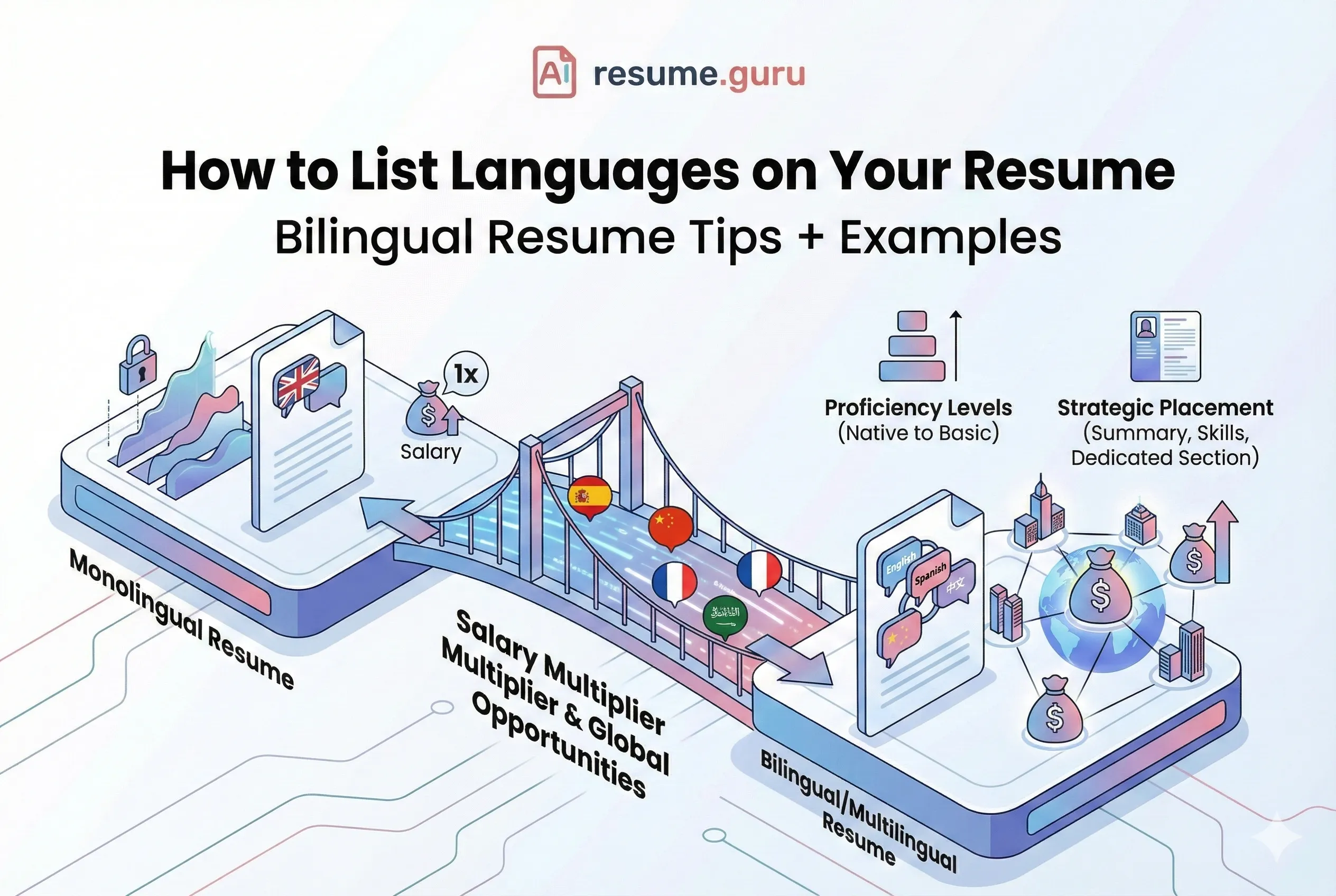
Bilingual employees earn 5-20% more on average. Multilingual job postings are up 30% in the last five years. And for many roles—especially in international companies, tourism, healthcare, and customer service—speaking additional languages isn’t just a bonus. It’s a requirement. In bilingual markets like Canada, where French and English are often both expected, listing your levels correctly matters even more (see our Canadian resume format guide).
Of employers
Say foreign language skills are increasingly important
Source: American Council on Teaching Foreign Languages, 2024
But listing languages incorrectly can actually hurt your resume. Vague proficiency claims, awkward formatting, or listing languages that aren’t relevant can look unprofessional. If you operate in two languages day to day, our bilingual resume guide walks through structuring a full dual-language resume.
This guide shows you exactly how to add language skills that strengthen your candidacy.
Quick Reference
- Always include languages if job-relevant or if applying internationally
- Use standard proficiency levels: Native, Fluent, Professional, Conversational, Basic
- Be honest: You may be tested in interviews
- Format consistently: Dedicated section or integrated with Skills
- Prioritize: List most relevant/proficient languages first
When Languages Matter on Your Resume
If a role wants your application in the local language, you can translate your resume rather than rewriting it by hand.
High-Value Industries for Language Skills
| Industry | Language Value | Common Languages |
|---|---|---|
| International Business | Very High | Mandarin, Spanish, German, Japanese |
| Tourism & Hospitality | Very High | Spanish, French, Mandarin, German, Japanese |
| Healthcare | High | Spanish, Mandarin, Vietnamese, Tagalog |
| Customer Service | High | Spanish, French, Mandarin, Portuguese |
| Translation & Interpretation | Essential | Depends on specialization |
| Diplomatic/Government | Very High | Arabic, Mandarin, Russian, Spanish |
| NGO/Non-Profit | High | French, Spanish, Arabic, Swahili |
| Tech (Global Companies) | Moderate-High | Mandarin, Spanish, German, Japanese |
| Finance (Global Markets) | Moderate-High | Mandarin, Japanese, German, Arabic |
| Domestic-Only Roles | Low | May not be relevant |
When to Prioritize Languages on Your Resume
Include Languages Prominently If
- Job posting mentions language requirements
- Company operates internationally
- Role involves customer/client interaction
- Position is in a multilingual market (Miami, Los Angeles, NYC)
- Industry commonly serves non-English speakers (healthcare, law)
- You're applying to a foreign company
- The role involves translation, interpretation, or localization
- You're applying in a non-English-speaking country
Language Proficiency Levels
Using standardized proficiency levels makes your skills clear and credible. Here are the most common frameworks:
Common Descriptors (Most Widely Used in US)
| Level | Description | What It Means |
|---|---|---|
| Native / Mother Tongue | The language you grew up speaking | Complete mastery, cultural fluency |
| Bilingual | Equal proficiency in two languages | Can operate professionally in either |
| Fluent / Full Professional | Near-native proficiency | Can handle any professional situation |
| Professional Working | Strong proficiency | Can conduct business, may have minor gaps |
| Limited Working | Intermediate proficiency | Can handle basic professional conversations |
| Conversational | Can hold conversations | Social fluency, limited professional use |
| Elementary / Basic | Foundational knowledge | Simple phrases, limited utility |
CEFR Scale (Common European Framework - International Standard)
| Level | Description | Professional Utility |
|---|---|---|
| C2 | Mastery | Native-equivalent; no limitations |
| C1 | Advanced | Full professional proficiency |
| B2 | Upper Intermediate | Independent professional use |
| B1 | Intermediate | Can function in most situations |
| A2 | Elementary | Basic communication only |
| A1 | Beginner | Very limited; typically don’t list |
CEFR for International Applications
If applying to European companies or international organizations, CEFR levels are widely understood and appreciated—they’re also the standard on the Europass and European CV format. Include them in parentheses: “Spanish (C1)” or “French (B2)”. For how language expectations shift by region, see our international resume formats guide.
ILR Scale (Interagency Language Roundtable - Government/Military)
| Level | Description |
|---|---|
| 5 | Native or Bilingual |
| 4 | Full Professional |
| 3 | Professional Working |
| 2 | Limited Working |
| 1 | Elementary |
| 0 | No Proficiency |
How to Format Languages on Your Resume
Option 1: Dedicated Languages Section
Best for: Multilingual candidates, international roles, or when languages are job-critical
LANGUAGES

English         Native
Spanish         Fluent (C1)
Portuguese      Professional Working
French          Conversational (B1)
Or in a more compact format:
LANGUAGES

English (Native) | Spanish (Fluent) | Portuguese (Professional) | French (Conversational)
Option 2: Within Skills Section
Best for: When space is limited or languages are supplementary
SKILLS

Technical: Python, SQL, Tableau, Excel, Salesforce
Languages: Spanish (Fluent), Mandarin (Conversational)
Certifications: Google Analytics, HubSpot
Option 3: Bullet Points with Context
Best for: When you want to highlight specific language applications
LANGUAGES

• Spanish - Fluent: Conducted 50+ client meetings in Spanish; translated marketing materials
• Mandarin - Conversational: Completed Mandarin business course; lived in Shanghai for 6 months
• French - Reading proficiency: Can review French technical documentation
Option 4: In Header/Contact Section
Best for: When languages are your primary qualification or the role is language-focused
MARIA GONZALEZ
Translation & Localization Specialist
Spanish (Native) | English (Fluent) | Portuguese (Professional)
maria@email.com | 555-123-4567
Language Listings by Situation
Native Speaker + Foreign Languages
LANGUAGES

English         Native
Mandarin        Fluent - 5 years living/working in Beijing
Japanese        Professional Working - JLPT N2 Certified
Bilingual (Two Native Languages)
LANGUAGES

Spanish         Native (raised bilingual)
English         Native (raised bilingual)
French          Professional Working
Non-Native English Speaker (International Application)
LANGUAGES

Mandarin        Native
English         Fluent - TOEFL 115, IELTS 8.5
Japanese        Conversational
Including Test Scores
Adding standardized test scores (TOEFL, IELTS, DELE, JLPT) adds credibility—especially for non-native speakers applying to English-speaking companies or vice versa. If you’re submitting the same resume in more than one language, our resume translator keeps your formatting intact while you localize.
Heritage Speaker
If you grew up speaking a language at home but received formal education in another:
LANGUAGES

English         Native (formal education)
Vietnamese      Native (heritage speaker) - Professional working proficiency
Spanish         Conversational
Differentiating Skills Within a Language
Sometimes you have different proficiency levels for different skills in the same language. For the rest of the skills section, find the right skills to list alongside them:
LANGUAGES

Spanish
  Speaking: Fluent
  Writing: Professional Working
  Reading: Fluent

Mandarin
  Speaking: Conversational
  Reading: Professional Working (traditional & simplified)
  Writing: Limited
This level of detail is appropriate for:
- Translation/interpretation roles
- Positions requiring written communication in the language
- Academic applications
Industry-Specific Language Formatting
Healthcare
Medical roles often need specific language capabilities:
LANGUAGES

Spanish - Fluent
• Medical interpretation certified (40-hour course)
• Experience explaining diagnoses and treatment plans
• Familiar with medical terminology in Spanish

Vietnamese - Conversational
• Patient communication for basic needs
Legal
Legal positions may require certified proficiency:
LANGUAGES

Spanish - Fluent (Court Certified Interpreter - State of California)
Portuguese - Professional Working (Legal document review)
Business/Corporate
For corporate roles, emphasize business applications:
LANGUAGES

Mandarin - Professional Working
• Conducted negotiations with suppliers in Mandarin
• Delivered presentations to Chinese clients
• Business correspondence and email

Japanese - Conversational
• Basic business etiquette and greetings
• Completed Japanese Business Communication course
Languages to List (and Skip)
Worth Including
Languages to List
- Languages required or preferred in the job posting
- Languages relevant to the company's markets
- Languages common in your local job market
- Languages at Professional Working level or above
- Languages with formal certifications or credentials
- Heritage languages with professional-level proficiency
- Less common languages that might differentiate you
Consider Skipping
Languages You Might Leave Off
- Elementary/Basic languages (unless rare and job-relevant)
- Languages you studied in high school but haven't used since
- 'Currently learning' languages without practical proficiency
- Programming languages (list separately under Technical Skills)
- English (if native, applying in English-speaking country, and not specified)
- Languages irrelevant to the position
The Honesty Test
If you couldn’t conduct a 5-minute phone conversation in the language, think twice about listing it beyond “Basic” level. Interviewers often test language claims with surprise questions.
What If You’re Asked to Prove It?
Language verification in interviews can happen several ways:
Common Verification Methods
- Conversational switch: Interviewer suddenly speaks in your listed language
- Case study in target language: “Walk us through this problem in Spanish”
- Written test: Email or document writing sample
- Role play: Customer service scenario in the language
- Request for certifications: TOEFL, DELE, JLPT scores
How to Prepare
- 1
Brush up before interviews
If your language skills are rusty, practice conversations, listen to podcasts, or use language apps in the weeks before interviews.
- 2
Review professional vocabulary
Make sure you know industry-specific terms in your listed languages. 'Conversational Spanish' should include basic business vocabulary.
- 3
Prepare a 30-second pitch
Be ready to briefly introduce yourself and your experience in each language you've listed.
- 4
Don't oversell
It's better to say 'Conversational' and impress than say 'Fluent' and stumble.
Languages That Stand Out in 2026
High-Demand Languages
| Language | Why It's Valuable | Key Industries |
|---|---|---|
| Mandarin Chinese | World's largest economy, massive market | Tech, Finance, Manufacturing, Consulting |
| Spanish | 400M+ speakers, US Hispanic market growth | Healthcare, Education, Retail, Government |
| Arabic | Middle East markets, diplomatic needs | Government, NGO, Energy, Finance |
| German | EU's largest economy, engineering hub | Engineering, Manufacturing, Pharma |
| Japanese | Third-largest economy, tech innovation | Tech, Automotive, Finance, Gaming |
| Portuguese | Brazil's emerging market | Finance, Agriculture, Mining |
| French | Diplomatic language, African markets | NGO, Government, Luxury Goods |
| Korean | Tech and entertainment growth | Tech, Entertainment, Manufacturing |
| Russian | Diplomatic importance, energy sector | Government, Energy, Journalism |
| Hindi | India's growth, tech workforce | Tech, Customer Service, Outsourcing |
Niche Languages That Differentiate
Less common languages can make you uniquely valuable:
- Vietnamese, Tagalog, Hmong: US healthcare in specific regions
- Swahili, Amharic: NGO and development work
- Dutch, Swedish, Norwegian: EU business operations
- Turkish: Bridge between Europe and Middle East
- Polish, Ukrainian: EU expansion markets
Real Resume Examples
For full resumes built around these sections, see real resume examples by role.
Example 1: International Business Role
SARAH CHEN
International Business Development Manager

LANGUAGES
Mandarin Chinese    Native
English             Fluent (TOEFL 117)
Japanese            Professional Working (JLPT N2)
Korean              Conversational

EXPERIENCE
Business Development Manager | TechCorp Asia | 2022-Present
• Manage partnerships across China, Japan, and Korea markets
• Conduct negotiations in Mandarin and English
• Led market entry into South Korea using language skills
Example 2: Healthcare Position
LANGUAGES

Spanish - Fluent
• Certified Medical Interpreter (CCHI)
• 5+ years providing interpretation in clinical settings
• Familiar with medical terminology and patient communication

Vietnamese - Conversational
• Heritage speaker
• Basic patient communication for vital signs, pain assessment
Example 3: Entry-Level Marketing
SKILLS

Marketing: SEO, Google Analytics, Social Media Management, Content Creation
Technical: Adobe Creative Suite, Canva, Mailchimp, HubSpot
Languages: Spanish (Fluent), French (Conversational)
Common Mistakes to Avoid
| Mistake ❌ | Better Approach ✅ |
|---|---|
| Vague: 'Proficient in Spanish' | Specific: 'Spanish - Professional Working (C1)' |
| Overselling: 'Fluent' when you're rusty | Honest: 'Conversational' with context |
| Irrelevant: Listing 5 basic languages | Focused: List 2-3 relevant, strong languages |
| No context: 'Japanese - Good' | Clear: 'Japanese - JLPT N3, business correspondence' |
| Mixing: 'Languages: Python, Spanish' | Separated: Technical Skills / Languages sections |
| Outdated: Listing high school French you haven't used | Current: Only languages you can actually use |
Language Certificates Worth Mentioning
English Proficiency
- TOEFL (Test of English as a Foreign Language)
- IELTS (International English Language Testing System)
- Cambridge English (FCE, CAE, CPE)
- TOEIC (business English)
Spanish
- DELE (Diplomas de Español como Lengua Extranjera)
- SIELE (online certification)
French
- DELF/DALF (Diplôme d’études/approfondi en langue française)
- TCF (Test de connaissance du français)
German
- Goethe-Zertifikat (A1-C2)
- TestDaF
Chinese
- HSK (Hanyu Shuiping Kaoshi) - Levels 1-6
Japanese
- JLPT (Japanese Language Proficiency Test) - N5-N1
Other
- TOPIK (Korean)
- TORFL (Russian)
- CAPLE (Portuguese)
Certificate Placement
Include certifications directly with the language: “Spanish - Fluent (DELE C1)” or list them in a Certifications section if you have several.
Final Checklist
Language Skills Review
- Languages are relevant to target positions
- Proficiency levels are honest and standardized
- Format is consistent and easy to scan
- Most important languages listed first
- Certifications included where available
- Context provided for professional applications
- No elementary/basic languages cluttering the list
- Prepared to demonstrate skills in interview
Your Next Step
Language skills can be a significant competitive advantage—when presented correctly.
Review your resume’s language section against this guide. Are your proficiency levels clear? Are the languages you’ve listed relevant to your target roles? Could you confidently demonstrate those skills in an interview?
If so, your multilingual abilities become an asset, not just a line on your resume. And when a posting names a specific language as a requirement, treat it like any other keyword—our resume keywords guide covers how to mirror those terms so your application gets matched.
Build a resume that showcases your skills
Our builder helps you format language skills professionally while optimizing your entire resume for ATS and recruiter review.
Start Building FreeRelated Resources
- Bilingual Resume Guide — Create an effective bilingual resume
- Canadian Resume Format — Often requires French/English bilingualism
- International Resume Formats — Resume standards by country
- European CV Format — Europass and EU standards
- Resume Summary Generator — Highlight language skills in your summary
- Resume Templates — Layouts with proper language sections
Frequently Asked Questions
Where should I put languages on my resume?
Languages can go in a dedicated 'Languages' section, within your Skills section, or in your Education section if you studied the language formally. For most resumes, a separate Languages section near the bottom works well—or within Skills if space is limited.
Should I list English on my resume?
It depends on context. If you're applying in an English-speaking country and English is your native language, it's often assumed and can be omitted. If you're a non-native speaker or applying internationally, listing your English proficiency is valuable. Always list English if the job posting mentions it as a requirement.
How do I describe my language proficiency level?
Use standardized terms: Native/Bilingual, Fluent/Full Professional, Professional Working Proficiency, Limited Working Proficiency, or Elementary. You can also use CEFR levels (A1-C2) or ILR scale (0-5) for international applications. Be honest—you may be tested.
Should I include languages I'm currently learning?
Only if you've reached at least conversational level (B1/Intermediate). Listing 'Basic Spanish' or 'Currently learning French' adds little value and takes up space. Exception: If the job posting specifically values language learners or the language is rare for the role.
Can I lie about language skills on my resume?
Absolutely not. Language skills are easily verified in interviews, often with surprise questions in that language. Being caught exaggerating language abilities damages your credibility on everything else. Be honest about your proficiency level.
Put this into practice
You have the theory. These take a few minutes and work on the resume you already have.