Amazon resume workshop
Amazon resume guide: role keywords, strong bullets and full examples
Find the language your role uses, match it to proof from your own work and build a resume an Amazon interviewer can question line by line.
Tailor my resume for AmazonFree account, no card. Import your resume, then paste your Amazon posting to see your match score and missing keywords.
The short version
A strong Amazon resume proves the basic qualifications in your posting, uses your role’s language and backs each claim with what you did and what changed. Amazon doesn’t accept cover letters, so your resume has to make the whole case, and your interviewers will have a copy. Leave out lists of Leadership Principles and show them through customer problems, decisions, setbacks and results instead.
What you will have by the end
- An evidence map built from your own posting
- The language your role uses, matched to your proof
- Bullets and a full resume layout you can adapt
On this page
Step 1 of 7
Know what your Amazon resume has to do
Amazon’s own hiring pages tell you more about this document than most keyword lists do. Together, they make it clear that your resume does three jobs: it shows you meet the basic qualifications, it stands in for a cover letter and it sets up your interview.
Clear the first check
Amazon’s role guides move you forward if you meet the basic qualifications, so make each one easy to spot.
Replace the cover letter
Amazon doesn’t accept cover letters. If something matters to your application, it has to earn a place on the page.
Fit the role you’re applying for
Amazon accepts one resume per applicant, so check the version in your profile before you apply for a different kind of role.
Show your work
Amazon says it’s a good idea to link public copies of your work. Use a portfolio, code repository or published writing.
Set up the interview
interviewers will have a copy. Amazon’s SDE guide tells candidates to be familiar with the technologies listed on their resume, so list what you can discuss.
From Amazon: Online application FAQ · Interview loop and STAR guidance · SDE II preparation · Product manager preparation
Step 2 of 7
Turn the posting into an evidence map
Copy your posting into a document and sort every line into basic qualifications, preferred qualifications and responsibilities. Next to each one, write the job, project or result that proves it. You now know exactly what your resume needs to say first.
Your gaps will show up too. A missing basic qualification is worth a second look before you apply. A missing preferred qualification simply means you lead with your strengths. Here is what a finished map looks like for a software role.
Requirement
professional software development experience
Evidence
your current role, your dates and the main system you worked on.
Requirement
designing and shipping features
Evidence
a feature you carried from design through launch, and what happened after release.
Requirement
operating what you build
Evidence
an on-call fix, an alert you added or a recurring failure you removed.
Requirement
experience with distributed systems
Evidence
the services you worked on and one scaling or reliability decision you made.
Requirement
mentoring others
Evidence
who you helped, what you taught them and what they could then do on their own.
Keep reading
- Choose software engineering skills with evidence →
Use project-backed skills that match the role you are targeting.
- Match your resume to the job description →
See the full process for tailoring your resume to one posting.
Step 3 of 7
Use your role’s language and put proof behind it
Your posting comes first. After that, Amazon’s role guides are the best public source of the words each job family uses. Use the language below to decide which of your projects to feature and how to describe them, using the terms that are true of your work.
The same goes for tools. Name AWS services, languages and platforms when your posting asks for them and you have used them. Amazon’s SDE II guide says you don’t need to know a specific programming language, so a real project in Java beats a long list of services you once read about.
| Role | Language to look for | Evidence to show | Example line |
|---|---|---|---|
| SDE II | Feature life cycle, trade-offs, operational work, documentation, mentoring, scalable and well-tested code | A shipped feature, a design decision, an operational fix, someone you trained | Designed and shipped order-status APIs, documented how they are tested and operated, and trained two engineers to run them. |
| SDE III | System-wide view, high-performance and scalable systems, secure, extensible, technical leadership | Architecture you led, systems others now build on, advice teams came to you for | Led the design of a multi-region inventory service now used by four teams, with extension points that let each team add its own rules. |
| Software development manager | Team leadership, system design, stakeholder collaboration, customer satisfaction, project management | Team results, people you developed, a design you guided, a delivery you rescued | Led a team of seven through a platform migration, moving each service in stages with no customer-facing downtime. |
| Product manager | Customer segments, requirements, business models, success metrics, marketing plans, cross-functional | A segment you targeted, a specification, a launch, how you measured it | Defined requirements for a small-seller segment, partnered with engineering and marketing on launch and grew activation from 41% to 58%. |
| Program manager | Process review, gaps, validated solutions, global stakeholders, vendors, risk | A gap you found, a test you ran, vendors and teams you aligned, a risk you caught | Found a gap in vendor onboarding, tested a revised process in two regions and rolled it out globally, cutting setup time by nine days. |
| Technical program manager | Dependencies, technical risks, milestones, sprints, status reporting | A multi-team delivery, a dependency you caught early, how you reported progress | Ran delivery across five teams for a payments launch, catching a dependency conflict that would have delayed launch by a month. |
| Business intelligence engineer | KPIs, data pipelines, dashboards, SQL, ETL, data warehousing, ambiguous data | A KPI you defined, a pipeline you automated, an insight stakeholders acted on | Automated weekly seller reporting with SQL and ETL pipelines, saving 12 analyst hours a week and exposing a regional returns problem. |
| Customer Success Manager | Vendors, selection, value, convenience, data-driven insights, operational standards | A vendor plan you shaped, growth you influenced, a standard you held | Built joint business plans with 15 vendors, using selection and pricing data to grow their combined sales by 18%. |
| Field and operations leadership | People management, metrics, rates, labor, production and shipping | Teams you ran, safety and quality results, a metric you diagnosed | Led a 40-person shift, using daily rate and quality data to lift units per hour by 11% while reducing safety incidents. |
From Amazon: SDE II preparation · SDE III preparation · SDM preparation · Product manager preparation · Program manager preparation · TPM preparation · BIE preparation · Customer Success Manager preparation · Field Manager Assessment
Step 4 of 7
Show Leadership Principles without naming them
Amazon evaluates every candidate through its 16 Leadership Principles, which is exactly why a list of them on your resume adds so little: everyone can copy the names. Write the proof instead. Pick the five to seven principles that your posting and your experience support best, then let your results do the talking and keep the full story for your interview.
Here is the difference that makes. All of these lines use fictional details, so bring your own.
| Principle | Instead of | Write something like |
|---|---|---|
| Customer Obsession | Passionate about delivering great customer experiences. | Traced a spike in setup complaints to one confusing step, rebuilt it with support and cut related contacts by 28%. |
| Ownership | Responsible for the reporting platform. | Took over an orphaned billing report after repeated finance errors, fixed the source query and wrote the runbook the team still uses. |
| Invent and Simplify | Led innovation initiatives. | Replaced three approval spreadsheets with one shared workflow, removing four handoffs from every vendor request. |
| Insist on the Highest Standards | Quality-focused team player. | Added a release check that stopped malformed pricing files reaching stores, cutting pricing incidents from nine a quarter to one. |
| Bias for Action | Fast-paced self-starter. | Shipped a manual fallback within two days of a vendor outage, keeping orders moving while the permanent fix was built. |
| Frugality | Did more with less. | Cut monthly cloud spend by $18K by removing unused environments and resizing batch jobs, with no change in processing time. |
| Dive Deep | Detail-oriented analyst. | Tracked a 6% revenue gap to duplicate refunds in one regional feed, corrected the pipeline and reconciled 14 months of data. |
| Hire and Develop the Best | Managed a team of eight. | Coached two associates into shift-lead roles by giving each a process to run and reviewing the results together every week. |
| Deliver Results | Consistently exceeded expectations. | Delivered the vendor portal on its committed date despite a three-week partner API slip by building against a test stub. |
From Amazon: Leadership Principles · Interview loop and STAR guidance
Step 5 of 7
Write bullets that survive the follow-up question
A strong bullet gives an interviewer something to ask about. Start with what you did, name the system or problem, say how you did it and finish with what changed. Amazon describes itself as data-driven and asks for metrics where they apply, so use a number when you have a real one. When you don’t, describe the lasting change: who adopted it, what stopped happening or what it replaced.
The test is simple. Read each bullet and ask, “Could I talk about this for five minutes?” If not, swap it for one you could. The details below are illustrative; use your own experience and results.
Software engineer
Before
Worked on backend performance.
After
Owned checkout API performance from profiling through rollout; replaced repeated database calls with request-level caching, added peak-load regression checks and cut p95 latency from 840 ms to 310 ms.
Make it yours: Name the system, your technical choice and how you know it worked. Swap in your own system and measurements.
Product manager
Before
Managed onboarding improvements.
After
Used support themes and 20 customer calls to prioritize a new onboarding flow, wrote the requirements and led design and engineering through launch, lifting week-one activation from 34% to 47%.
Make it yours: Show the customer signal, your prioritization decision and the metric you used to judge it.
Operations manager
Before
Responsible for team processes.
After
Mapped recurring handoff errors across two shifts and introduced a shared checklist with clear escalation steps, reducing mislabeled pallets from about 40 a week to 6.
Make it yours: Explain the problem and the mechanism you changed. Amazon’s standard is a problem fixed so it stays fixed.
Program manager
Before
Coordinated stakeholders on vendor projects.
After
Aligned legal, finance and three regional vendor teams on one contract process, resolving a recurring approval bottleneck and shortening vendor setup from 30 days to 21.
Make it yours: Name who you aligned and what you resolved, so your influence is visible without a job title behind it.
Early career
Before
Completed internship on the data team.
After
Taught myself SQL during an internship to answer a vendor returns question, built the analysis my manager presented to the regional team and documented it so analysts could rerun it monthly.
Make it yours: Internships, class projects and volunteering all count. Amazon’s own STAR guidance mentions working, studying and volunteering.
Keep reading
- Write concise achievement bullets →
Compare action, context and outcome patterns across more worked examples.
From Amazon: SDE II preparation · Interview loop and STAR guidance
Now rewrite your own bullets
Paste your Amazon posting into the editor to find your keyword gaps. Tailoring runs on a copy, and any number it doesn’t know stays marked [X] for you to fill in.
Step 6 of 7
See it assembled: two complete examples
Names, employers and achievements in these examples are illustrative.
Backend engineer with five years delivering order and payment services in Java. Owns design, rollout and on-call support for checkout systems processing 28,000 orders a day, with a focus on failure recovery and predictable latency.
- Led checkout API redesign for 28,000 daily orders; replaced repeated PostgreSQL reads with request-scoped caching, cutting p95 latency from 840 ms to 310 ms at the same peak load.
- Prevented duplicate payment capture with idempotency keys; added a transactional outbox polled by a retry worker for payment-status events, keeping recovery in existing database and on-call tooling rather than adding a queue service.
- Added JUnit integration tests for timeouts, duplicate events and partial failures, then load-tested at twice peak traffic; used a staged rollout with automated rollback on payment error rate.
- Traced recurring pages to retry storms and an overly broad alarm; added bounded backoff and actionable alerts, reducing weekly pages from 14 to 3 over eight weeks without raising payment failures.
- Wrote recovery runbooks and coached two engineers through design reviews and their first on-call rotations; both became independent rotation members within three months.
- Built Java shipment-status APIs on AWS Lambda and DynamoDB for three carrier integrations, serving 2 million requests daily; added contract tests to catch carrier payload changes before release.
- Reworked a PostgreSQL delivery report after query-plan analysis exposed an unindexed join; reduced runtime from 40 minutes to 3 and scheduled the export to S3 with failure alerts.
- Isolated malformed carrier updates in a replay workflow instead of blocking shipment processing; added payload validation and a support runbook so operators could recover affected records without a code deployment.
- Worked with customer support to replace repeated shipment lookups with a paginated event-history endpoint; documented ordering and error responses, and coordinated client migration without breaking existing integrations.
Why it works
- The checkout work connects scale, a measured bottleneck and a specific design choice. The payment bullet explains why a simpler operational approach won.
- Tests, rollout safeguards and eight weeks of on-call results show what happened after the code shipped, rather than stopping at implementation.
- The earlier carrier work establishes the foundation for broader ownership. Each listed technology has evidence in the experience section.
Distribution operations manager with seven years progressing from shift supervision to responsibility for two outbound shifts. Leads four supervisors and 120 associates handling 18,000 cases daily, balancing safe work, shipment accuracy and labor cost.
- Direct four supervisors and 120 associates across two outbound shifts; set daily staffing and dispatch plans for 18,000 cases, reviewing backlog, labor hours, quality and safety at each shift handoff.
- Partnered with the safety coordinator and lift operators to separate pedestrian crossings from pallet staging; closed 23 observed hazards and reduced reported near misses from 11 in the prior quarter to 3 in the following quarter across the same work areas.
- Traced mislabeled pallets to interrupted printer batches; introduced scan verification and a shared exception log, reducing errors from 38 to 7 a week over a 12-week review at comparable volume.
- Built an Excel staffing model from WMS order profiles and attendance data; cross-trained 26 associates for two work areas and cut overtime hours 18% during the next peak while sustaining 97% on-time dispatch.
- Established weekly coaching and skills reviews with supervisors; developed two associates into shift leads and reduced new-hire time to independent picking from six weeks to four using observed proficiency checks.
- Supervised a 40-person outbound shift serving regional grocers; moved replenishment ahead of loading cutoffs and rebalanced dock assignments, raising on-time departures from 89% to 97% over six months.
- Replaced three manual shipping reports with one Excel tracker built from WMS exports; reconciled labor hours with payroll weekly and gave the site manager a consistent basis for peak staffing decisions.
- Investigated repeat short picks with inventory control; introduced targeted cycle counts and location checks before replenishment, reducing inventory-related dispatch holds from 16 to 6 weekly over ten weeks.
Why it works
- The opening establishes reporting lines, shift coverage and daily volume, so the results that follow have a clear operating context.
- The safety and labeling bullets name the failure mechanism, the people involved and a review period. The staffing result keeps delivery performance visible alongside lower overtime.
- Progression from a 40-person shift to two shifts is supported by staffing, coaching and training work. OSHA training is shown separately as training, not presented here as an Amazon requirement.
Keep reading
- See more software engineer resume examples →
Compare complete resumes across experience levels and specialties.
From Amazon: SDE II preparation · Field Manager Assessment
Step 7 of 7
Run these checks before you apply
Before you upload, read your resume the way a busy reviewer will: quickly, from the top, looking for your fit with this one role. These checks catch the problems most likely to cost you.
Length
one page usually suits early-career candidates, and two is fine when every line is relevant. Cut older work before you cut your best evidence.
Layout
use a clean layout with clear headings such as Experience, Skills and Education. Paste the text into a plain document to check it still reads in the right order.
First third
make sure your strongest match to this posting appears there, not on page two.
Principle labels
remove any “Leadership Principles” section. If a bullet opens with “Demonstrated Ownership”, rewrite it around the action.
Forecasts
replace “projected to save $2M” with what has actually happened so far. Interviewers will ask.
Team credit
say what you personally did. Amazon’s interview guidance prefers “I” to “we”, so get used to it now.
Confidential detail
describe scope and results without exposing anything an employer would object to.
Links and export
click every link, then check the final file for clipped text and bad page breaks.
Keep reading
- Format a readable resume →
Use clear headings, readable text and consistent sections in your final document.
From Amazon: Interview loop and STAR guidance · Product manager preparation
Amazon resume FAQs
What skills and keywords belong on an Amazon resume?
Start with your posting’s basic and preferred qualifications, then use Amazon’s guide for your role to see its language. Include only the terms you can back up. An SDE II resume might show scalable systems and operational work, while a BIE resume would show SQL, ETL and KPIs.
How many keywords should an Amazon resume include?
There’s no published target, so skip the counting. Cover every basic qualification you meet, add the preferred qualifications that are true of your work and place each term in a bullet that shows you using it. One well-placed term with evidence beats five in a skills list.
How do I use Leadership Principles in resume bullets?
Show the behavior and leave out the label. “Tracked a 6% revenue gap to duplicate refunds” shows Dive Deep without saying so. Choose the five to seven principles your experience supports best, then keep the fuller story for your interview.
Should an Amazon resume be one page or two?
Amazon doesn’t set a length on its hiring pages. One page usually suits early-career candidates and two is fine when your experience earns it. Lead with what is relevant to your posting, and cut anything you wouldn’t want to discuss in an interview.
Does Amazon use an ATS to screen resumes?
Amazon has you apply through an application profile on amazon.jobs, but it doesn’t publish how its systems process a resume or any score you need to reach. Write for both software and people: clean text, standard headings, your posting’s real language and evidence behind every claim.
Do I need a special Amazon resume template?
No. Amazon doesn’t require a particular design. Choose a clean template with clear headings and consistent dates, then spend your energy on your evidence. Check the exported file for page breaks and clipped text before you upload it to your profile.
Can I tailor my existing resume instead of starting again?
Yes. Import your existing resume into AI ResumeGuru and paste your Amazon posting. You get a match score, your keyword gaps and a guided pass on a separate copy, with unknown numbers marked [X] so that every claim stays accurate. Your original resume stays as it was.
Your next step
Build your Amazon version in AI ResumeGuru
Import your existing resume, then paste your Amazon posting or a link to it. You see your match score and the posting’s keywords straight away, including the skills you have but never show. A guided pass then adapts a separate copy of your resume, so your original stays untouched.
It keeps you honest as well. A keyword only goes where the work really happened, and any number it doesn’t know is marked [X] for you to fill in. Run the AI review when you are done, publish a portfolio for the link Amazon suggests including, and practice explaining your strongest bullets in a mock interview.
Put the guidance into a complete application
Continue your preparation
Related Skills Guides
Choose software engineering skills with evidence
Use project-backed skills that match the role you are targeting.
Product management skills to demonstrate
Find product skills that you can support with decisions and outcomes.
Operations management examples
For management roles, select evidence of process, quality and team leadership.
Related Articles
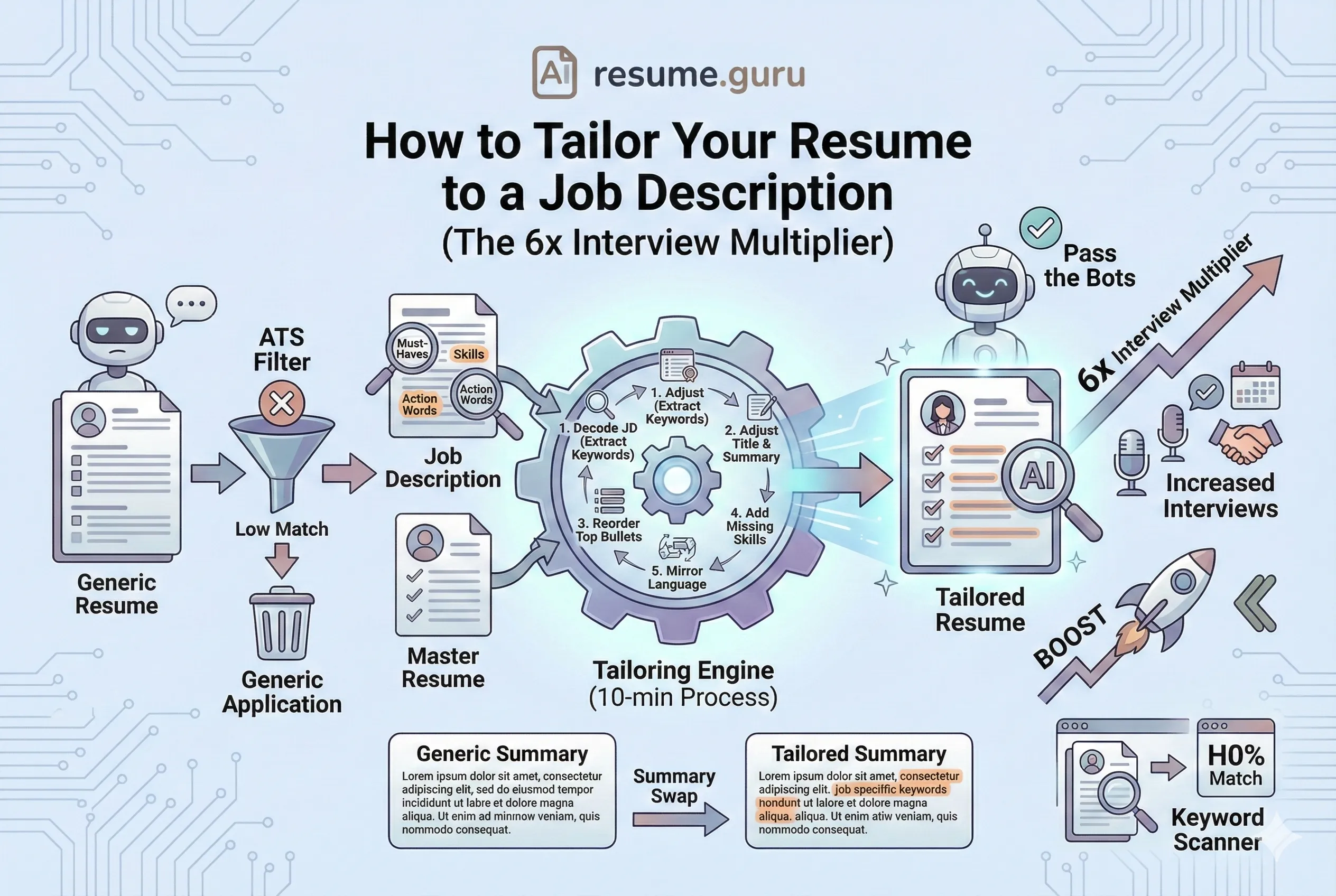
How to Tailor Your Resume to a Job Description: A Practical Workflow
Match a job description to your actual experience, choose relevant evidence and customize your summary, skills and bullets without starting over.
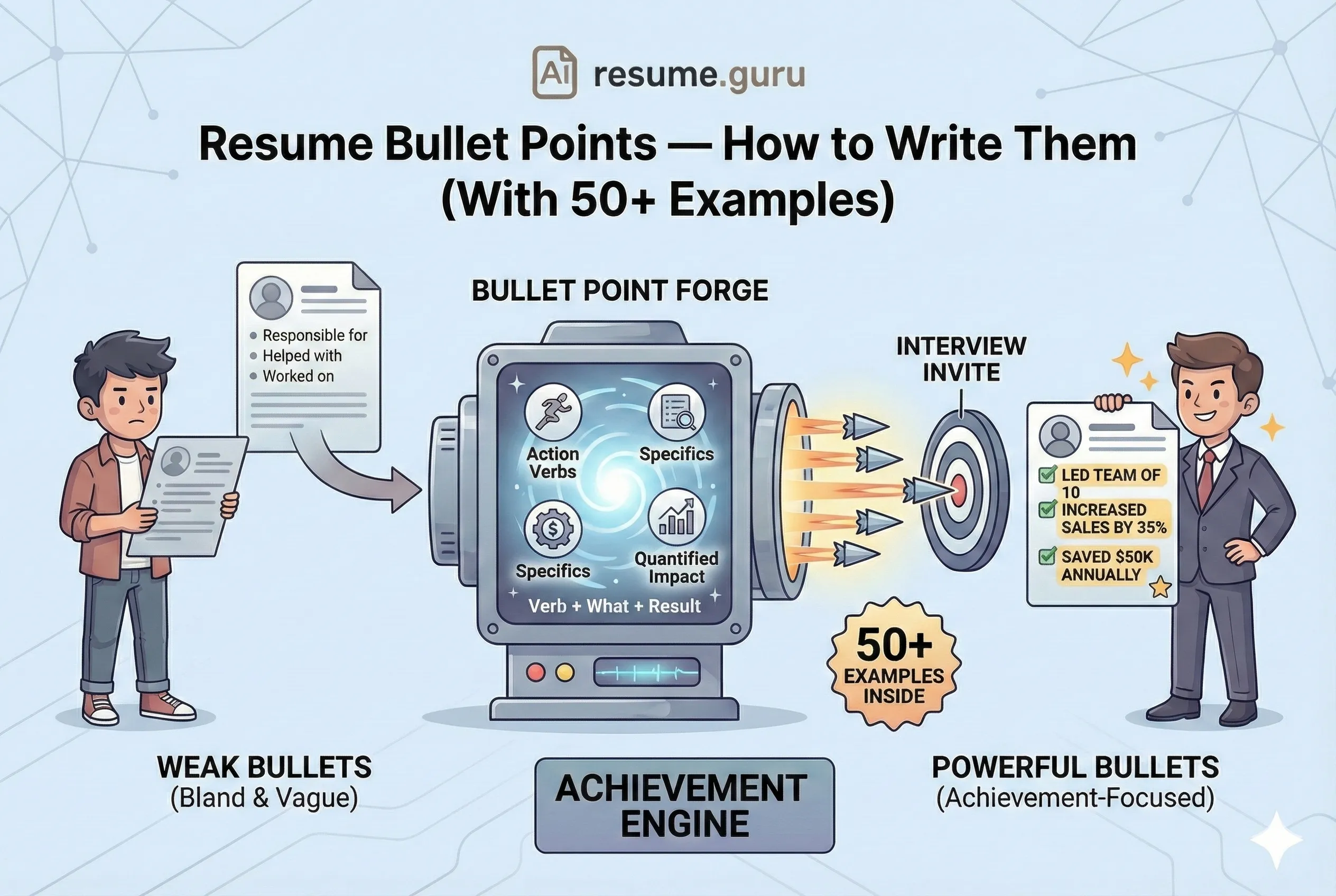
Resume Bullet Points: How to Write Them With 50 Examples
Turn your responsibilities into specific resume bullets. Use 50 role examples, same-facts rewrites and practical ways to show contribution without inventing numbers.
Software Engineer Resume Examples 2026 — Templates & Guide
Stop guessing what recruiters want. See the exact software engineer resume templates, skills, and formats landing interviews at FAANG and startups in 2026.