Amazon interview practice
Amazon interview preparation: stories for all 16 Leadership Principles
Build a bank of stories that covers every principle, including the failure and the argument you lost, then rehearse until no follow-up question can catch you out.
Practice for my Amazon interviewFree account, no card. Paste your Amazon posting, choose a behavioral round and answer questions built from your resume.
The short version
Amazon evaluates every candidate through its 16 Leadership Principles, and its role guides say each interviewer typically asks two or three behavioral questions. Prepare about eight real stories that cover the principles, including a failure, a disagreement and a trade-off. Structure them with STAR, say “I” rather than “we”, support results with data and be ready to explain why you decided as you did. Then add your role’s extras, such as coding, system design or a writing sample.
What you will have by the end
- All 16 Leadership Principles mapped to your own evidence
- Eight stories, including a failure and a disagreement
- Answers to the follow-ups behind each story
On this page
Step 1 of 7
Know what your interview loop will test
Amazon’s interview loop is a series of one-to-one conversations. You will likely meet two to seven people for 45 minutes to an hour each, including managers, teammates, stakeholders and possibly a Bar Raiser, someone from another team who is focused on hiring quality. Each person assesses different things, but Amazon says you don’t need to tailor your answers to their role. If they’re typing while you talk, they’re taking notes for the team.
What comes before and alongside those conversations depends on your role. Use this table to set your plan, then check your recruiter’s instructions.
| Role | Before the loop | In the loop |
|---|---|---|
| SDE II | Online assessment: two coding questions in 90 minutes, 20 minutes of system design scenarios and an 8-minute work style survey | Four 55-minute interviews. Expect at least one system design question and syntactically correct code, with no pseudocode |
| SDE III | 60-minute technical phone screen: half Leadership Principles, half coding and system design | Five 55-minute interviews with members of the software development community |
| Product manager | 60-minute phone screen with a senior leader: half behavioral, half functional. Writing assessment two days before the loop | Five 55-minute interviews covering product and stakeholder management. Your writing sample may come up |
| Program manager | 60-minute phone screen: half behavioral, half program and project experience. Writing assessment two days before the loop | Five 55-minute interviews covering program and stakeholder management |
| Technical program manager | 60-minute technical phone screen, then a writing assessment two days before the loop | Five 55-minute interviews with the technical program management community |
| Business intelligence engineer | Online assessment, then one or two 60-minute technical phone screens. Some candidates go straight to the loop | Five 55-minute interviews with the business intelligence community |
From Amazon: Interview loop and STAR guidance · SDE II preparation · SDE III preparation · Product manager preparation · Program manager preparation · TPM preparation · BIE preparation
Step 2 of 7
Map all 16 Leadership Principles to your experience
Amazon says one of the best ways to prepare is to reflect on how you have shown these principles in your past work, and its PM guide adds that there’s no need to memorize them. Work through this table with your own experience in mind. Each row turns a principle into what a good story proves, plus a question to practice with. We wrote these questions from Amazon’s published principles to test your stories.
| Leadership Principle | What your story should prove | Practice question |
|---|---|---|
| Customer Obsession | You started from a customer need and worked backwards, even when something else was competing for attention. | When did customer evidence change what you built or prioritized? |
| Ownership | You acted beyond your own team and protected long-term value over a quick win. | Tell me about a problem outside your job that you carried through to a fix. |
| Invent and Simplify | You found a simpler way, or borrowed a good idea from elsewhere, and stuck with it even when others doubted it. | What did you make simpler, and what did you remove to do it? |
| Are Right, A Lot | You sought other perspectives and tried to prove yourself wrong before deciding. | When did you look for evidence against your own view, and what did you find? |
| Learn and Be Curious | You went looking for something new and put it to use. | What did you teach yourself recently because the work needed it? |
| Hire and Develop the Best | You raised the bar through hiring or coaching, and helped people grow. | Who did you coach, and what could they do afterwards that they couldn’t before? |
| Insist on the Highest Standards | You stopped a defect going down the line and fixed the problem so it stayed fixed. | When did you refuse to accept “good enough”, and what did it cost you? |
| Think Big | You set a bold direction that others could rally behind. | When did you propose something far larger than what you were asked for? |
| Bias for Action | You moved quickly on a reversible decision and took a calculated risk. | When did you act without all the information, and how did you limit the risk? |
| Frugality | You did more with less, and the constraint improved the solution. | What constraint pushed you to a better answer than more budget would have? |
| Earn Trust | You listened, spoke candidly and were openly critical of your own work. | When did you tell people your own work had a problem? |
| Dive Deep | You stayed close to the details and investigated when the metrics and the anecdotes disagreed. | When did a number and what people were telling you not match? What did you find? |
| Have Backbone; Disagree and Commit | You challenged a decision respectfully, then committed fully once it was made. | Tell me about a decision you argued against and then helped succeed. |
| Deliver Results | You focused on the key inputs and came through despite a setback. | What setback threatened a commitment, and what did you change to deliver? |
| Strive to be Earth’s Best Employer | You made work safer or better, and helped people grow and feel empowered. | What did you change that made work safer, fairer or better for your team? |
| Success and Scale Bring Broad Responsibility | You thought about the secondary effects of your work and left things better than you found them. | When did you change a plan because of its effect on people beyond your immediate customer? |
From Amazon: Leadership Principles · Interview loop and STAR guidance · Product manager preparation
Step 3 of 7
Build eight stories that cover the whole table
Start with about eight substantial stories and use the table below to check your range. Choose projects with different customers, constraints and outcomes, including work that failed and a decision you challenged. One story may demonstrate several principles; practice the relevant part rather than delivering the same script for every question. Add another example wherever your evidence is weak.
Amazon asks for range too: examples of times you took risks, succeeded, failed and grew. Use recent work where you can. If you are early in your career, Amazon’s STAR guidance explicitly includes studying and volunteering, so class projects, internships and volunteer work all count.
| Story to prepare | Principles it can support | Details to have ready |
|---|---|---|
| A customer problem you found and solved | Customer Obsession, Dive Deep, Invent and Simplify | How you spotted it, what customers said and what you measured afterwards |
| A problem outside your job that you took on | Ownership, Earn Trust, Deliver Results | Who officially owned it, why you stepped in and what is different now |
| A failure or missed goal | Earn Trust, Learn and Be Curious, Deliver Results | Your specific mistake, when you told people and what you do differently now |
| A decision you challenged | Have Backbone; Disagree and Commit, Earn Trust | Your position and evidence, who decided and what you did once they had |
| A trade-off under time pressure | Bias for Action, Insist on the Highest Standards | The options you rejected, what could be reversed and how you contained the risk |
| An investigation that surprised you | Dive Deep, Are Right, A Lot | What you first assumed, what proved you wrong and what you did next |
| Something you simplified or did with less | Invent and Simplify, Frugality, Think Big | What you removed, what it saved and who else adopted it |
| Someone you developed or a workplace you improved | Hire and Develop the Best, Earth’s Best Employer | Where the person or team started, what you did and what changed |
Keep reading
- Practice more behavioral questions by theme →
Expand your story bank with structured questions and worked STAR answers.
From Amazon: Interview loop and STAR guidance · Phone screening · SDE II preparation
Step 4 of 7
Use STAR without sounding rehearsed
Amazon asks for a complete story: the context, what you were trying to accomplish, what you specifically did and how it turned out. STAR is one way to organize that, and Amazon says it’s not the only one. It also says it doesn’t expect perfect answers or rehearsed scripts, and that the interviewer’s job is to help draw out the details. Know your story well enough to tell it in a natural way.
Keep the setup short, because your decisions are what people want to hear. Use one situation per question, and when you finish, try Amazon’s own tip: pause and ask whether your interviewer would like more context.
Situation
one or two sentences of background, enough to show why it was interesting or difficult.
Task
your goal and what you were personally responsible for.
Action
most of your answer. Walk through your steps and your reasoning, saying “I” rather than “we”.
Result
what happened and what you learned, with numbers if you have them. Amazon’s advice is not to be shy.
The same answer, before and after
Before
We were getting a lot of support tickets about setup, so the team redesigned the onboarding guide. It went really well and customers were much happier.
After
Customers kept contacting support after setup, and I wanted to know why. I reviewed three months of tickets, found that four steps caused most of the confusion and rewrote the guide with a support colleague. I had someone new to the product test it before launch. Setup contacts fell by 28% the next quarter, and support adopted it as the standard. I also learned to test instructions with someone new, because I had missed two of those steps myself.
Make it yours: Compare the two. The stronger version has a person in it, a reason for each step, a number and a lesson. Check your own stories for the same four things.
Keep reading
- Turn a STAR story into a resume bullet →
Connect the full interview story to the concise achievement in your application.
From Amazon: Interview loop and STAR guidance
Step 5 of 7
Worked answers: stories that went well
Here are four complete answers across different roles. Each is fictional and shows the depth to aim for, along with the follow-ups to prepare and how the same story would look on a resume. Amazon’s guides say the focus is on the what and the how of your experience, as well as the why of your decisions, so that’s what the follow-ups probe. They are ours, written as realistic practice.
Software engineer: when the dashboard and customers disagreed
Dive DeepCustomer Obsession-
Situation
Our payment dashboard showed 99.4% success, yet support kept hearing from mobile customers whose payments had failed.
-
Task
I owned the payments service on call, and I wanted to find out which picture was true.
-
Action
I compared 200 support tickets against our request logs and found that the dashboard missed sessions where the app timed out before reaching us. I added client-side timeout events to the metric, which put true mobile success at 96.8%. Most failures traced back to a three-second client timeout, which was shorter than our slowest bank’s response time. I raised it, added a clear “still processing” state and tested both on slow networks.
-
Result
Mobile payment success reached 99.1% within four weeks, payment contacts fell by about a third and the corrected metric became our launch check. I now compare dashboards against raw customer reports before I trust them.
Follow-ups to prepare
Try each one out loud, then open it for what to cover.
-
Why did you trust the tickets over the dashboard?
Explain that you trusted neither at first. Amazon’s Dive Deep principle is about being skeptical when metrics and anecdotes differ, so show how you tested both.
-
Why not simply raise the timeout and move on?
Show the trade-off you weighed. A longer wait without feedback could make customers retry and pay twice, which is why the status message mattered.
-
What would you do differently?
Offer something real, such as instrumenting the client when the service first launched, so the blind spot would never have existed.
The same story on a resume
Found a blind spot in payment reporting by reconciling 200 support tickets with request logs; fixed client timeouts and lifted mobile payment success from 96.8% to 99.1%.
Make it yours: Use any story where the first number you saw turned out to be wrong. Know your sample size and how you reached your conclusion.
Product manager: simplifying setup for small sellers
Customer ObsessionInvent and Simplify-
Situation
Only 41% of new small sellers finished setting up their store, and sales wanted more features to win them over.
-
Task
I owned activation for this segment and needed to decide what to build next.
-
Action
I sat in on 20 onboarding calls and analyzed where sellers dropped off. Most were stuck on tax and shipping forms they couldn’t complete on day one. I wrote a one-page proposal to move those steps until a seller’s first order, reducing setup from eleven steps to five, and I made the case to legal and finance by showing nothing required was being dropped.
-
Result
Activation rose to 58% in two quarters with no new features, and first-order rates rose with it. The team adopted the rule that any new setup step needs customer evidence behind it.
Follow-ups to prepare
Try each one out loud, then open it for what to cover.
-
Sales wanted features. How did you handle that?
Share the data that changed the conversation and say what you did for sales afterwards. This also shows Earn Trust.
-
How did you know the forms were the cause?
Connect what you heard on calls to the drop-off data. Neither source would have been enough by itself.
-
What was the risk of moving those steps?
Name the risk, such as a compliance gap at first sale, and describe how you tested and guarded against it.
The same story on a resume
Raised small-seller activation from 41% to 58% by cutting setup from eleven steps to five, using 20 onboarding calls and funnel analysis to prioritize over new features.
Make it yours: Bring a story where customer evidence changed the plan. Show who you had to convince and how you did it.
Operations manager: fixing a problem so it stayed fixed
Insist on the Highest StandardsOwnership-
Situation
Mislabeled pallets were reaching outbound about 40 times a week, and each shift blamed the other.
-
Task
I ran the day shift, but the fix needed both shifts, so I took on the whole problem.
-
Action
I spent a week on the floor at changeover and tracked each error to its source. Most came from pallets moved mid-count with no clear owner. With the night shift lead, I built a one-page handoff checklist and had associates help test it, then changed the rule so that nothing moved without a signed count. Some leads worried it would slow us down, so I reviewed rates with them daily for the first two weeks.
-
Result
Mislabeled pallets fell to about six a week within a month, and rates held steady. The other building adopted the checklist, and I still audit it monthly.
Follow-ups to prepare
Try each one out loud, then open it for what to cover.
-
The night shift wasn’t yours. Why take this on?
Connect to Ownership: customers didn’t care which shift caused the error. Be clear about how you worked with the other lead without going around them.
-
What happened when people pushed back?
Give a real objection and how you tested it with data, so you don’t come across as someone who simply overruled them.
-
How did you know it would last?
Amazon’s standard is problems fixed so they stay fixed. Explain what you audit and who now owns it.
The same story on a resume
Reduced mislabeled pallets from about 40 a week to 6 by tracing errors to changeover and introducing a signed handoff count across two shifts; adopted by a second building.
Make it yours: Pick a recurring problem you solved at its source. Show what you changed in the system, as well as what you did that week.
Early career: answering a question nobody had time for
Learn and Be CuriousOwnership-
Situation
During my internship on a marketplace team, a vendor manager asked why returns from one category had risen, but no analyst had time to look.
-
Task
My assigned project was something else, but I offered to find out in my own time if someone could point me to the data.
-
Action
I hadn’t used SQL beyond a class, so I worked through our data documentation and asked an analyst to check my first queries. The analyst caught a double-counting error, which taught me to validate totals against a known report. I then broke returns down by vendor and reason and found that one product’s size chart caused most of the increase.
-
Result
My manager shared the analysis with the regional team, the vendor corrected the chart and returns for that product dropped by about a fifth over the next two months. I documented my queries so analysts could rerun them.
Follow-ups to prepare
Try each one out loud, then open it for what to cover.
-
How did you fit this around your main project?
Be specific about how you managed your time and confirmed your main work stayed on track. Ownership shouldn’t mean dropping commitments.
-
What did that double-counting error teach you?
This is a good moment to be openly self-critical. Say what you got wrong and how you check your work now.
The same story on a resume
Taught myself SQL during an internship to trace a category’s returns to one product’s size chart; the vendor’s fix reduced that product’s returns by about a fifth.
Make it yours: Small scope is fine. Show curiosity, what you did by yourself and where you asked for help.
From Amazon: SDE II preparation · Product manager preparation · Leadership Principles
Now test one of your own stories
Paste your Amazon posting and pick a behavioral round. Your AI interviewer asks about your resume, digs into your answers and coaches you on each one.
Step 6 of 7
Worked answers: the failure, the disagreement and the trade-off
These are the stories most people under-prepare, and they’re where you can really stand out. Amazon says not every story has to be a success, because failure is part of innovation and what matters is what you learned. Its guides also ask for examples of how you took responsibility for mistakes, and tell you not to finger-point or shift blame. It’s fine to be self-critical. An answer with a real mistake in it is far more convincing than a polished one.
The failure: a migration I rushed
Earn TrustLearn and Be Curious-
Situation
I was leading a database migration for our customer accounts service, with a deadline tied to a vendor contract ending.
-
Task
I owned the plan and the production run.
-
Action
To save a day, I skipped the rehearsal on production-sized data. During the run, the migration locked a table for 40 minutes and about 1,200 customers saw errors. I stopped it, rolled back and told my manager and support within ten minutes, saying plainly that skipping the rehearsal had been my call. I contacted the vendor about a short extension, then ran a full rehearsal that exposed the locking problem and rewrote the job to run in small batches.
-
Result
The second run finished with no customer impact, three days past our target but within the extended contract. I wrote the review with my own decision as the root cause and added a required rehearsal step for every migration. The team’s next three migrations ran without incident.
Follow-ups to prepare
Try each one out loud, then open it for what to cover.
-
Why did you skip the rehearsal?
Give the real reason, deadline pressure, without using it as an excuse. Say what you should have weighed at that moment.
-
How did people react when you told them?
Be honest about the discomfort. Amazon’s Earn Trust principle says leaders are vocally self-critical, even when it’s awkward or embarrassing.
-
How do you make that kind of call now?
Point to the mechanism you added and a later decision where you chose differently. That’s your proof of growth.
The same story on a resume
Rewrote a failed account migration to run in small batches after a rollback; completed it with no customer impact and added a rehearsal step used for later migrations.
Make it yours: Pick a failure that genuinely mattered and was genuinely yours. Say exactly what you did wrong before you say what you fixed.
The disagreement: arguing for a staged launch, then backing the decision
Have Backbone; Disagree and CommitEarn Trust-
Situation
We were launching a new checkout in six markets ahead of the holiday season.
-
Task
As product manager, I had to recommend a rollout plan.
-
Action
I recommended starting with two markets, because our payment testing in the others was thin. My director preferred launching everywhere to catch peak sales. I shared my data, the failures we might see and a compromise, and we talked it through. My director heard me out and chose all six, because missing peak would cost more than a contained failure. I told my team that this was now our plan and that I was behind it. Then I put my energy into making it work, building a market-by-market rollback plan and staffing a launch-day review.
-
Result
We launched on time and caught peak. One market hit a local payment gap and rolled back for two days using that plan, then recovered. Looking back, I was right about the risk and my director was right about the cost of waiting.
Follow-ups to prepare
Try each one out loud, then open it for what to cover.
-
How exactly did you disagree?
Describe your evidence and how you raised it directly. Amazon’s principle asks for respectful challenge, even when that’s uncomfortable.
-
Did you hold anything back after the decision?
Your answer should be no, with proof. Show how you spoke about the plan to your team and where you spent your effort.
-
What if the launch had gone perfectly?
Say that would have been fine. You committed because the decision had been made, not because you expected to be proved right.
The same story on a resume
Delivered a six-market checkout launch ahead of peak with a market-by-market rollback plan that contained one local payment failure to two days.
Make it yours: Choose a story where you lost the argument and still helped the outcome. Stories that end with “and I was proved right” tend to miss the commit half.
The trade-off: shipping for a partner without lowering the bar
Bias for ActionInsist on the Highest Standards-
Situation
A partner launch date was fixed by a contract, and two weeks out our new pricing service still had gaps in its test coverage.
-
Task
I led the work and had to decide whether to ask for a delay.
-
Action
I split the work by what could be undone. The pricing logic could sit behind a flag and be switched off instantly, but one database change couldn’t be reversed, so I left it out by designing around it for now. I proposed launching to the partner’s traffic only at 5%, with automated alerts and a person watching the first three days. I wrote down the remaining test gaps with a date to close them and shared that with my manager and the partner team.
-
Result
We met the date. The 5% rollout caught two pricing bugs before most customers could see them, and we reached full traffic two weeks later. We closed the test gaps and shipped the database change the following month.
Follow-ups to prepare
Try each one out loud, then open it for what to cover.
-
What would have made you ask for a delay?
State your red line clearly. Here, anything that couldn’t be switched off quickly or could charge customers incorrectly at scale.
-
Isn’t launching with test gaps lowering the bar?
Explain how you protected customers through limited traffic and alerts, and show you followed through on the gaps you promised to close.
-
Who else did you involve in the decision?
Show that the risk was visible to the people who owned it. Being fast doesn’t mean deciding alone.
The same story on a resume
Met a contractual partner launch by releasing a new pricing service behind a flag to 5% of traffic; caught two pricing bugs early and reached full traffic in two weeks.
Make it yours: Use Amazon’s own distinction: many decisions are reversible and don’t need extensive study. Show that you knew which of yours were and which weren’t.
From Amazon: Interview loop and STAR guidance · Leadership Principles · Product manager preparation
Step 7 of 7
Prepare for everything beyond the stories
Your stories will carry most of the conversation, but these moments are easy to prepare for and easy to fumble if you don’t. Each one below comes from Amazon’s published guidance.
Why Amazon?
Amazon calls this a common question. Be specific about the role and team, and connect them to work you actually enjoy doing.
Writing sample
Amazon uses one-to-six-page narrative memos instead of slide decks. PM prompts may ask about your most innovative project or how you simplified customers’ lives, and interviewers may discuss your sample.
Coding
for SDE roles, expect syntactically correct code in an online editor. Ask clarifying questions, think out loud and be ready to discuss time and space complexity.
System design
clarify requirements and treat your interviewer as a customer. Compare your options, justify your choice and cover scale, operations and failure points.
Your questions
Amazon tries to leave a few minutes at the end of each interview for them. Ask each interviewer something real about the team, its customers or how success is measured.
Remote setup
interviews run on Zoom or Amazon Chime. Test the platform beforehand, use a headset and don’t worry if a second Amazonian is there to shadow.
On-site
arrive 15 minutes early with a government-issued photo ID. Comfortable, casual clothes are fine, unless your role is in a fulfillment center, where safety rules may apply.
Afterwards
expect to hear back within five business days, and check in with your recruiter if you haven’t.
“Why Amazon?”: product role answer
Before
Amazon is a great company with a huge scale and a fantastic culture, and I’ve always admired its Leadership Principles.
After
I do my best work when I’m close to customers and working from data. On this team you’re working on seller onboarding, which is what I’ve spent the past three years improving for small businesses. I’d like to try that at far greater scale, and I’m interested in how written narratives shape your decisions. I’d enjoy working in a place where the thinking gets written down.
Make it yours: Replace the compliments with three true things: what you like doing, why this team and what you want to learn here.
From Amazon: Interview loop and STAR guidance · SDE II preparation · Product manager preparation
Amazon interview FAQs
How many Leadership Principles does Amazon have?
Amazon publishes 16: Customer Obsession; Ownership; Invent and Simplify; Are Right, A Lot; Learn and Be Curious; Hire and Develop the Best; Insist on the Highest Standards; Think Big; Bias for Action; Frugality; Earn Trust; Dive Deep; Have Backbone; Disagree and Commit; Deliver Results; Strive to be Earth’s Best Employer; and Success and Scale Bring Broad Responsibility.
How many stories should I prepare for an Amazon interview?
About eight is a good target. Amazon’s role guides say each interviewer typically asks two or three behavioral questions, so a four-interview loop could include around 8 to 12. One strong story can support two or three principles, so eight varied stories give you plenty of range.
Do I have to use the STAR method at Amazon?
No. Amazon says STAR is one way to structure your answers, but not the only way. It asks for a complete story: the context, what you were trying to do, what you did and how it turned out. STAR is a reliable way to get all four in, as long as your answer stays natural.
What is a Bar Raiser at Amazon?
Amazon describes a Bar Raiser as someone from another team who is focused on hiring quality, and says one may be among your interviewers. You don’t need a special approach. Amazon advises treating each interviewer the same, so prepare your stories well and answer honestly.
Should I memorize answers for each Leadership Principle?
No. Amazon’s PM guide says there’s no need to memorize the principles, and it says it doesn’t expect rehearsed scripts. Know the key facts, decisions and results of each story, then practice telling it naturally. That also makes it easier to handle follow-up questions.
Should I talk about a failure in my Amazon interview?
Yes. Amazon’s sample questions ask about times you took a risk, made a mistake or failed, and it says not every story has to be a success. Pick a real mistake of your own, say what you did wrong, then explain how you recovered and what you do differently now.
Can AI ResumeGuru help me practice for an Amazon interview?
Yes. Create a free account, add your resume and paste your Amazon posting to practice with an AI interviewer. You get questions based on your experience, coaching on each answer and a scorecard. The practice is based on your materials and isn’t an official Amazon test.
Your next step
Rehearse the follow-ups before Amazon asks them
Reading a good answer isn’t the same as giving one. Practice in AI ResumeGuru with your resume and your Amazon posting, so the questions come from your own experience and the job you want. Your AI interviewer asks one question at a time, digs into what you say and coaches you on each answer. At the end, your scorecard shows you what to fix before the real thing.
A good sequence is below. Free accounts include practice sessions every month, and Pro has no monthly limit. Sessions are typed for now, so answer the way you would speak, then say your best answers out loud.
First round
choose Behavioral drill and run your eight stories. Note every follow-up you struggled with.
Second round
with your posting attached, choose Gap attack for questions on what your resume barely shows.
Final round
turn on Strict mode, which saves all feedback for the final report, just as a real interview would.
Put the guidance into a complete application
Continue your preparation
Related Skills Guides
Software engineering skills backed by projects
Choose relevant technical skills and connect them to delivered work.
Product management skills to demonstrate
Find product skills that you can support with decisions and outcomes.
Operations management examples
For management roles, select evidence of process, quality and team leadership.
Related Articles
Behavioral Interview Questions: 22 Examples + STAR Answers
“Tell me about a time when…” Here are 22 common behavioral interview questions by theme, the STAR method for answering them out loud, and full example answers you can model.
STAR Method Resume: How to Write Bullets That Get Interviews
The STAR method is the thinking framework behind every strong resume bullet, but you don't write the full story on a resume. Here's how to compress STAR into results-first bullets, with the STAR vs. XYZ vs. CAR vs. PAR breakdown and 8 before/after examples.
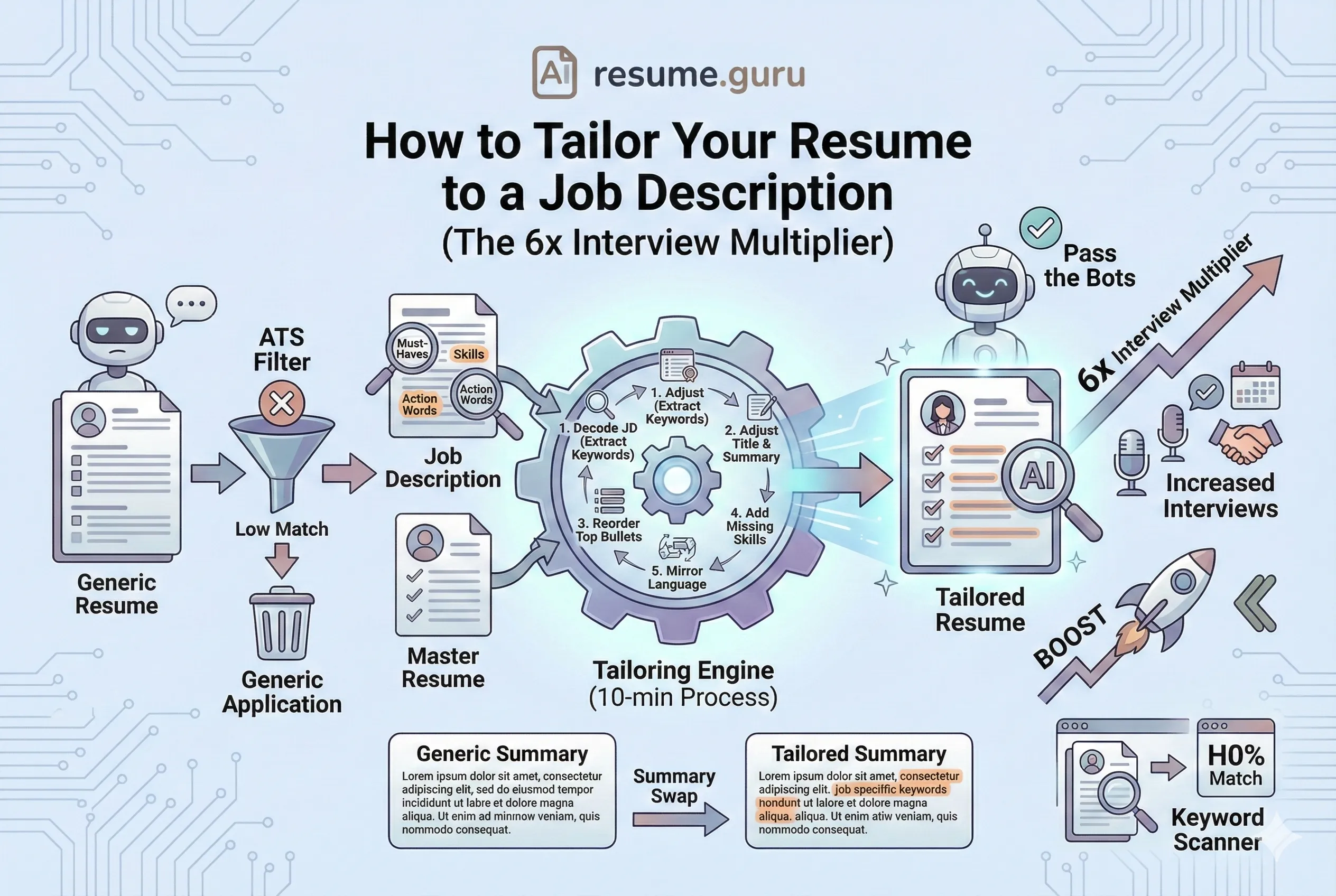
How to Tailor Your Resume to a Job Description: A Practical Workflow
Match a job description to your actual experience, choose relevant evidence and customize your summary, skills and bullets without starting over.