You’ve heard of the STAR method. You probably picked it up from interview-prep advice, the classic “tell me about a time when…” So when someone says “use STAR on your resume,” there’s a fair question hiding underneath:
Do I write the whole STAR story on my resume, or not?
Short answer: no. And understanding why is the key to writing bullets that actually get read.
The STAR method on a resume is a thinking framework, not a sentence template. STAR (Situation, Task, Action, Result) is how you plan a strong accomplishment, but a resume isn’t the place to narrate all four parts. Recruiters scan in seconds, so on a resume STAR collapses into a tight, results-first bullet. This guide shows you exactly how to make that move, how STAR compares to the XYZ, CAR, and PAR formulas, the common STAR mistakes to avoid, and 8 before/after examples.
The Short Version
- STAR = Situation, Task, Action, Result, the framework for thinking through an accomplishment.
- On a resume, compress STAR into one bullet: lead with the action, end with the result.
- That compression is basically the XYZ formula (“Accomplished X, by doing Z, measured by Y”).
- Save the full STAR story for interviews and cover letters.
What STAR Stands For
Each letter has a job, and the Action is where verb choice does the heavy lifting — browse resume action verbs if yours are repeating.
- Situation: the context or challenge you faced.
- Task: your specific responsibility or goal in it.
- Action: what you did about it.
- Result: the measurable outcome.
In an interview, you’d narrate all four. On a resume, you keep the Action and Result front and center and let the Situation and Task be implied. That single shift, from describing duties to describing results, is what separates a bullet that gets skimmed from one that gets you the call. It’s the same move at the heart of writing achievements instead of responsibilities.
STAR vs. XYZ vs. CAR vs. PAR: One Idea, Four Names
People get tangled in the acronyms. They are not competing systems. They are four ways to package the same logic, with different amounts of context baked in. Here’s the map:
| Framework | Stands For | Best For |
|---|---|---|
| STAR | Situation, Task, Action, Result | Interviews, cover letters, full storytelling |
| CAR | Challenge, Action, Result | Resume bullets (a tighter STAR) |
| PAR | Problem, Action, Result | Resume bullets, problem-to-impact framing |
| XYZ | Accomplished X, measured by Y, by doing Z | Resume bullets, results-first scanning |
CAR is just STAR with Situation and Task merged into one “Challenge.” And XYZ, popularized by Laszlo Bock, Google’s former head of People Operations, in Work Rules! (2015), is the most resume-native because it front-loads the result.
The point: on a resume, all four collapse toward the same thing, a strong verb plus what you did plus a quantified result.
What is the PAR method, and how is it different from STAR?
PAR stands for Problem, Action, Result. It is the closest sibling to CAR: both fold STAR’s Situation and Task into a single opening idea, then move straight to what you did and what happened. The only real difference is framing. PAR leads with a problem (something was broken, slow, or costly), which works well when your impact came from fixing something specific.
So when do you reach for PAR over STAR? Use PAR thinking when the accomplishment is fundamentally a fix: “Resolved a 30% checkout drop-off by rebuilding the payment flow, recovering ~$120K in monthly revenue.” Use full STAR when you are telling the story out loud, in an interview or a cover letter, where the listener wants the context. On the page, PAR and STAR produce an identical-looking bullet.
Don't compress by hand if you don't want to
Picking a framework is the easy part. Turning a duty into a tight, results-first line is where most people stall. Our free Bullet Generator takes a plain description of what you did and rewrites it into a STAR-shaped, results-first bullet, so you can compare frameworks on real wording instead of in the abstract.
How to Compress STAR Into a Resume Bullet
Watch a full STAR story become a single bullet:
Full STAR (great for an interview, too long for a resume)
“When our support queue was overwhelmed (Situation), I was asked to reduce response times (Task). I built a triage ticketing system and retrained the team (Action), which cut average response time by 20% (Result).”
Compressed resume bullet (XYZ order)
“Cut average support response time 20% by designing a new ticket-triage system and retraining a 6-person team.”
Same accomplishment. The resume version implies the Situation and Task, leads with the Result, and fits in one line.
Reserve the long version for your best stories
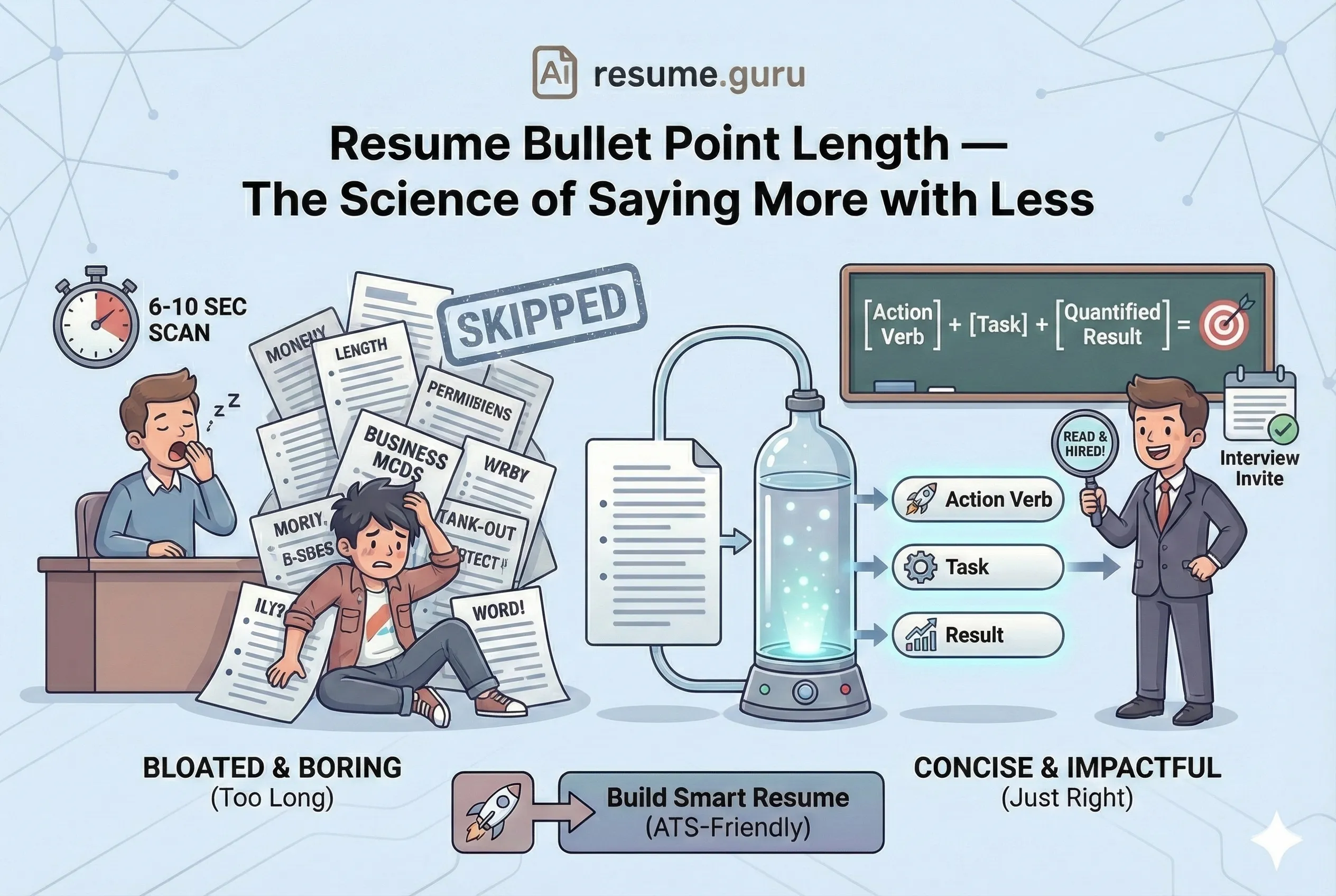
Recruiters spend about 7.4 seconds on an initial resume scan (Ladders eye-tracking study, 2018). Give your top two or three career achievements a little more room; keep everything else to single, tight bullets.
Turn a Duty Into a STAR Bullet (Step by Step)
- 1
Write the plain duty first
Start where most resumes stop. e.g., 'Responsible for managing social media accounts.'
- 2
Find the Situation/Task, why it mattered
Engagement was flat; the goal was to grow inbound leads. You don't write this on the resume, but it shapes the bullet.
- 3
Pin down your Action with a strong verb
What did YOU do? 'Built and executed a 3-channel content calendar.' Pull from our action verbs and power words guides.
- 4
Quantify the Result
Numbers, %, time, money, or scale. 'Grew engagement 38% in 6 months.' See our quantify-achievements guide.
- 5
Assemble it results-forward
Lead with the verb, end with the metric: 'Grew Instagram engagement 38% in 6 months by launching a 3-channel content calendar.'
- 6
Cut the filler
Delete 'responsible for,' 'duties included,' and weak verbs. Make sure the result is visible at a glance.
Speed it up
Our free Bullet Generator turns a plain description of what you did into a results-driven bullet automatically. Describe the task; it handles the verb and structure. Pair it with our action verbs for resumes and power words lists for Step 3.
8 Before/After Examples (by Role)
Here’s the compression in action across roles, from customer service and sales to project management and engineering. Use your own honest numbers, and approximate with ”~” if you’re unsure.
| Before ❌ | After ✅ (STAR compressed) |
|---|---|
| Managed company social media accounts | Grew Instagram engagement 38% in 6 months by launching a 3-channel content calendar |
| Worked on backend performance | Reduced API p95 latency from 800ms to 210ms by rewriting the caching layer, supporting 3x traffic |
| Handled customer tickets | Cut average first-response time 20% by designing a ticket-triage workflow for a 6-person team |
| Responsible for hitting sales targets | Exceeded annual quota by 127% ($1.4M closed) by building a referral pipeline of 40+ leads per quarter |
| Managed software projects | Delivered a 5-person Agile project 2 weeks early and 8% under budget by restructuring sprint planning |
| Prepared financial reports | Built quarterly C-suite reports that flagged a $250K margin leak, prompting a 6% COGS saving |
| Improved onboarding process | Raised 90-day new-hire retention 18% by redesigning onboarding into a structured 30-day plan |
| Managed store inventory | Reduced out-of-stock incidents 30% by implementing automated stock tracking and renegotiating vendor lead times |
Notice the pattern in every “after”: action verb, then what you did, then a measurable result. That’s STAR, compressed. The role changes; the shape doesn’t.
Common STAR Method Mistakes (and How to Fix Them)
Most STAR bullets fail in the same handful of ways. The full four-part version still belongs in the room, so practice interview answers with the stories you trimmed out of the resume. Recruiters and resume writers cite these constantly, so a quick pass against this list catches the majority of weak lines.
Do this
- Lead with the Action and Result; imply the Situation
- Quantify with a number, scope, or concrete outcome
- Reserve full STAR stories for two to four standout bullets
- Keep each bullet to one or two lines
- Use a distinct strong verb to open each bullet
Avoid this
- Spending half the bullet narrating the Situation
- Stopping at the Action with no Result attached
- Writing a paragraph instead of a scannable line
- Forcing a full STAR story onto every single bullet
- Repeating 'Managed' or 'Responsible for' down the page
The biggest offender is too much Situation. People front-load context (“In a fast-paced environment where the team faced…”) and bury the result at the end where a six-second scan never reaches it. Flip it. Lead with the outcome.
The second is no metrics. A bullet that ends “…which improved the process” is just a duty wearing a costume. If you have no hard number, use scope or a concrete outcome instead (more on that below).
Don't STAR every bullet
A resume where every line is a full results story reads as exhausting and slightly unbelievable. Use STAR-shaped bullets for your strongest two to four points per role, then let routine duties stay short. Contrast is what makes the big wins pop.
How Many Resume Bullets Should Use the STAR Method?
Not all of them. The goal is a results-first resume, not a wall of metrics. A practical split: under each recent role, make your top two to four bullets fully STAR-shaped with a clear result, and let the remaining lines stay short and factual. Older or less relevant roles can run leaner still.
This mirrors how recruiters read. They scan for proof of impact, find it in your strongest bullets, and use the shorter lines for scope and context. For role-by-role guidance on how many bullets to list and how to order them, see our guide to writing the work experience section.
STAR Method for Cover Letters
The cover letter is where the full STAR story belongs. You have room for narrative there, so don’t compress it. Pick one accomplishment that maps directly to the job, then walk through all four parts in two or three sentences: the situation you faced, the task you owned, the action you took, and the result you delivered.
The resume gives the recruiter the headline (“Cut support response time 20%”); the cover letter gives them the story behind it. Used together, they reinforce the same win without repeating the same words.
This is also why STAR feels so familiar from interview prep. The exact same four-part structure powers strong answers to “tell me about a time when…” questions. If you’ve drafted STAR bullets for your resume, you’ve effectively pre-written your interview stories. Our guide to behavioral interview questions and the STAR method shows how to expand a compressed bullet back into a full spoken answer.
What If You Don’t Have Numbers?
Not every accomplishment has a clean metric, and that’s fine. This is also the answer for using STAR with no work experience: scope and outcome do the heavy lifting.
- Scope: team size, number of clients, frequency, volume (“Trained 12 new hires,” “Processed 200+ orders weekly”).
- Outcome: a clear result even without a percentage (“Reduced customer complaints,” “Adopted company-wide,” “Eliminated a recurring error”).
For students and career starters, apply STAR thinking to coursework, internships, volunteer roles, clubs, and side projects. “Organized a campus event for 200 attendees, raising $3,000 for charity” is a STAR-shaped bullet with no paid job behind it. A specific non-numeric result still beats a vague duty. For the full toolkit, see our guide to quantifying achievements.
STAR Bullets Checklist
Before You Finalize Each Bullet
- Starts with a strong action verb (not 'Responsible for')
- Leads with or clearly shows the result
- Includes a number, scope, or concrete outcome
- Fits in one or two lines
- Implies the situation rather than narrating it
- Uses keywords from the job description where honest
That last item matters more than it looks. A perfect STAR bullet still gets filtered if it misses the keywords the ATS is scanning for. Paste the job description into our free Keyword Scanner to see which terms your bullets are missing, then work the genuine ones in. STAR gives recruiters the proof; the right keywords get the bullet seen in the first place.
For the complete anatomy of a bullet point and 50+ examples by industry, see our resume bullet points guide. This post focuses on the STAR framework specifically.
The Bottom Line
STAR is how you think about an accomplishment. The resume bullet is the output: compressed, results-first, scannable in a glance. Tell the full STAR story in the interview and cover letter. On the resume, lead with what you achieved.
Write achievement bullets in seconds
Describe what you did, and our free Bullet Generator turns it into a results-driven, STAR-shaped bullet. Then drop your bullets straight into the AI resume builder and save them to a free account, so your whole resume is built around results, not duties.
Try the Bullet GeneratorRelated Resources
- Bullet Generator — Turn plain descriptions into achievement bullets
- Resume Bullet Points Guide — The full anatomy of a strong bullet
- How to Quantify Achievements — Add numbers to your results
- Action Verbs for Resume — Start every bullet with a strong verb
Frequently Asked Questions
What is the STAR method on a resume?
STAR stands for Situation, Task, Action, Result, a framework for describing accomplishments. On a resume you don't write the full four-part story. You compress it into a results-first bullet that leads with a strong action verb and ends with a measurable outcome, keeping just enough context to make it land.
Should I use the STAR method on my resume or save it for the interview?
Use the full STAR story in interviews and cover letters, where you have space to tell it. On a resume, compress STAR into a single tight bullet. Recruiters scan in seconds, so lead with the action and result and let the situation be implied. STAR is the thinking; the bullet is the output.
What is the PAR method on a resume, and how is it different from STAR?
PAR stands for Problem, Action, Result. It is STAR with Situation and Task merged into one Problem, so it is built for tight resume bullets rather than spoken interview stories. PAR, CAR, and XYZ all produce the same shape: context, what you did, and a measurable outcome.
What's the difference between the STAR method and the XYZ formula?
STAR (Situation, Task, Action, Result) is a fuller, narrative framework. The XYZ formula, 'Accomplished X, as measured by Y, by doing Z,' popularized by Google's Laszlo Bock, is a resume-native, results-first compression of the same idea. On a resume, STAR thinking naturally collapses into an XYZ-style bullet.
How many resume bullets should use the STAR method?
Aim for the bullets that show impact, not every line. Use STAR-shaped, results-first bullets for your strongest two to four points under each recent role, then let routine duties stay short. If every bullet tries to be a full STAR story, the page gets dense and nothing stands out.
Can you use the STAR method in a cover letter?
Yes, and the cover letter is where the full STAR story belongs. You have room for narrative there, so walk through the situation, your task, the action you took, and the result. Pick one accomplishment that maps to the job and tell it in two or three sentences instead of compressing it.
How do I write a STAR bullet if I don't have numbers to quantify?
Use scope and outcome instead of hard metrics: team size, frequency, scale, or a qualitative result like 'reduced complaints' or 'adopted company-wide.' If you can estimate honestly, use an approximate number with '~'. A clear non-numeric result still beats a vague duty.
Can you use the STAR method with no work experience?
Yes. Apply STAR thinking to coursework, internships, volunteer work, clubs, and projects. 'Organized a campus event for 200 attendees, raising $3,000 for charity' is a STAR-shaped bullet with no formal job required. Lead with the action and result the same way you would for a paid role.
How long should a STAR resume bullet be?
One to two lines, with fuller treatment reserved for your top two or three career achievements. If a recruiter can't grasp the result in a glance, the bullet is too long. Our [resume bullet point length guide](/blog/resume-bullet-point-length) covers the exact targets and line-wrap rules.
Does the STAR method work for ATS / applicant tracking systems?
Yes. STAR-style bullets naturally include the action verbs and skill keywords an ATS scans for, and the results give recruiters the proof they want. Just make sure the keywords from the job description appear in the bullets where they fit honestly, then check them against the posting.
Put this into practice
You have the theory. These take a few minutes and work on the resume you already have.