Resume
Amazon resume guide
Find the language your role uses, match it to proof from your own work and build a resume an Amazon interviewer can question line by line.
Read the resume guide →Amazon application plan
See what Amazon asks for at each stage, choose the experience that fits your role and walk in with a resume and interview stories that back each other up.
Tailor my resume for AmazonFree account, no card. Import your resume, then paste your Amazon posting to see your match score and missing keywords.
The short version
Apply through amazon.jobs with one focused resume, because Amazon doesn’t accept cover letters. Depending on the role, you may then take an online assessment or a phone screen before an interview loop with two to seven people. Every candidate is evaluated through Amazon’s 16 Leadership Principles, so prepare real stories alongside your resume. After the loop, Amazon says to expect a response within five business days.
What you will have by the end
Resume
Find the language your role uses, match it to proof from your own work and build a resume an Amazon interviewer can question line by line.
Read the resume guide →Interview
Build a bank of stories that covers every principle, including the failure and the argument you lost, then rehearse until no follow-up question can catch you out.
Read the interview guide →Step 1 of 5
Your next move depends on the stage you have reached. Find yours below and start there. The rest of this page gives you the role-by-role detail behind each one.
You have found a role you want
Read the basic qualifications first and match each one to a job or project you can talk about. Build one resume around that evidence, with your most relevant work near the top.
You have been sent an online assessment
Read the instructions before anything else. Some assessments have a deadline and Amazon says it can’t grant extensions. Work style assessments typically take 10 to 20 minutes and work sample simulations 20 minutes to an hour. SDE I and II applicants should review Amazon’s software topics first.
You have a phone screen or interview loop booked
Build a bank of stories that covers the Leadership Principles, including a failure and a disagreement. Then rehearse them against the follow-up questions until you can explain every decision.
You are applying for an hourly warehouse role
This is a separate route. Amazon says you don’t need a resume to apply for a fulfillment center associate position, so head straight to its hourly hiring site.
From Amazon: Online application FAQ · Assessments · Interview loop and STAR guidance
Step 2 of 5
Amazon says its process differs from role to role, and its role guides are specific about it. A software candidate and a product manager follow noticeably different routes, so check yours before you plan your preparation. Your recruiter’s instructions always take priority over a general guide.
| Role | After you apply | Interview loop | Prepare on top of stories |
|---|---|---|---|
| SDE II | Online assessment | Four 55-minute interviews | Coding and system design |
| SDE III | 60-minute technical phone screen | Five 55-minute interviews | Coding, system design and technical leadership |
| Software development manager | Technical phone screen and a writing assessment | Five 55-minute interviews | System design, team leadership and writing |
| Product or program manager | 60-minute phone screen, plus a writing assessment two days before the loop | Five 55-minute interviews | Functional experience and a written sample |
| Technical program manager | Technical phone screen and a writing assessment | Five 55-minute interviews | Dependencies, technical risk and writing |
| Business intelligence engineer | Online assessment, then often one or two technical phone screens | Five 55-minute interviews | SQL, ETL and analysis |
| Customer Success Manager | Possible online assessment, then a 60-minute phone screen | Four to five 60-minute interviews | Vendor, business and data experience |
| Field manager (university) | Field Manager Assessment, about an hour | Follow your recruiter’s instructions | Rates, ratios and labor and shipping math |
From Amazon: Amazon: how we hire · SDE II preparation · SDE III preparation · SDM preparation · Product manager preparation · Program manager preparation · TPM preparation · BIE preparation · Customer Success Manager preparation · Field Manager Assessment
Step 3 of 5
Most of a good application carries over from any employer. These published details don’t, and each one should change how you spend your preparation time.
No cover letters
Amazon says it doesn’t accept them. Spend that time on your resume, which now has to make your whole case.
One resume on file
Amazon says it accepts one resume per applicant. Check which version is in your profile before you apply for a different kind of role.
Links to your work
Amazon says it’s a good idea to link public copies of your work on your resume, and it may ask for samples if you are selected to interview.
Principles for everyone
all candidates are evaluated through the Leadership Principles, whatever the role. You don’t need to memorize them. You do need stories that show them.
Writing matters
Amazon runs on narrative memos of one to six pages, not slide decks, so some roles ask for a writing sample.
Stories over riddles
Amazon says it avoids brain teasers and asks about what you have really done, how you did it and why you decided as you did.
A Bar Raiser may join
your loop may include someone from another team who is focused on hiring quality. Answer them as you would anyone else.
From Amazon: Online application FAQ · Interview loop and STAR guidance · Leadership Principles
Step 4 of 5
Choose your projects before you write anything. The table below translates Amazon’s published role descriptions into the proof to gather. If a project appears in more than one column, even better: it is probably one of your strongest.
Then use each project three ways. The resume line earns the interview, the story survives the questioning and a portfolio page shows the detail neither has room for.
| Role family | Evidence to collect | Story to be ready to tell |
|---|---|---|
| Software | A feature you carried through its life cycle, a design decision and an operational fix | When you chose between new features and operational work |
| Product | A customer segment, a requirements document, a launch and its success metrics | How customer data changed what you built |
| Program and technical program | A process gap you closed, a dependency you caught and a risk you managed | How you kept several teams aligned without authority |
| Data and analytics | KPIs you defined, pipelines you automated and a recommendation your analysis changed | When messy data led to an answer nobody expected |
| Operations and field leadership | Safety, quality and delivery results, plus the people you coached | How you fixed a problem so it stayed fixed |
Portfolio page: the problem, the support data you reviewed, a before-and-after of the setup flow and what you would try next. Interview story: why you investigated the tickets, which fix you rejected and how you checked it worked.
The same story on a resume
Traced repeat setup complaints to one confusing step, rebuilt it with support and product, and cut setup-related contacts by 28% in the following quarter.
Make it yours: Pick your two or three strongest projects and write all three versions. Your application then tells one consistent story, whichever part of it someone reads first.
Keep reading
Choose relevant technical skills and connect them to delivered work.
Find product skills that you can support with decisions and outcomes.
For management roles, select evidence of process, quality and team leadership.
From Amazon: SDE II preparation · Product manager preparation · Program manager preparation · TPM preparation
Turn your best project into your first bullet
Import your resume and paste the Amazon posting. You get a match score, the keywords you are missing and a guided pass on a separate copy.
Step 5 of 5
If you have a role in mind and a week to spare, this order gets you ready without wasted effort. Every step builds on the one before, so your resume and your interview answers end up telling the same story.
Day 1
Save the posting. Mark the basic qualifications and match each one to your evidence.
Day 2
Choose your strongest projects and gather the numbers, dates and links for each.
Day 3
Rewrite your experience section around those projects, starting with what the posting asks for first.
Day 4
Finish the resume, read it as a stranger would and upload it to your Amazon profile when it’s ready.
Day 5
Draft about eight stories covering the Leadership Principles, including a failure and a disagreement.
Day 6
Run your stories through a behavioral practice round and note where the follow-ups caught you out.
Day 7
Rework your weakest two stories and prepare your answer to “Why Amazon?”.
Keep reading
Turn the requirements of one posting into a focused application.
Choose one role and read its basic qualifications. Match each one to work you can explain, then build your resume around that evidence. Prepare about eight stories that cover the Leadership Principles, and check Amazon’s guide for your role to see which assessments or screens to expect.
No. Amazon says its process differs from role to role. SDE II candidates take an online assessment before a four-interview loop, while product managers have a phone screen and writing assessment before a five-interview loop. Follow your recruiter’s instructions for your own application.
No. Amazon’s application FAQ says it doesn’t accept cover letters and asks you to make sure your resume is up to date. Put anything you would have explained in a letter into your resume, and link to public examples of your work.
Amazon recommends one. If you don’t have one you can still apply, but you must add a brief description of your background, dates of employment, education and skills. You can also use LinkedIn instead of uploading a resume. Fulfillment center associate roles don’t require a resume.
Amazon says you can expect to hear back within five business days of your interview loop, and suggests checking in with your recruiter if you haven’t heard by then. You can also check your application status in your amazon.jobs profile at any time.
Show them rather than name them. A customer problem you solved or a defect you stopped says more than the words Customer Obsession or Highest Standards. Use the principles to choose your strongest projects, then let your results and your interview stories make the connection.
Yes. Paste your Amazon posting or a link to it and you get a match score, your missing keywords and a guided tailoring pass on a separate copy. A free account covers your first tailored resume, and you review each change against your real experience.
Your next step
Import your resume into AI ResumeGuru and paste your Amazon posting or a link to it. You get a match score and the keywords you are missing, then a guided pass that adapts a separate copy of your resume. Your original stays untouched, and any number it doesn’t know is marked [X] rather than invented.
When the interview gets closer, your AI interviewer reads that resume and the posting, asks questions, digs into your answers and coaches you on each one. You finish with a scorecard showing what to fix before the real thing. Publish a portfolio too, and you have a link to put on your resume.
Choose relevant technical skills and connect them to delivered work.
Find product skills that you can support with decisions and outcomes.
For management roles, select evidence of process, quality and team leadership.
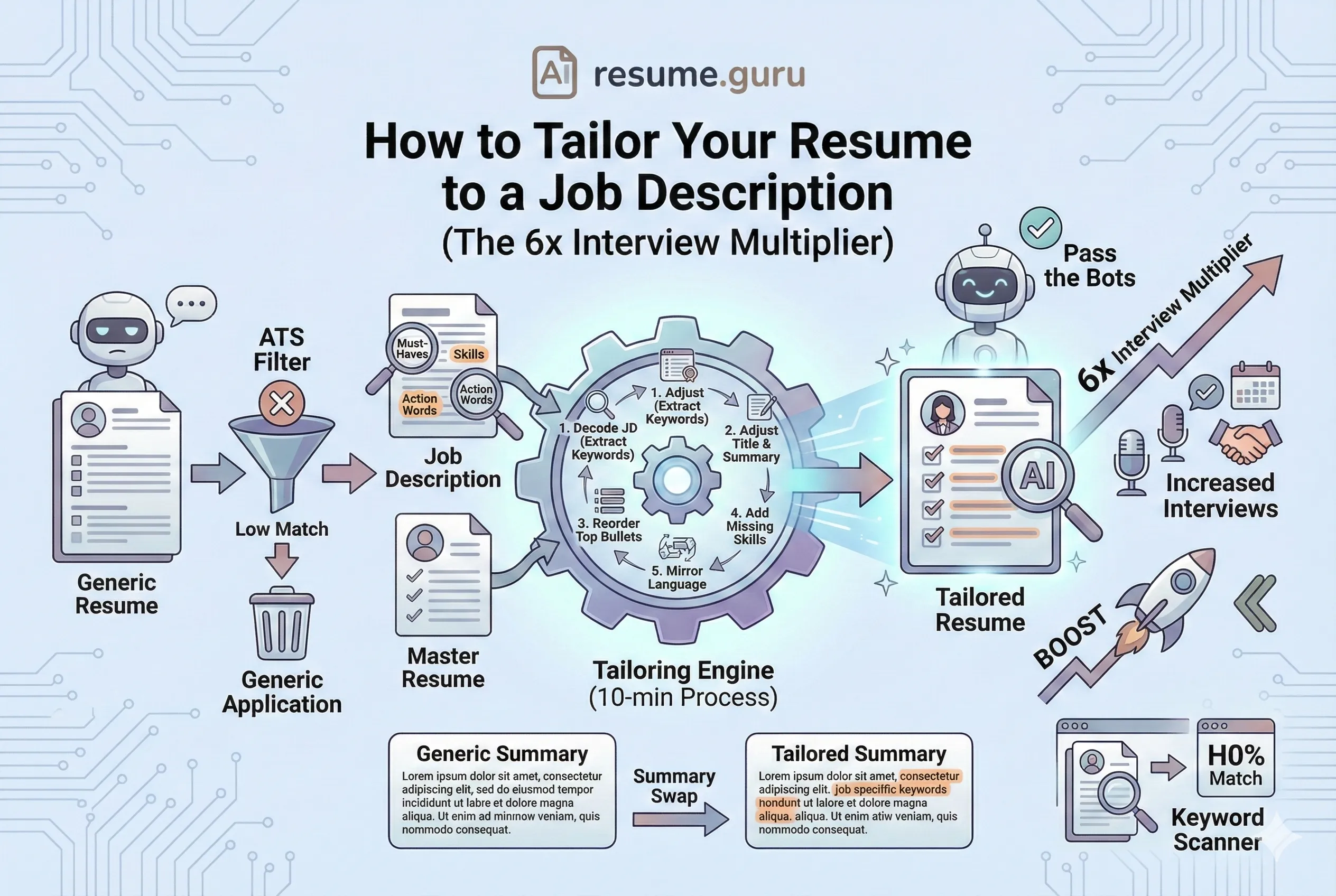
Match a job description to your actual experience, choose relevant evidence and customize your summary, skills and bullets without starting over.
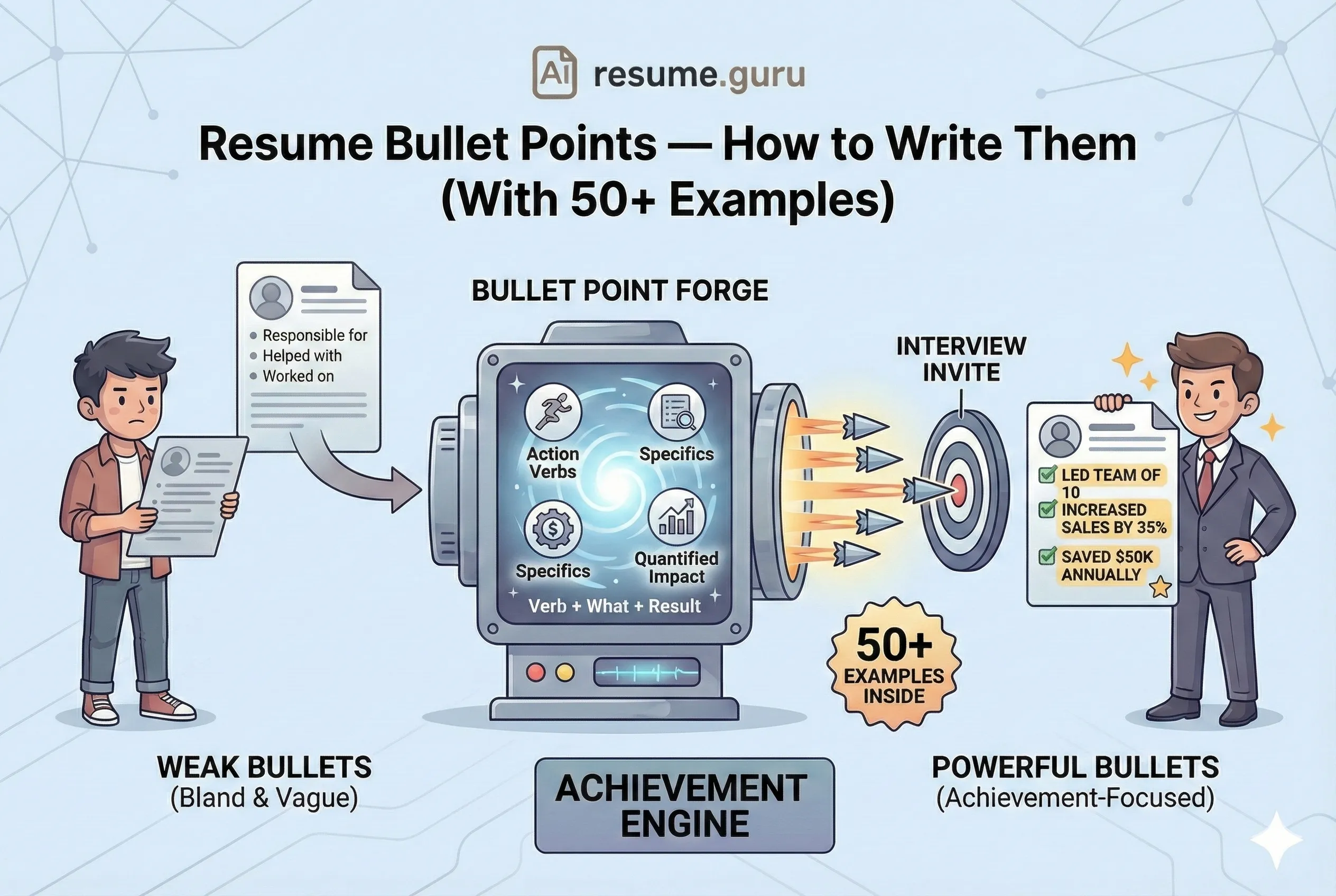
Turn your responsibilities into specific resume bullets. Use 50 role examples, same-facts rewrites and practical ways to show contribution without inventing numbers.
Stop guessing what recruiters want. See the exact software engineer resume templates, skills, and formats landing interviews at FAANG and startups in 2026.