The short answer, up front: a cover letter should be half a page to one full page, about 250 to 400 words across three or four paragraphs. Never more than one page.
That covers the main search too. How many words? 250 to 400. How many paragraphs? Three or four. Half a page or one page? Both work, as long as you stay under one full page. It’s the length almost every recruiter and career site agrees on. Below is the breakdown by word count, paragraph, and section, the few situations where the rules change (internships, career changes, and industries like law and finance), and how to hit the right length without counting words by hand.
The Ideal Length
- Page: half a page to one full page (one page is the hard ceiling).
- Words: 250-400, the sweet spot for most jobs.
- Paragraphs: 3-4 (opener, body, closing).
- Format: single-spaced, 1-inch margins, 11-12pt font.
If you would rather not count words by hand, our free Cover Letter Generator writes a one-page letter inside the 250-400 range automatically, so length stops being something you have to think about.
Why Length Matters
Because recruiters skim. A long letter doesn’t show effort, it buries your best point under paragraphs nobody reads.
of hiring managers spend under 30 seconds on a cover letter
Most spent under two minutes total, which is why your strongest point has to land in the first few lines.
Source: Resume Genius, 2023
The goal isn’t to fill a page. It’s to make a sharp, scannable case in as few words as it takes. That same logic drives resume length too: more pages rarely means more impact. Starting from a formatted file helps here too—browse ATS-safe templates so the layout isn’t what’s eating your space.
The Length Breakdown
Hitting these numbers is easier when you already know which two achievements matter, so tailor your resume to the job first and let the letter echo it.
| Measure | Target |
|---|---|
| Page length | ½ to 1 page (1 page max) |
| Word count | 250-400 words |
| Paragraphs | 3-4 |
| Spacing | Single-spaced, blank line between paragraphs |
| Margins / font | 1-inch margins, 11-12pt |
How Long Each Section Should Be
The 250-400 words aren’t spread evenly. Here’s where they go:
| Section | Words | What it does |
|---|---|---|
| Opening | 50-75 | Names the role, hooks with enthusiasm plus one top qualification |
| Body (1-2 paragraphs) | 150-200 | Proves fit with 2-3 specific, quantified achievements |
| Closing | 50-75 | Reaffirms interest, confident call to action, thanks |
The body is where your numbers live. It’s the only section that should carry metrics. The opener and closing stay lean. If you want each section auto-sized into this range without trial and error, the Cover Letter Generator drafts a structured letter you can then trim to taste.
Too Short vs. Too Long
Too short (under ~150 words) ❌
- Signals low effort
- No room to prove fit
- Leaves the reader wanting basic info
Too long (over 1 page) ❌
- Recruiters skim and miss your best point
- Often just duplicates the resume
- Reads as padded, not thorough
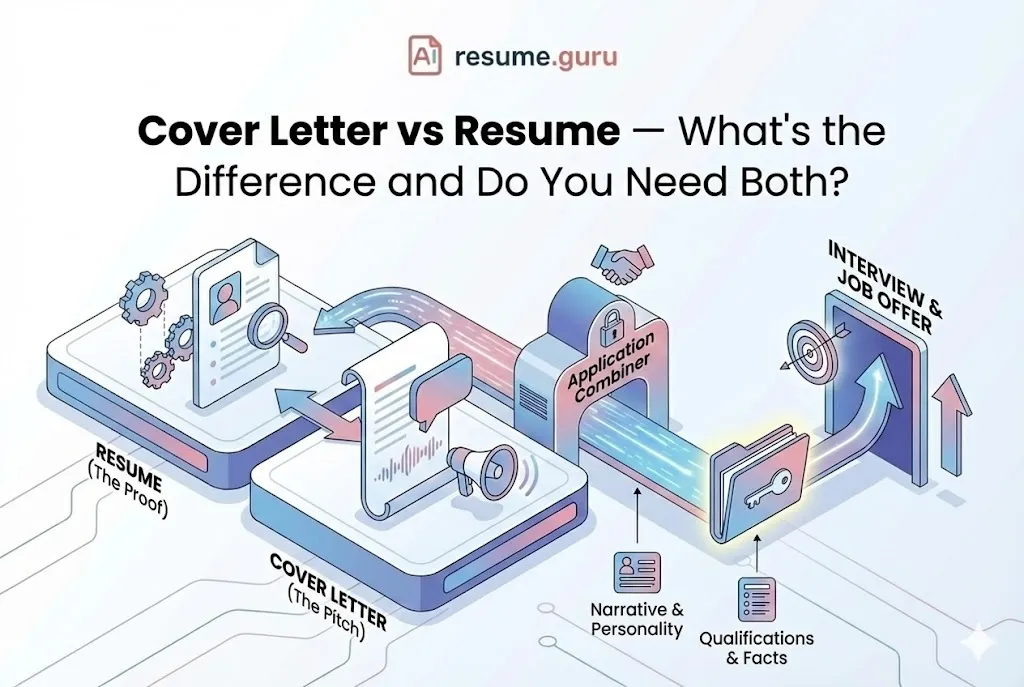
The cover letter is a teaser for your resume, not a copy of it. Don’t give everything away. Give them a reason to read the resume. Length is only half the battle—the resume behind it still has to clear a good ATS score. (If you’re still deciding whether you even need both, here’s how a cover letter and resume differ.)
Length and the ATS: Why Word Count Cuts Both Ways
Length isn’t only about what a human reads. Many companies route cover letters through an applicant tracking system, and word count quietly affects how you score there too.
- Too short and you leave out the role’s keywords. A 120-word letter rarely has room to mention the skills and tools the job description calls for, so it can read as a thin keyword match.
- Too long and you dilute those keywords. Padding a letter to fill a second page spreads your relevant terms across filler, which weakens the density that matters for matching.
The 250-400 word range is also the sweet spot for keyword balance: enough room to naturally echo the job’s core requirements, not so much that the important terms get lost. If you’re tailoring a letter to a specific posting, pull the right terms first with our keyword scanner, then weave them in. For the bigger picture on how screening software reads your application, see how an ATS actually works.
Mirror the job, don't stuff it
Aim for 3-5 of the job description’s exact phrases inside your 250-400 words. That’s enough to register as a match without sounding like a keyword list. Quality of fit beats volume every time.
When the Rules Change
Length shifts a little by situation:
Length by Situation
- Entry-level / no experience: lean shorter, 200-300 words
- Internship: 200-300 words, weighted toward coursework and projects
- Career change: standard 300-400 words, focused on transferable skills
- Mid-career: the standard 300-400 words
- Executive / senior: top of the range (~400 words), but still one page
- Academic / federal: the real exception, can run 1.5-2 pages
- Email cover letter: shorter, 150-250 words, no address block
How long should a cover letter be for an internship?
Keep it short, roughly 200 to 300 words. As a student or recent grad, you have less work history to cover, so a full page of text usually means padding. Spend the body on relevant coursework, projects, clubs, or part-time roles, and make your enthusiasm for that specific team clear. A focused half-page reads as confident, not thin. For a full walkthrough, see writing a cover letter with no experience.
How long should a cover letter be for a career change?
Use the standard 300 to 400 words, but spend almost all of them connecting your old experience to the new role. The risk for career changers isn’t length, it’s over-explaining the pivot until the letter sprawls onto a second page. Resist that. Translate two or three of your strongest wins into the target field’s language and let the relevance do the work. Pair the letter with a resume built for the switch using these career change resume tactics.
How long should a cover letter be by industry?
The 250-400 word range holds across most fields, but tone and where you land in that range shift:
| Industry | Length note |
|---|---|
| Law / finance / consulting | Top of the range (~350-400 words), formal tone, never over one page |
| Tech / startups | Leaner is fine (~250-350 words), direct and outcome-focused |
| Creative / marketing | 250-400 words, but voice and a strong hook matter more than hitting a count |
| Academic / research | The genuine exception: 1.5-2 pages is expected |
| Government / federal | Can run longer to address specific requirements line by line |
Outside academia and federal roles, the one-page ceiling holds even in the most formal industries. A law firm partner is not waiting for your second page.
Should a cover letter be 2 pages?
For almost every job, no. Two pages is the classic overreach: it signals you couldn’t prioritize, and recruiters who already skim rarely reach the bottom of page one, let alone page two. The only real exceptions are academic and some federal cover letters, where the format genuinely expects more depth. If you’re an executive with decades of experience, you still get one page. Having more to say never means you get more pages, it means you edit harder.
Is a Cover Letter Even Worth It If It’s Optional?
When a posting marks the cover letter as optional, the honest answer is that it usually still helps. When two candidates look similar on paper, a sharp 250-400 word letter is a cheap edge that shows real interest in that specific role. Skip it only when the posting tells you not to include one, or when you truly have nothing to add beyond your resume.
The trick is that an optional letter has to earn its space, which makes length discipline matter even more. A tight, relevant half page reads as effort. A rambling full page reads as a box you checked. For the wider debate and the data behind it, see are cover letters dead in 2026.
The Quick Length Check
Is My Cover Letter the Right Length?
- Fits on one page (no exceptions outside academic/federal)
- Between 250 and 400 words
- Three or four paragraphs
- Single-spaced, 1-inch margins, 11-12pt
- No sentence repeats the resume word for word
- Echoes 3-5 of the job description's key terms
- A recruiter could read it in under a minute
The Bottom Line
Half a page to one page. 250 to 400 words. Three or four tight paragraphs. That’s the formula, and it holds for almost everyone, internship to executive.
Knowing the right length is one thing. Hitting it while writing is another. If trimming and word-counting isn’t how you want to spend your evening, let a tool keep you in range, then make sure your resume is just as sharp.
Get the length right automatically
Our free Cover Letter Generator writes a one-page, correctly-sized letter (250-400 words, 3-4 paragraphs) tailored to the job. Pair it with an ATS-ready resume from the AI Resume Builder, saved to a free account so your letter and resume stay in sync.
Try the Cover Letter GeneratorRelated Resources
- Cover Letter Generator — Generate a correctly-sized letter in seconds
- How to Address a Cover Letter — Get the salutation right
- Cover Letter With No Experience — Write your first cover letter
- Are Cover Letters Dead in 2026? — When a cover letter still earns its place
Frequently Asked Questions
How long should a cover letter be?
A cover letter should be half a page to one full page, about 250 to 400 words across three or four paragraphs. It should never exceed one page, even for senior candidates. Aim for something a recruiter can scan in under a minute.
How many words should a cover letter be?
Around 250 to 400 words. Under about 150 words reads as low-effort and leaves no room to prove fit. Over roughly 500 words risks getting skimmed or skipped. The 250-400 range is the widely accepted sweet spot for most jobs.
How many paragraphs should a cover letter have?
Three to four: an opening that names the role and hooks the reader, one or two body paragraphs proving your fit with specific achievements, and a closing that reaffirms interest with a call to action. Keep each paragraph tight, just a few sentences each.
Should a cover letter be 2 pages?
For standard jobs, no. Keep it to one page. The main exceptions are academic and some federal applications, where the genre expects depth and 1.5 to 2 pages can be appropriate. For everything else, one page is the firm ceiling, even for executives.
Is 500 words too long for a cover letter?
Usually, yes. 500 words pushes past the half-to-one-page sweet spot and onto a second page once you add the address block. Recruiters skim, so a 500-word letter often gets cut short. Trim to 250 to 400 words so your strongest point lands fast.
How long should a cover letter be for an internship?
Shorter than a full-time letter, around 200 to 300 words. Interns have less work history, so focus on coursework, projects, and genuine interest in the team. A tight half-page beats a padded full page that restates your resume line by line.
How long should a cover letter be for a career change?
The standard 300 to 400 words, but spend most of them connecting old skills to the new role. Use the body to translate transferable wins into the language of the target field. One clear page beats two pages of over-explaining the pivot.
How long should a cover letter be with no experience?
Lean shorter, around 200 to 300 words. With less work history to cover, focus on transferable skills, relevant coursework or projects, and genuine enthusiasm. A tight, focused letter beats one padded to hit a word count.
How long should an email cover letter be?
Shorter than a formal letter, about 150 to 250 words in two or three tight paragraphs. Skip the letterhead and address block, and get to the point in the first line, since it's often read on a phone between other tasks.
Should a cover letter be single or double spaced?
Single-spaced, with a blank line between paragraphs. Use one-inch margins and an 11-12pt font. Spacing matters because it decides whether your 250-400 words actually fit cleanly on one page or spill awkwardly onto a second.
Is a cover letter still worth submitting if it's optional?
Usually, yes. When two candidates look similar on paper, a sharp 250-400 word letter is a low-cost edge that shows real interest. Skip it only if the posting says not to include one or if you genuinely have nothing to add beyond the resume.
How long do recruiters spend reading a cover letter?
Not long. In one survey, 36% of hiring managers spent under 30 seconds on a cover letter and most spent under two minutes (Resume Genius, 2023). That is exactly why length and clarity matter, since your best point has to land fast.
Put this into practice
You have the theory. These take a few minutes and work on the resume you already have.