Let’s kill a myth right now.
Changing careers doesn’t mean starting from zero. You’re not a fresh graduate. You have years of experience—it just happens to be in a different field.
The challenge isn’t that you lack skills. It’s that your resume is speaking the wrong language.
Of workers
Have made a dramatic career change at some point
Source: Indeed Survey, 2024
You’re not alone in this. Half of all workers pivot careers at least once. And the ones who do it successfully aren’t the ones who hide their past—they’re the ones who translate it.
The Career Change Mindset
- Your past experience is an asset, not a liability
- The goal is translation, not erasure
- The hybrid format beats the functional format every time
- Recruiters want to see how your skills connect to their needs
Why Most Career Change Resumes Fail
Here’s what doesn’t work:
-
The “Start Fresh” Approach — Deleting your entire work history and pretending you’re entry-level. You lose all your credibility.
-
The Functional Resume Trap — Hiding your experience by leading with a giant skills section and no timeline. Recruiters hate this format.
-
The “Everything Bagel” Resume — Including every job you’ve ever had without tailoring anything to the new role. Irrelevant noise drowns your signal.
The Functional Resume Problem
Functional resumes focus on skills with minimal employment history. But recruiters find them suspicious—they assume you’re hiding gaps, job-hopping, or lack of experience. 72% of hiring managers prefer chronological or hybrid formats.
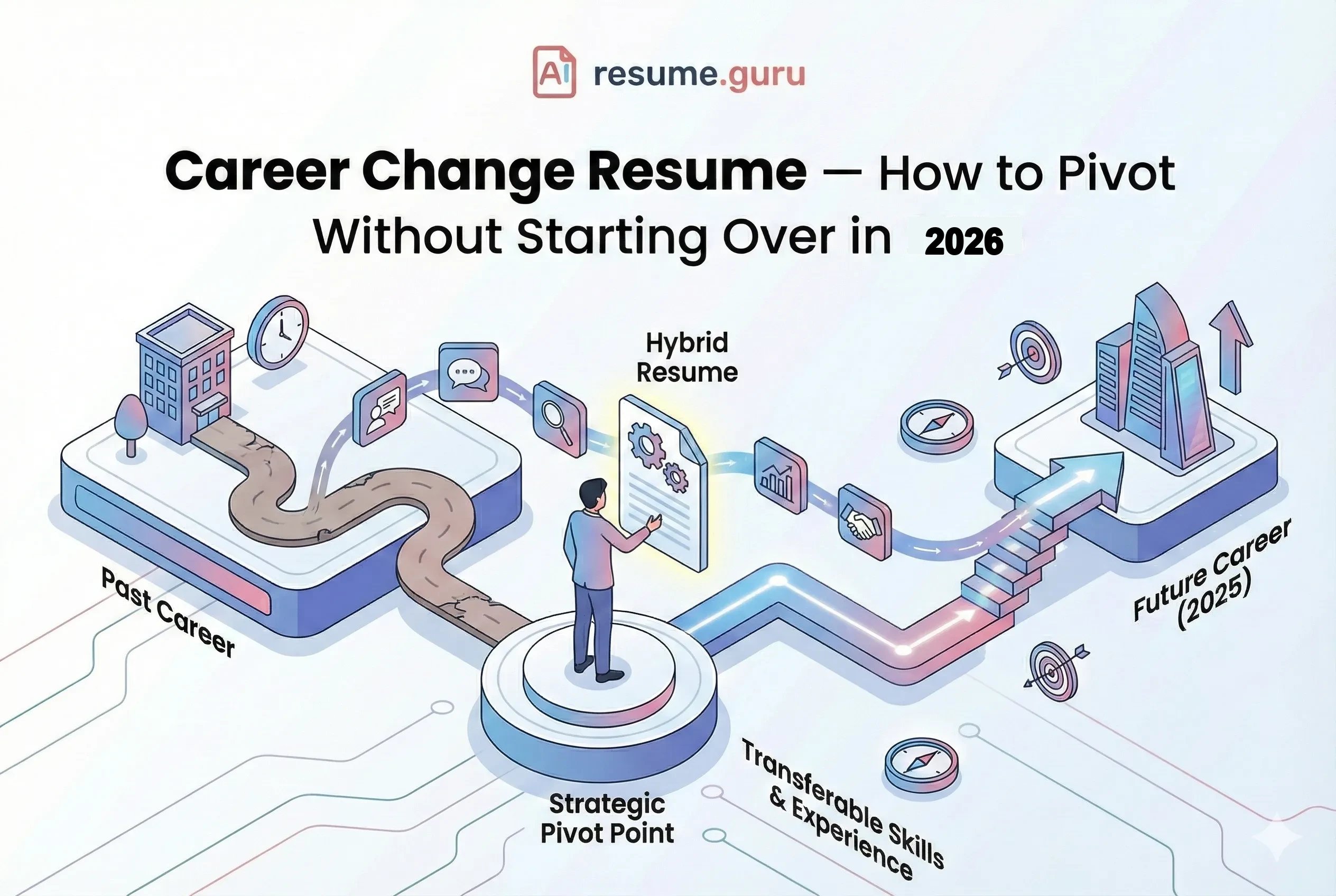
The solution? A hybrid approach that leads with your transferable skills—but still shows your career trajectory.
The Hybrid Format: Your Secret Weapon
A hybrid resume combines the best of both worlds:
- Top section: Skills-focused summary that speaks to your target role
- Experience section: Chronological work history, but reframed around transferable achievements
- Result: You show recruiters what you can do while proving you have real experience
| Resume Format | Best For | Recruiter Trust |
|---|---|---|
| Chronological | Linear career progression | ✅ High |
| Functional | Hiding gaps/career issues | ❌ Low |
| Hybrid/Combination | Career changers, diverse experience | ✅ High |
If you’ve just retrained, decide whether to include GPA on your resume in that top section.
Step 1: Rewrite Your Summary to Bridge the Gap
Your summary is the first thing recruiters read. For a career changer, it needs to do one thing: connect your past to their future.
The Career Change Summary Formula
[Current/Past Identity] + [Years of Relevant Skill] + [Transferable Strengths] + [Target Role/Industry] + [Value Proposition]
Examples
Teacher → Corporate Trainer:
Educator with 7 years designing curriculum and facilitating learning for diverse audiences. Transitioning to corporate training to apply instructional design expertise, presentation skills, and learner engagement strategies to professional development programs.
Retail Manager → Operations:
Retail operations manager with 5 years overseeing store logistics, inventory control, and team scheduling. Seeking an operations coordinator role to apply process optimization and team leadership skills in a corporate environment.
Customer Service → Sales:
Customer success specialist with 4 years retaining high-value accounts and driving upsell conversations. Applying relationship-building and product expertise to a sales development role.
The Bridge Phrase
Use phrases like: “Transitioning to…” / “Applying X skills to…” / “Leveraging experience in X to pursue…” These phrases acknowledge the change while framing it as intentional growth.
Step 2: Identify and Translate Your Transferable Skills
Every career has skills that carry over. Your job is to find them—and rename them.
Common Transferable Skills
Universal Skills That Transfer
- Communication (written and verbal)
- Problem-solving and critical thinking
- Project management and organization
- Leadership and mentoring
- Data analysis and reporting
- Customer/client relationship management
- Technical proficiency (software, tools)
- Time management and prioritization
The Translation Game
The same skill can be described in industry-specific language. Here’s how to translate:
| Your Experience ❌ | Their Language ✅ |
|---|---|
| Taught 30 students per class | Facilitated training for 30+ participants |
| Handled customer complaints | Resolved escalated client issues |
| Managed the stockroom | Oversaw inventory management and logistics |
| Supervised the closing shift | Led operational team during high-volume periods |
| Created lesson plans | Developed curriculum and instructional materials |
Keyword Tip
Use our Keyword Scanner to extract the exact language from job descriptions in your target industry. Mirror their words, not yours.
Applying across borders adds a second translation problem, and you can translate your resume without losing the reframing you just did.
Step 3: Reorganize Your Experience Section
You don’t have to list every job in full detail. Career changers can strategically emphasize relevant experience and minimize (or omit) unrelated roles.
Strategies
1. Create a “Relevant Experience” Section
If only some of your jobs relate to the new field, group them under “Relevant Experience”—and put less relevant roles under “Additional Experience” in condensed format.
RELEVANT EXPERIENCE
Customer Success Manager, TechCorp — 2021-2024
• Built client relationships...
• Increased retention by 25%...

ADDITIONAL EXPERIENCE
Retail Associate, TargetMart — 2018-2021
Barista, Coffee Shop — 2016-2018
2. Reframe Bullets Around Transferable Outcomes
Even if your job titles look unrelated, your bullet points can emphasize universally valued skills.
| Before (Role-Specific) ❌ | After (Transferable) ✅ |
|---|---|
| Rang up customers at checkout | Processed 100+ daily transactions, maintaining accuracy under high volume |
| Taught high school English | Communicated complex concepts to diverse audiences of 30+ |
| Solved IT tickets | Diagnosed and resolved technical issues, reducing average response time by 20% |
Step 4: Fill the Gap with Projects, Certifications, and Upskilling
If you’re changing fields, proving you’ve invested in learning the new domain is crucial.
What to Include
- Online certifications: Coursera, LinkedIn Learning, Google Certificates
- Bootcamps: Coding bootcamps, design courses, etc.
- Volunteer work: Relevant to the new field
- Personal projects: Portfolio pieces, freelance work, side businesses
- Industry events: Conferences, workshops attended
Strong Pivot Signal
“Completed Google Data Analytics Certificate while transitioning from retail management. Applied learnings to personal project analyzing sales trends across 3 quarters.”
This shows commitment, initiative, and practical application.
Step 5: Address the Elephant in the Room
Recruiters will wonder: Why the change?
Your resume should hint at the answer—and your cover letter should address it head-on.
In Your Summary
Include a phrase like:
- “Transitioning after 5 years in education…”
- “Seeking to apply [skill] in a new context…”
- “Drawn to [industry] by [specific reason]…”
In Your Cover Letter
Be direct:
“After 6 years in hospitality management, I’m pursuing a career in HR—a natural extension of my experience building teams, handling sensitive employee situations, and improving workplace culture.”
The key is framing the change as intentional evolution, not desperation.
Career Change Resume Template
Here’s the structure that works:
- 1
Contact Information
Name, email, phone, LinkedIn, city
- 2
Professional Summary (2-4 sentences)
Bridge your past to your target role
- 3
Skills Section
8-12 transferable skills using target industry language
- 4
Relevant Experience
Roles with transferable achievements, reframed
- 5
Education & Certifications
Include new industry credentials prominently
- 6
Additional Experience (Optional)
Condensed older/unrelated roles
- 7
Projects (Optional)
Portfolio pieces, volunteer work, side projects
To put that structure on the page without fighting a layout, browse ATS-safe templates with a skills block near the top.
Common Mistakes to Avoid
Mistake #1: Being Apologetic
“I know I don’t have direct experience, but…”
Never apologize. Frame your experience as an asset, not a deficit.
Mistake #2: Using a Functional Resume
Recruiters distrust them. Use hybrid instead—it shows skills prominently while maintaining chronological credibility.
Mistake #3: Not Tailoring Each Application
A career changer can’t afford to send generic resumes. Every application needs keywords and phrases from that specific job description.
Mistake #4: Ignoring Your Network
50% of jobs come through connections. Cold applications are harder for career changers—warm introductions give you a chance to explain your story.
An outside read catches all four quickly, so run a free resume roast before you send it.
The Bottom Line
Changing careers isn’t starting over—it’s redirecting.
Your years of experience aren’t worthless. They’re full of skills that translate if you know how to present them. The hybrid format lets you lead with those skills while maintaining the chronological credibility that keeps recruiters reading.
Don’t apologize. Don’t hide. Translate.
Build your career change resume
Our templates and AI writing tools help you reframe experience for any new industry—in minutes, not hours.
Start Building FreeRelated Resources
- Resume Section Order — Strategic section placement
- Transferable Skills Guide — Identify what carries over
- Professional Summary Examples — More pivot-friendly summaries
- Skills Finder Tool — Discover in-demand skills for your target field
- Resume Templates — Hybrid-friendly designs
- Resume Examples — See career pivot resumes in action
Frequently Asked Questions
What's the best resume format for a career change?
The hybrid (combination) format works best for career changers. It leads with a strong skills summary, followed by work experience. This lets you highlight transferable abilities upfront while still showing your career trajectory—unlike functional resumes, which recruiters distrust.
Do I need to include all my previous jobs on a career change resume?
No. Focus on roles that demonstrate transferable skills. Older or completely unrelated jobs can be condensed into a brief 'Additional Experience' section or omitted entirely if they don't support your pivot.
How do I explain a career change in my resume summary?
Frame your transition as an evolution, not a reset. Connect your previous experience to your target role: 'Customer success manager with 5 years building client relationships, now applying communication and problem-solving skills to sales enablement.'
Should I use a functional resume for career change?
Generally no. While functional resumes de-emphasize work history, recruiters often view them with suspicion—assuming you're hiding gaps or lack of experience. The hybrid format gives you the best of both worlds.
How do I show transferable skills on my resume?
Reframe your achievements using language from your target industry. A teacher who 'designed curriculum' becomes 'developed training programs.' Lead with a dedicated skills section, and quantify impact wherever possible.
Put this into practice
You have the theory. These take a few minutes and work on the resume you already have.