You've got the technical skills. The certifications. The experience.
And yet... the interview callbacks aren't coming.
Here's what might be missing: soft skills. The human stuff. The "how you work" skills that determine whether you're a good colleague, a strong leader, or the person everyone actually wants on their team.
Of employers say soft skills are essential
When making hiring decisions
Source: LinkedIn Global Talent Trends, 2024
Hard skills get your resume past the ATS. Soft skills get you the job offer.
The problem? Most people either ignore soft skills entirely—or list them so generically ("team player," "good communicator") that they mean nothing.
Let's fix that.
What You'll Learn
- The 10 most in-demand soft skills for 2026
- How to demonstrate (not just list) soft skills on your resume
- Industry-specific soft skills that employers prioritize
- Common mistakes that make your soft skills section useless
- Examples of soft skills done right—and wrong
Hard Skills vs. Soft Skills: What's the Difference?
Before we dive in, let's clarify:
| Hard Skills | Soft Skills |
|---|---|
| Technical abilities you can learn and measure | Personality traits and interpersonal behaviors |
| Python, SQL, Excel, Photoshop, CPA certification | Communication, leadership, adaptability, empathy |
| Taught in classes, courses, certifications | Developed through experience and self-awareness |
| Easy to list and prove | Must be demonstrated through examples |
| Get you past the ATS filter | Get you the offer after the interview |
The Balance Employers Want
The ideal candidate has both. Technical skills show you can do the job. Soft skills show you'll do the job well—and that people will want to work with you.
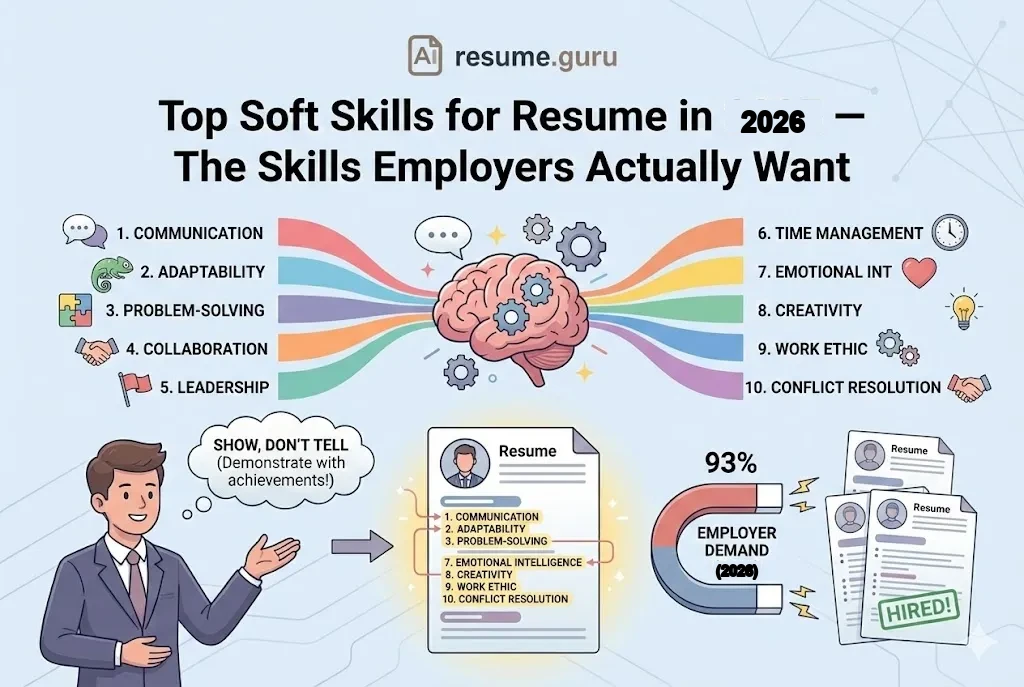
The Top 10 Soft Skills Employers Want in 2026
Based on analysis of thousands of job postings and employer surveys, here are the soft skills that matter most this year:
1. Communication
The #1 most requested soft skill—and has been for years. But "communication" means more than just "can speak."
What employers actually mean:
- Clear written communication (emails, documentation, reports)
- Effective verbal communication (presentations, meetings, 1:1s)
- Active listening and asking good questions
- Adapting your style to different audiences
How to Show It
Instead of: "Excellent communication skills"
Write: "Presented quarterly results to C-suite executives, translating complex data into actionable insights for non-technical stakeholders"
2. Adaptability & Flexibility
After the chaos of recent years, employers want people who can handle change—technology shifts, team restructures, pivot moments.
What employers actually mean:
- Openness to new tools, processes, and ways of working
- Staying productive during uncertainty
- Learning quickly when requirements change
- Maintaining composure under pressure
How to Show It
Instead of: "Adaptable team member"
Write: "Transitioned team from Waterfall to Agile methodology within 3 months, training 12 colleagues and reducing project delivery time by 25%"
3. Problem-Solving & Critical Thinking
Every job involves problems. Employers want people who solve them—not just escalate them.
What employers actually mean:
- Identifying root causes, not just symptoms
- Evaluating options and making decisions
- Creative solutions to novel challenges
- Data-informed decision making
How to Show It
Instead of: "Strong problem-solving skills"
Write: "Diagnosed recurring customer complaints to a single API issue, proposed fix that reduced support tickets by 40%"
4. Collaboration & Teamwork
Solo contributors are rare. Most work happens in teams—cross-functional, remote, global.
What employers actually mean:
- Working effectively with diverse personalities
- Contributing to group goals, not just personal metrics
- Giving and receiving feedback constructively
- Building relationships across teams and departments
How to Show It
Instead of: "Team player"
Write: "Partnered with Engineering, Design, and Marketing teams to launch product feature 2 weeks ahead of schedule, coordinating 15+ stakeholders across 3 time zones"
5. Leadership
You don't need "manager" in your title to show leadership. Employers want people who take initiative and influence outcomes.
What employers actually mean:
- Taking ownership without being asked
- Mentoring or guiding others
- Driving projects forward
- Making decisions and taking responsibility
How to Show It
Instead of: "Natural leader"
Write: "Led initiative to standardize onboarding process, reducing new hire ramp-up time from 8 weeks to 5 weeks"
6. Time Management & Organization
Remote and hybrid work made this more important than ever. Can you manage yourself?
What employers actually mean:
- Meeting deadlines consistently
- Prioritizing effectively when everything feels urgent
- Managing multiple projects simultaneously
- Staying productive with minimal supervision
How to Show It
Instead of: "Excellent time management"
Write: "Managed portfolio of 25+ client accounts while maintaining 98% on-time delivery rate across all projects"
7. Emotional Intelligence
EQ is the new IQ. How well do you understand your own emotions—and others'?
What employers actually mean:
- Self-awareness and self-regulation
- Empathy for colleagues and customers
- Navigating difficult conversations
- Building genuine relationships
How to Show It
Instead of: "High emotional intelligence"
Write: "De-escalated 50+ customer conflicts per month with 95% resolution rate and average CSAT score of 4.8/5"
8. Creativity & Innovation
AI can do routine work. Humans are still better at generating novel ideas—for now.
What employers actually mean:
- Proposing new approaches to old problems
- Thinking beyond "how we've always done it"
- Experimenting and iterating
- Connecting dots others don't see
How to Show It
Instead of: "Creative thinker"
Write: "Proposed and implemented gamification strategy for user onboarding, increasing 30-day retention by 35%"
9. Work Ethic & Reliability
It sounds basic, but employers desperately want people who simply show up and deliver.
What employers actually mean:
- Consistent performance over time
- Following through on commitments
- Going beyond minimum requirements
- Taking pride in quality of work
How to Show It
Instead of: "Hard worker with strong work ethic"
Write: "Maintained 100% project completion rate over 3 years while consistently exceeding quarterly targets by 15-20%"
10. Conflict Resolution
Conflict happens. The question is: can you handle it constructively?
What employers actually mean:
- Addressing disagreements directly but diplomatically
- Finding win-win solutions
- Not avoiding difficult conversations
- Keeping relationships intact through disagreement
How to Show It
Instead of: "Good at conflict resolution"
Write: "Mediated cross-departmental dispute over resource allocation, reaching agreement that improved project delivery by 20% without additional headcount"
Industry-Specific Soft Skills
Different industries prioritize different soft skills. Here's what matters most by sector:
| Industry | Top Soft Skills | Why |
|---|---|---|
| Technology | Problem-solving, Collaboration, Adaptability | Fast-changing environment, cross-functional teams, complex challenges |
| Healthcare | Empathy, Communication, Stress Management | Patient care, life-or-death decisions, emotional situations |
| Sales | Persuasion, Relationship Building, Resilience | Client relationships, rejection handling, negotiation |
| Finance | Attention to Detail, Ethics, Analytical Thinking | Accuracy matters, regulatory compliance, high-stakes decisions |
| Marketing | Creativity, Communication, Data Interpretation | Storytelling, audience understanding, ROI measurement |
| Education | Patience, Communication, Adaptability | Diverse learners, classroom management, curriculum changes |
| Customer Service | Empathy, Patience, Conflict Resolution | Angry customers, problem-solving, de-escalation |
| Management | Leadership, Delegation, Emotional Intelligence | Team development, performance issues, strategic thinking |
Where to Put Soft Skills on Your Resume
Soft skills should appear in multiple places—woven throughout, not dumped in a single section.
- 1
Professional Summary (2-3 soft skills)
Lead with a soft skill that matches the job. 'Collaborative product manager...' or 'Analytical marketer with...'
- 2
Experience Bullets (demonstrate, don't list)
Every achievement is an opportunity to show a soft skill in action. Use the 'skill + result' formula.
- 3
Skills Section (if ATS-required)
Some job postings specifically mention soft skills. Include them in your skills section using exact wording from the posting.
- 4
Cover Letter (expand on 1-2 keys skills)
Your cover letter is where you can tell a short story that demonstrates a key soft skill.
Pro Tip
Read the job posting carefully. If it mentions "collaborative environment" or "fast-paced team," those are signals about which soft skills to emphasize.
The "Show, Don't Tell" Formula
The biggest mistake with soft skills? Telling instead of showing.
| Telling ❌ (Weak) | Showing ✅ (Strong) |
|---|---|
| Excellent communication skills | Delivered 15+ presentations to executive leadership, securing $2M in additional project funding |
| Team player | Collaborated with 5-person cross-functional team to launch feature serving 50K daily users |
| Strong leader | Mentored 3 junior developers, with 2 receiving promotions within 18 months |
| Detail-oriented | Maintained 99.5% accuracy rate across 500+ monthly transactions |
| Problem solver | Identified inventory tracking inefficiency and implemented solution saving $30K annually |
| Adaptable | Transitioned to fully remote work within 1 week while maintaining 100% client delivery rate |
The Formula
[Soft Skill Action] + [Specific Context] + [Quantified Result]
This proves you have the skill—not just that you claim to have it.
Common Soft Skills Mistakes
Mistake 1: Creating a Generic List
"Communication, teamwork, leadership, problem-solving" without any context. Everyone writes this. It means nothing.
Fix: Only include soft skills you can back up with specific examples.
Mistake 2: Using Clichés
"Passionate," "self-starter," "go-getter," "rockstar." These are red flags, not selling points.
Fix: Use professional language and let achievements speak for themselves.
Mistake 3: Ignoring the Job Posting
The job says "collaborative environment" and your resume doesn't mention collaboration anywhere.
Fix: Customize your soft skills emphasis for each application. Mirror the language in the posting.
Mistake 4: Only Listing Hard Skills
A resume full of technical skills and no indication of how you work with humans.
Fix: Balance every technical achievement with the soft skill that enabled it.
Mistake 5: Overloading Soft Skills
Listing 15 soft skills makes you look like you're overcompensating.
Fix: Focus on 3-5 relevant soft skills and demonstrate each one clearly.
Soft Skills Checklist
Before you submit, make sure your resume covers these bases:
Soft Skills Resume Checklist
- Professional summary mentions 2-3 relevant soft skills
- At least 50% of experience bullets demonstrate a soft skill
- Soft skills match the job posting language
- No generic phrases like 'team player' without evidence
- Skills section includes soft skills if the posting mentions them
- Each soft skill has at least one specific example
Quick Reference: Power Phrases for Soft Skills
Use these phrases to naturally incorporate soft skills into your bullets:
Communication:
- "Presented to...", "Communicated with...", "Documented...", "Trained..."
Leadership:
- "Led initiative to...", "Mentored...", "Spearheaded...", "Championed..."
Collaboration:
- "Partnered with...", "Collaborated across...", "Coordinated with..."
Problem-Solving:
- "Diagnosed...", "Resolved...", "Identified and fixed...", "Streamlined..."
Adaptability:
- "Transitioned to...", "Pivoted...", "Rapidly learned...", "Adjusted strategy to..."
Time Management:
- "Managed simultaneously...", "Delivered on deadline...", "Prioritized..."
The Bottom Line
Hard skills get you hired. Soft skills get you promoted.
In 2026, employers aren't just looking for people who can do the job. They're looking for people who can do the job while being excellent to work with.
Your resume needs to prove both.
Remember
- Name the skill AND show evidence of it
- Use quantified results whenever possible
- Match your soft skills to the job posting
- Weave soft skills throughout—not just in a list
- Focus on 3-5 relevant skills, not 15 generic ones
Need help showcasing your soft skills?
Our AI-powered resume builder suggests achievement-focused bullet points that demonstrate your skills—not just list them. Build a resume that shows employers who you really are.
Start Building FreeRelated Resources
- Resume Optimization Guide — Complete guide to ATS-friendly formatting and keywords
- ATS Keywords by Industry — Hard skill keywords for your industry
- Entry-Level Resume Guide — How to showcase skills without job experience
- Bullet Point Generator — Turn duties into achievement-focused bullets
- Resume Summary Generator — Craft a summary that highlights your key skills
Frequently Asked Questions
What are soft skills on a resume?
Soft skills are interpersonal and behavioral skills—like communication, leadership, and problem-solving—that determine how you work with others and approach challenges. They're essential for workplace success.
Should I list soft skills on my resume?
Yes, but show them—don't just list them. Instead of writing 'communication skills,' describe an achievement that demonstrates strong communication. ATS systems and recruiters both look for these skills.
What are the top 5 soft skills employers want in 2026?
Based on hiring trends: 1) Communication, 2) Adaptability, 3) Problem-Solving, 4) Collaboration/Teamwork, and 5) Leadership. These appear in the majority of job postings across industries.
How many soft skills should I include on my resume?
Include 3-5 soft skills that are relevant to the job. Don't create a laundry list—integrate them into your experience bullets and summary where you can show evidence.
What's the difference between soft skills and hard skills?
Hard skills are technical abilities you can learn and measure (coding, Excel, certifications). Soft skills are personality traits and behaviors (leadership, empathy, time management). Employers need both.
Do ATS systems scan for soft skills?
Yes. Modern ATS systems increasingly scan for soft skill keywords like 'leadership,' 'collaboration,' and 'problem-solving.' Include them naturally in your resume—especially in your summary and experience bullets.
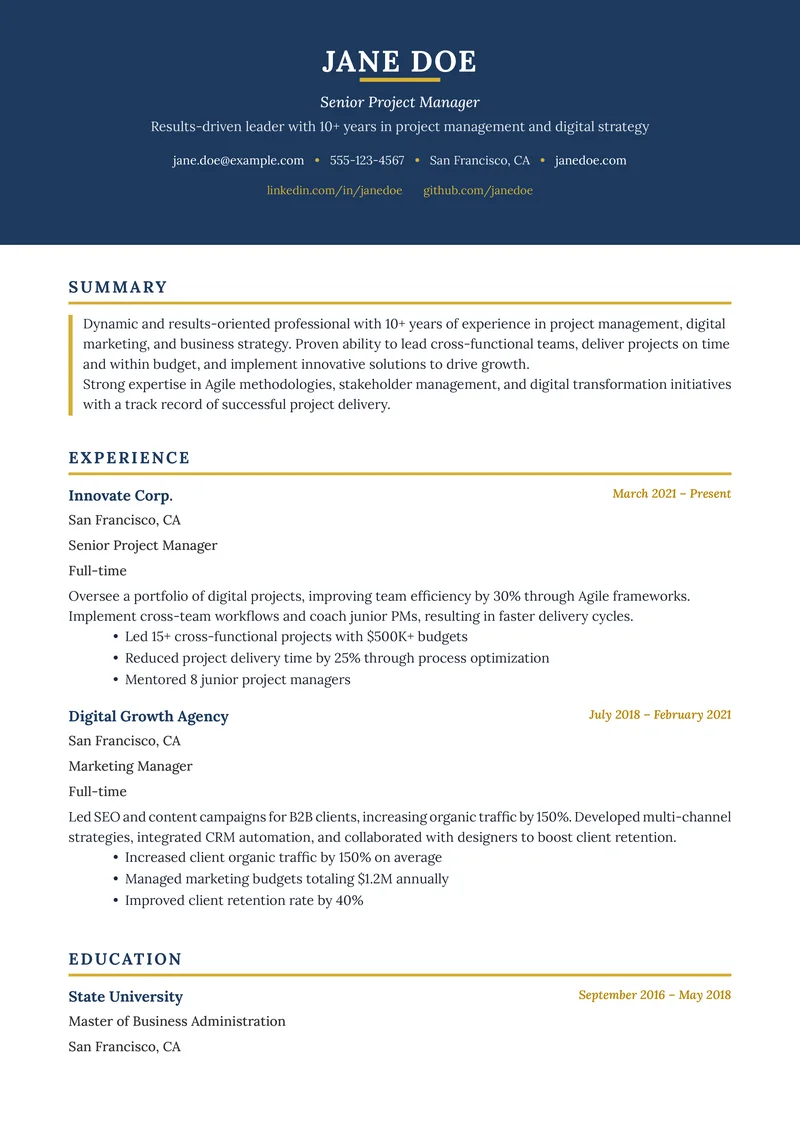
Build Your Perfect Resume
Create an ATS-optimized resume with our AI-powered builder.
No signup required.Start Building FreeExplore Resources
Enjoyed this article?
Share it with your network