Tesla interview practice
Tesla interview preparation: explain your decisions under constraints
Build technical and behavioral stories from your own work, practice the follow-up questions and prepare for the specific Tesla team you are speaking with.
Practice my Tesla interviewFree account, no card. Paste your Tesla posting, choose a behavioral round and answer questions built from your resume.
The short version
Prepare for your Tesla interview by choosing relevant projects you can explain from first problem to verified result. Practice your personal contribution, technical assumptions, rejected alternatives, failure modes and what you would change. Confirm the interview format and any exercise with your recruiter. Use the job posting to decide whether your preparation should focus on software, production engineering, service or another discipline.
What you will have by the end
- Defend a technical decision with assumptions, alternatives and validation.
- Practice different stories for software, production and service work.
- Identify weak follow-up answers before your scheduled interview.
On this page
Step 1 of 5
Confirm the format, then practice the role’s actual work
Ask your recruiter what the conversation covers, who you will meet and whether you need to prepare code, a presentation or another exercise. Build your plan around those instructions. A company-wide sequence of rounds is less useful than knowing the task in front of you.
Use the posting to identify technical themes. Tesla’s published software, manufacturing and field-service roles call for different work. The practice prompts below are our preparation exercises, not a list of confirmed Tesla interview questions.
| Target role | Practice exercise | Follow-up to answer |
|---|---|---|
| Software / data | Sketch an ingestion path with retries, monitoring and data reconciliation | How would you detect silent loss, duplicate events or an unhealthy dependency? |
| Manufacturing | Design an experiment for an intermittent assembly defect | Which variables stay fixed, what is the acceptance criterion and how do you hand off the change? |
| Field service | Explain your order of operations for an intermittent equipment fault | What evidence changes your hypothesis, and what verifies a safe return to service? |
| Engineering leadership | Plan a constrained release with quality and operations partners | What would stop the release, and who owns the unresolved risk? |
From Tesla: Tesla Software Engineer, Optimus — Fremont · Tesla Manufacturing Engineer, Power Module · Tesla Field Service Technician — Sacramento
Step 2 of 5
Practice full stories that survive technical follow-ups
These original stories are fictional, and their numbers are illustrative. They model the depth to prepare from your own work: situation, task, action and result, followed by the questions that test whether you understand the decision. Learn the sequence of reasoning rather than memorizing the wording.
Software: correct the symptom without losing data
Personal ownershipFailure reasoning-
Situation
our test-results dashboard showed inconsistent counts after network interruptions.
-
Task
I owned ingestion and needed to restore trustworthy data without dropping valid retries.
-
Action
I traced event identifiers through the uploader and database, reproduced an interrupted batch and found that acknowledgments could be lost after a successful write. I compared delaying retries with making writes idempotent. Delay could not guarantee correctness, so I added unique event keys, explicit conflict handling and a quarantine path for mismatched payloads.
-
Result
a 12,000-event replay produced no duplicate rows, and a two-week review found no new duplicates in monitored uploads. I documented the mismatched-payload case as an ongoing investigation path.
Follow-ups to prepare
Try each one out loud, then open it for what to cover.
-
Why would idempotency still need a quarantine path?
A reused key with different content could hide a real upstream fault. Explain how you distinguish a harmless retry from conflicting data instead of treating every duplicate key as success.
-
What happens when events arrive late?
Discuss the reconciliation window, event time versus ingestion time and how downstream reports handle correction. Correctness must extend beyond the happy-path insert.
Make it yours: Use a concrete failure sequence. It makes your design choice and its remaining limitations easier to examine.
Manufacturing: resist an unvalidated quick fix
Experiment designQuality ownership-
Situation
an assembly cell developed intermittent bond failures during a trial run.
-
Task
I owned the process investigation and needed a recommendation before the next trial.
-
Action
I checked measurement repeatability with quality, grouped failures by lot and setup, then ran an experiment on surface preparation and dwell time. I resisted raising energy immediately because it could obscure the cause and damage acceptable parts. The experiment identified inconsistent preparation. I revised the instruction, trained operators and asked quality to verify three new trial lots against the same acceptance criteria.
-
Result
rejects fell from 18 to 7 in comparable 300-piece lots. I handed over the control checks and kept production monitoring open rather than declaring the issue permanently closed.
Follow-ups to prepare
Try each one out loud, then open it for what to cover.
-
How did you know the inspection itself was reliable?
Start with measurement repeatability and agreement on failure definitions. Process conclusions are weak when different inspectors classify the same part differently.
-
What would make you reject the change?
Name a pre-agreed quality or process limit and who approves the decision. Faster output cannot substitute for passing acceptance criteria.
Make it yours: Show both pace and discipline: narrow the uncertainty, run a useful test and make the release boundary explicit.
Service: diagnose before replacing components
Fault isolationClear handoff-
Situation
a customer’s energy system showed an intermittent communication fault after earlier visits had not reproduced it.
-
Task
I was assigned to isolate the cause and leave a usable service record.
-
Action
I reviewed the approved procedure and prior case history, confirmed safe working conditions and compared logs with inspection findings. A connector defect fit the fault timing better than the initial software hypothesis. I documented the evidence, completed the authorized repair and ran the required verification checks.
-
Result
the system passed those checks and the follow-up case review showed no recurrence over the next month. I recorded that observation window and the checks to repeat if the symptom returned.
Follow-ups to prepare
Try each one out loud, then open it for what to cover.
-
Why did you move away from the software hypothesis?
Connect a specific observation to the hypothesis change. Avoid claiming intuition alone identified the fault or that one symptom proves a component is defective.
-
What if you could not reproduce the issue?
Explain safe limits, evidence collection and escalation under approved procedures. An unresolved intermittent fault should not become an invented confirmed diagnosis.
Make it yours: Describe troubleshooting judgment without improvising unsafe procedures or claiming more certainty than your checks provide.
Keep reading
- Practice concise behavioral answers with STAR →
Keep the situation short and give your actions and decisions enough space.
Now test one of your own stories
Paste your Tesla posting and pick a behavioral round. Your AI interviewer asks about your resume, digs into your answers and coaches you on each one.
Step 3 of 5
Prepare a setback that shows a changed decision
A useful failure story makes your mistake clear and shows how you changed the system or your approach. Do not turn a success into a disguised weakness. This fictional example uses illustrative numbers and a limited pilot result, not evidence from a real Tesla candidate.
Engineering: own an assumption that failed
-
Situation
I proposed an automated check to reduce manual review time.
-
Task
I owned the check and its rollout recommendation.
-
Action
my first test set contained mostly normal records, so I underestimated how many valid edge cases it would flag. During a pilot, reviewers found 14 false alerts in 200 records. I paused expansion, categorized the cases with the reviewers and added representative edge cases to the test suite. I changed the tool to flag uncertainty for review rather than reject records automatically.
-
Result
a second 200-record pilot produced three false alerts. I recommended keeping human review for ambiguous cases and made representative test coverage a release requirement.
Follow-ups to prepare
Try each one out loud, then open it for what to cover.
-
What was your mistake rather than the team’s mistake?
Own the unrepresentative test set and rollout recommendation. Team consultation after discovery does not erase your initial decision.
-
Why keep a manual step after improving the model?
Explain the cost of a wrong rejection, the unresolved cases and why the pilot did not establish enough evidence for full automation.
Make it yours: The lesson changes a decision rule: test representative edge cases and preserve a review path when uncertainty remains.
Step 4 of 5
Rehearse one project at three levels of detail
Prepare a short introduction, a structured project account and a deeper technical explanation. Start with the short version, then follow the interviewer’s questions. You should be able to move between a simple explanation and detailed reasoning without changing the facts.
Introduction
name your discipline, the work you have done and the part of this posting it prepares you for.
Project account
explain the problem, your responsibility, the main decision and the verified outcome.
Deep dive
sketch the architecture or process, state assumptions and walk through a failure or edge case.
Alternatives
name a plausible option you rejected and the evidence that made it less suitable.
Boundaries
separate what you built from what partners approved, tested or operated.
Next iteration
explain the largest remaining risk and the test you would run next.
Keep reading
- Connect technical stories to software resume examples →
For software roles, check that the projects on your resume support the depth you plan to discuss.
Step 5 of 5
Finish with a practice round and useful team questions
Run one rehearsal focused on your target work. Answer a project prompt, take two follow-ups and review where you became vague. Replace unsupported adjectives with the actual observation, calculation or decision. Repeat the weakest answer once; then explain the same project aloud so written fluency does not hide a spoken gap.
Prepare questions that help you judge the work: What does this team need the new hire to own first? How are changes validated before handoff? Which interfaces create the most recurring problems? What would good performance look like after the first substantial project? Ask your recruiter about interview accommodations if needed.
From Tesla: Tesla careers and accommodations
Tesla interview FAQs
What questions should I practice for a Tesla interview?
Practice explaining a relevant project, a hard technical decision, a setback and a disagreement over constraints. Add exercises from your discipline, such as data reliability, experiment design or fault isolation. The prompts here are preparation exercises rather than confirmed questions for every Tesla interview.
How do I explain my hardest technical problem?
State the problem and your responsibility, then spend most of the answer on diagnosis, alternatives, your decision and verification. Name the observation that changed your mind. Be ready to draw the system or process and explain what could still fail.
Should my interview story match my evidence of excellence?
The facts should agree, and your strongest project can serve both purposes. In the interview, expand the reasoning and respond to follow-ups rather than reciting the application paragraph. Prepare other examples so every question does not lead to the same story.
How should service candidates prepare differently from engineers?
Choose stories about diagnosis, approved procedures, verification and clear case handoffs. Explain how evidence narrowed the fault and what happened when the first hypothesis was wrong. Follow your own posting’s technical scope rather than preparing only software or manufacturing examples.
Can I practice for Tesla with AI ResumeGuru?
Yes. With a free account, use your resume and the Tesla posting for typed interview practice, then review the coaching and scorecard. Treat feedback as a way to improve clarity and reasoning, and rehearse aloud separately before the actual interview.
Your next step
Test whether your Tesla project story holds together
Use AI ResumeGuru’s interview practice with your resume and pasted Tesla posting. Choose a relevant practice round and type answers from your own experience. Focus the rehearsal on the constraint, your decision and the evidence behind the result.
Use the coaching and scorecard to find an unclear contribution or weak follow-up, then revise that answer and rehearse it aloud. Practice requires a free account; it prepares you before the conversation and does not generate answers during your real interview.
Put the guidance into a complete application
Software engineer resume examples
Complete junior and senior resumes, with project choices, engineering evidence and practical writing notes.
Mechanical engineer resume examples
Mechanical engineer resume examples showing graduate projects and experienced product delivery, with CAD, analysis assumptions, test evidence and manufacturing handoffs.
Continue your preparation
Related Skills Guides
Related Articles
Behavioral Interview Questions: 22 Examples + STAR Answers
“Tell me about a time when…” Here are 22 common behavioral interview questions by theme, the STAR method for answering them out loud, and full example answers you can model.
Software Engineer Resume Examples 2026 — Templates & Guide
Stop guessing what recruiters want. See the exact software engineer resume templates, skills, and formats landing interviews at FAANG and startups in 2026.
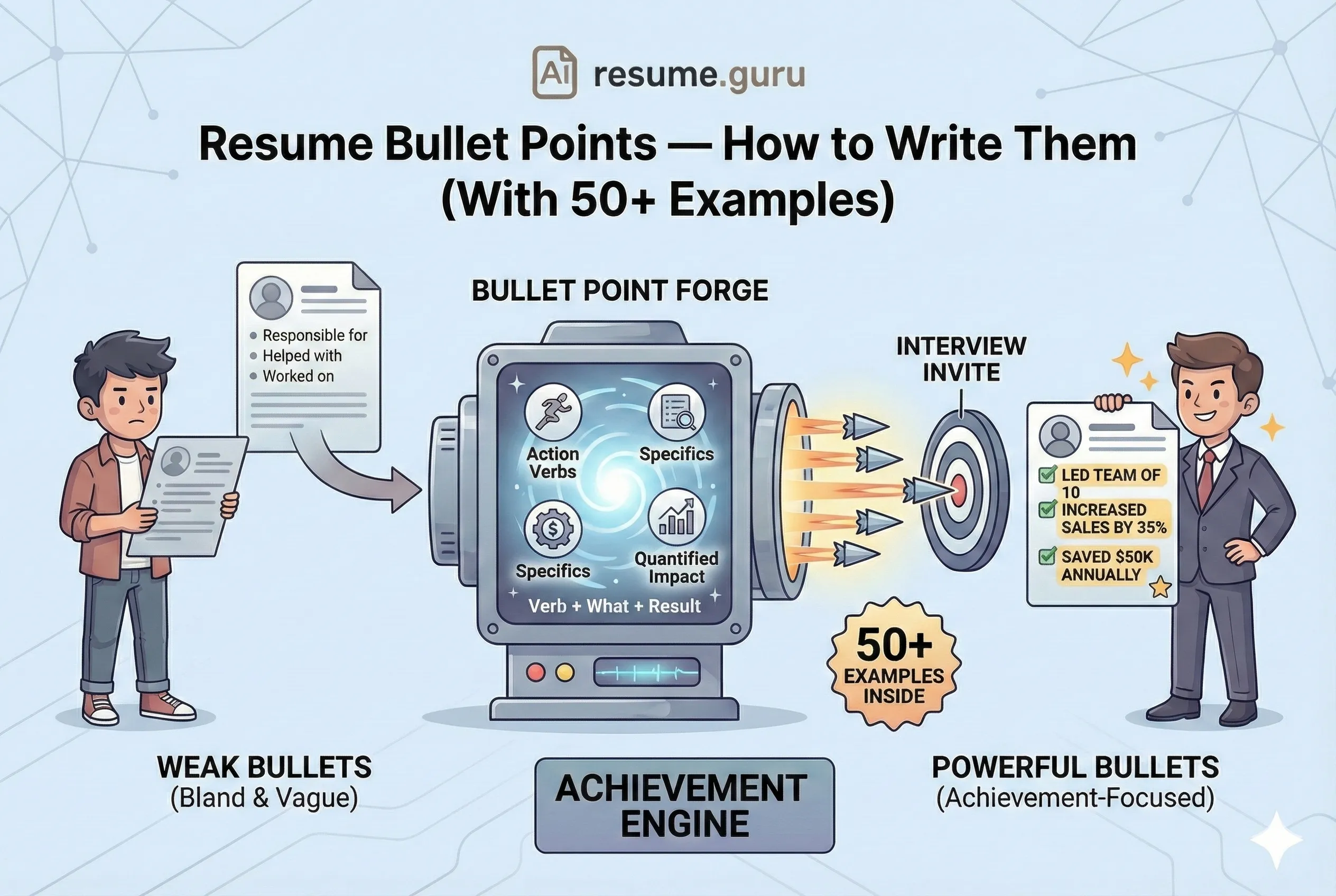
Resume Bullet Points: How to Write Them With 50 Examples
Turn your responsibilities into specific resume bullets. Use 50 role examples, same-facts rewrites and practical ways to show contribution without inventing numbers.