Goldman Sachs interview practice
Goldman Sachs interview preparation: explain the work behind claims
Prepare division-specific Goldman Sachs answers with complete stories, follow-ups and a worked earnings-to-cash exercise using original practice inputs.
Practice for Goldman SachsFree account, no card. Paste your Goldman Sachs posting, choose a behavioral round and answer questions built from your resume.
The short version
Prepare a clear reason for your division, detailed explanations of your resume and role-specific technical practice. Student guidance describes HireVue and Superday and mentions an engineering assessment; experienced applicants should follow their own instructions. Good practice makes the assumptions, checks, alternatives and personal contribution in each answer easy to follow.
What you will have by the end
- Explain division motivation through your own work and interests.
- Reconcile earnings to cash and investigate a reporting discrepancy.
- Prepare varied stories with clear ownership and follow-up reasoning.
On this page
Step 1 of 4
Confirm the format and prepare for the division’s work
Goldman Sachs’ student preparation page describes campus interviews and an engineering assessment. Confirm your own format and permitted tools rather than assuming every division or experienced role follows that route. For a recorded interview, practice concise answers aloud and check your setup before the scheduled session.
For banking, revisit accounting and model assumptions; for risk, practice uncertainty and escalation; for operations, trace a transaction or exception through checks; for engineering, practice coding and system decisions relevant to the invitation. Prepare independently and follow the employer’s AI-use and assessment instructions.
From Goldman Sachs: Goldman Sachs: student application and interview preparation · Goldman Sachs: New York investment banking summer associate, 2027 · Goldman Sachs: Salt Lake City operations summer analyst, 2027 · Goldman Sachs: Dallas risk summer analyst, 2027 · Goldman Sachs: New York engineering summer analyst, 2027
Step 2 of 4
Reconcile a favorable earnings story to a cash result
This fictional analysis exercise uses original inputs in millions of dollars. Revenue is 120, cash operating costs excluding depreciation are 84, depreciation is 6, the assumed tax rate is 25%, capital expenditure is 10 and working capital increases by 8. Assume no interest expense or other adjustments.
| Step | Base calculation | Result |
|---|---|---|
| EBITDA | 120 − 84 | 36.0 |
| EBIT | 36 − 6 | 30.0 |
| After-tax operating profit | 30 × (1 − 0.25) | 22.5 |
| Unlevered free cash flow | 22.5 + 6 − 10 − 8 | 10.5 |
| Higher working-capital use | 22.5 + 6 − 10 − 14 | 4.5 |
From EBITDA to cash: state the missing assumptions
I would first confirm the period, units and that the operating-cost figure excludes depreciation. EBITDA is 120 − 84 = 36. EBIT is 36 − 6 = 30, assumed operating tax is 30 × 25% = 7.5, and after-tax operating profit is 22.5. Adding back depreciation and subtracting capital expenditure and the working-capital increase gives unlevered free cash flow of 22.5 + 6 − 10 − 8 = 10.5. If working capital instead increases by 14, cash flow falls to 4.5 even though EBITDA is unchanged. I would investigate whether the increase comes from receivables, inventory or payables before describing operating performance as stronger. This is one period of a simplified model, so I would not use it alone to reach a valuation or financing conclusion. The key result is that earnings and cash generation tell different parts of the story.
Follow-ups to prepare
Try each one out loud, then open it for what to cover.
-
The operations extract shows working capital increased by 11. What next?
Reconcile period cutoff, currency, included entities and the signs of receivables, inventory and payables. With an increase of 11, the same bridge gives 7.5. Preserve both versions until the data owner confirms the correct scope.
-
Can you estimate value from the 10.5 cash-flow figure alone?
No. A valuation needs future cash flows, discount-rate and terminal assumptions, among other context. One simplified period does not justify a company value or investment decision.
Make it yours: For banking, explain the bridge and assumptions; for risk, stress cash demands; for operations, reconcile the data feeding the bridge. This is analytical practice, not an investment recommendation.
Now test one of your own stories
Paste your Goldman Sachs posting and pick a behavioral round. Your AI interviewer asks about your resume, digs into your answers and coaches you on each one.
Step 3 of 4
Practice four different stories rather than one polished script
These fictional spoken examples use illustrative inputs across finance, operations, risk and engineering.
Analytical integrity: correct a model under time pressure
In a finance class project, our team was about to present a valuation model when I noticed the cash-flow result looked unusually strong. I owned the working-capital schedule. I checked the formulas against our assumptions and found that an increase in receivables had been added to cash rather than subtracted. I corrected the sign, traced the change through all scenarios and asked a teammate to reproduce the bridge independently. We could have left the slide unchanged and mentioned a caveat, but that would have preserved the wrong conclusion. I told the presenter before rehearsal and we replaced the headline with a range. The corrected work changed our recommendation and taught me to validate financial direction, not only whether formulas calculate.
Follow-ups to prepare
Try each one out loud, then open it for what to cover.
-
How would you prevent that error recurring?
Add a direction check: higher receivables should consume cash when other inputs are unchanged. Pair the check with an independent bridge rather than relying only on formula consistency.
Make it yours: Keep the educational setting clear and prepare the exact sign logic.
Operations ownership: escalate without hiding the backlog
During an internship, a daily reconciliation had 38 breaks and a reporting cutoff approaching. I owned the investigation log, not the final release decision. I grouped breaks by cause, traced 24 to reference-data mismatches and sent the supervisor the evidence for correction. I considered prioritizing only the biggest amounts, but that would have missed a recurring source problem. For the remaining items, I recorded the owner, latest evidence and next action rather than marking them resolved. The supervisor approved the documented corrections and carried the unresolved items into the next handoff. We finished with an accurate status report and a clearer queue, which was more useful than a superficially clean total.
Follow-ups to prepare
Try each one out loud, then open it for what to cover.
-
How did you prioritize the remaining unresolved breaks?
Explain the actual cutoff, potential impact and dependencies with the supervisor. Keep unresolved items visible with owners and evidence; a small amount can still indicate a recurring source issue.
The same story on a resume
Grouped 38 reconciliation breaks by cause, documented 24 reference-data corrections and preserved owners and next actions for unresolved items.
Make it yours: A good operations result can be an accurate controlled handoff rather than a claim that every exception disappeared.
Risk judgment: separate scenario output from a decision
In a synthetic receivables project, I was responsible for the stress analysis. The base case showed a comfortable cash buffer, but I noticed the model assumed every customer paid on the same schedule. I grouped customers by concentration and modeled delayed collections for the largest group. I compared that with a uniform-delay scenario and documented why neither was a prediction. The concentrated delay used more cash even when total revenue stayed constant. I presented both cases and identified the input that mattered most: collection timing for the largest accounts. Our team added a concentration sensitivity instead of presenting one favorable base case. I learned to make the uncertainty visible before discussing the result.
Follow-ups to prepare
Try each one out loud, then open it for what to cover.
-
Which assumption would you investigate first with real data?
Collection timing and concentration are central to this exercise. Check historical patterns and data scope before selecting a stress scenario, and distinguish an observed distribution from a judgmental assumption.
Make it yours: Do not turn a classroom scenario into a claim of setting bank limits or preventing a real loss.
Engineering: financial correctness before throughput
For a synthetic transaction service, I owned amount validation. A performance test looked fast, but I found that floating-point handling could change small decimal totals. I built a minimal failing case, proposed decimal-safe representation and added checks for currency and duplicate requests. A teammate wanted to postpone the change until after the demo. I compared the options using correctness and implementation cost, then we agreed to complete the validation first and reduce the demo scope. Thirty-two edge-case tests passed before we returned to throughput work. I learned that a convincing performance number is not useful if the represented amounts are wrong.
Follow-ups to prepare
Try each one out loud, then open it for what to cover.
-
Why is passing 32 tests not proof the service is correct?
The tests cover selected cases. Discuss missing input combinations, rounding policies, concurrency and independent reconciliation; explain how further validation would address the remaining uncertainty.
Make it yours: Be ready to discuss representation, rounding rules, duplicate handling and what your tests did not establish.
Keep reading
- Build a behavioral answer with STAR →
Organize the situation, your decision and the result before practicing follow-up questions.
Step 4 of 4
Make your motivation specific enough to invite a conversation
Avoid a motivation built entirely on reputation. Name the division’s work, connect it to an experience and explain what you want to learn or contribute. Then ask about a responsibility you genuinely need to understand.
For operations, ask how teams investigate recurring breaks across business and technology. For risk, ask how analysts communicate model limitations. For banking, ask how a junior contributor’s analysis moves through review. For engineering, ask how correctness and reliability are evaluated alongside delivery. Use the answers to understand the team’s responsibilities and where you could contribute.
Keep reading
- Ask useful questions at the end →
Turn remaining uncertainty about the work and team into specific questions.
Goldman Sachs interview FAQs
How should I prepare for a Goldman Sachs Superday?
For a campus invitation, use the division and format in the instructions to plan practice. Prepare motivation, resume evidence and the relevant technical fundamentals. Rehearse follow-ups that ask what you personally did, what you checked and which assumption could change your conclusion.
Do experienced Goldman Sachs hires follow the student process?
Do not assume that. The public preparation page is student-scoped and describes campus recruiting. Experienced candidates should confirm their interviews, assessments and preparation materials with their recruiting contact.
How much finance should an engineering applicant prepare?
Start with the technical responsibilities and assessment instructions. Understand the business context well enough to discuss correctness, users and operational consequences, but do not replace coding and system preparation with a banking interview syllabus unless your role calls for it.
What makes an analytical answer credible?
Define units and assumptions, show the calculation, reconcile the result and explain its limits. Distinguish revenue, earnings and cash, and revise the recommendation when an input changes. A correct number needs an explanation of what it means.
Can I use confidential work in my interview stories?
Use an anonymized description and share only what you are permitted to disclose. You can explain the method, your action, review process and lesson without client names, non-public transaction terms or account data. Choose another example if the useful details cannot be shared.
Your next step
Practice the reasoning behind your Goldman Sachs answers
Open AI ResumeGuru’s mock interview, select or import your resume and paste the Goldman Sachs posting after arriving. Use typed practice with coaching and a scorecard to identify a missing assumption, unclear personal action or weak result. A free account includes a limited practice allowance. Revise from your own facts, then rehearse aloud and complete any separate technical preparation before the interview.
Continue your preparation
Related Skills Guides
Related Articles
Behavioral Interview Questions: 22 Examples + STAR Answers
“Tell me about a time when…” Here are 22 common behavioral interview questions by theme, the STAR method for answering them out loud, and full example answers you can model.
Questions to Ask at the End of an Interview (30 Smart Ones)
“Do you have any questions for us?” Don't freeze. Here are 30 smart questions by category, who to ask each, what to ask in second and final rounds, the ones that make you stand out, and what never to ask.
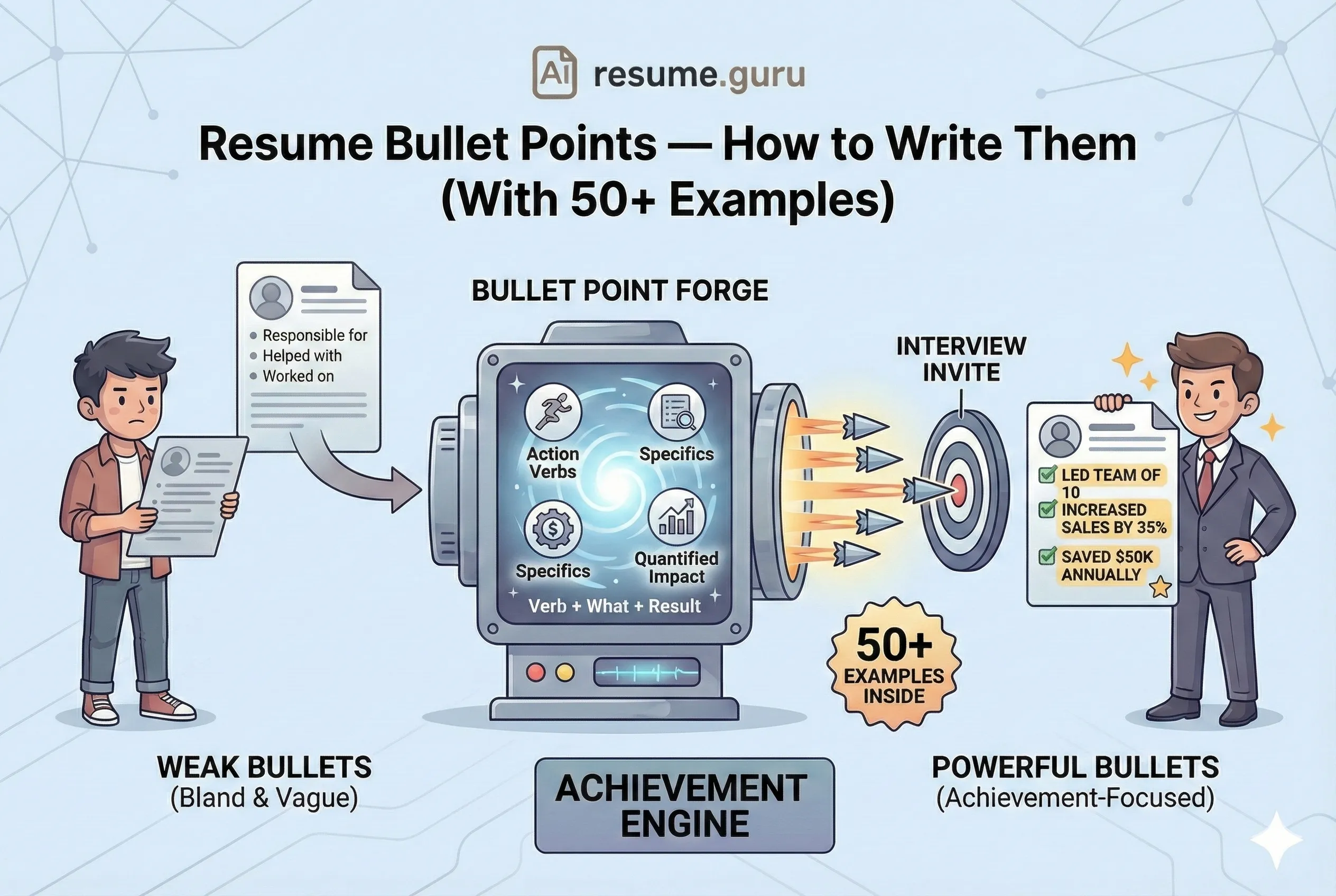
Resume Bullet Points: How to Write Them With 50 Examples
Turn your responsibilities into specific resume bullets. Use 50 role examples, same-facts rewrites and practical ways to show contribution without inventing numbers.