Capital One interview practice
Prepare for Capital One interviews with math and clear decisions
Practice Capital One case reasoning, behavioral stories and technical trade-offs with worked unit economics, sensitivity math and useful follow-ups.
Practice for Capital OneFree account, no card. Paste your Capital One posting, choose a behavioral round and answer questions built from your resume.
The short version
Confirm the interview format for your role, then practice explaining decisions with enough detail for follow-ups. For a confirmed case, clarify the objective, calculate with consistent units, test a key assumption and recommend an action. For behavioral or technical interviews, explain your personal contribution, alternatives, validation and lessons. Not every Capital One position uses a case.
What you will have by the end
- Calculate break-even and revise a recommendation under sensitivity.
- Prepare complete behavioral and technical decision stories.
- Ask follow-ups that expose assumptions before you commit.
On this page
Step 1 of 4
Confirm which Capital One interview you are preparing for
Capital One’s case guidance emphasizes reasoning, clear communication and a recommendation. Its business analyst article describes a mini case and Power Day for that job-family context. Use your own invitation to determine the format, especially for experienced engineering or other US roles.
Prepare a short introduction, a role-specific motivation and projects you can explain deeply. For a case, focus on the scenario rather than reciting resume achievements. Capital One’s candidate terms require independent screenings, interviews and assessments; external resources, AI tools and existing materials are prohibited during them unless permission is specifically indicated. Use these exercises beforehand and confirm any permitted tools with your recruiting contact.
From Capital One: Capital One: four tips for a case interview · Capital One: business analyst interview guidance · Capital One candidate frequently asked questions · Capital One: candidate terms and conditions
Step 2 of 4
Work a break-even case and change the recommendation
This fictional subscription-service case uses original practice inputs. Treat it as interview math: price is $15 per subscriber per month, variable cost is $9, fixed operating cost is $36,000 per month and expected steady monthly volume is 8,000 subscribers.
| Scenario | Contribution per subscriber | Break-even volume | Profit at 8,000 |
|---|---|---|---|
| Base: $15 price, $9 cost | $6 per month | 6,000 subscribers | $12,000 per month |
| Cost rises to $11 | $4 per month | 9,000 subscribers | −$4,000 per month |
| $16 price, $11 cost | $5 per month | 7,200 subscribers | $4,000 per month, if volume holds |
A profitable base case can still need a pilot
I would first confirm that we are optimizing monthly operating contribution and that the volume forecast means active paying subscribers. Contribution per subscriber is $15 − $9 = $6, so break-even is $36,000 ÷ $6 = 6,000 subscribers. At 8,000, revenue is $120,000, variable cost is $72,000 and operating profit before excluded costs is $12,000. I would recommend a limited pilot, because acquisition and launch costs are not yet included. If variable cost rises to $11, contribution falls to $4 and break-even becomes 9,000 subscribers; at 8,000 we lose $4,000. That changes my recommendation to renegotiate costs or test willingness to pay before expansion. At a $16 price and $11 cost, break-even is 7,200, but I would not assume volume stays unchanged after a price increase. My next decision depends on pilot evidence about demand and support cost.
Follow-ups to prepare
Try each one out loud, then open it for what to cover.
-
What if expected volume falls to 5,000?
At the original $6 contribution, profit is $30,000 − $36,000 = −$6,000 per month. Reassess the fixed-cost commitment or find evidence that demand can exceed break-even.
-
What if acquiring each subscriber costs $24?
For 8,000 newly acquired subscribers, that is $192,000 upfront. At a stable $12,000 monthly operating profit, simple recovery takes 16 months before churn, financing or other costs; ask for retention data before relying on that result.
Make it yours: Write the units beside each calculation. A conditional recommendation is stronger than defending the first answer after the economics change.
Now test one of your own stories
Paste your Capital One posting and pick a behavioral round. Your AI interviewer asks about your resume, digs into your answers and coaches you on each one.
Step 3 of 4
Practice stories with a decision and a defensible result
These fictional spoken answers use illustrative measurements across analytical, technical and collaboration settings.
Analysis: challenge a favorable result
Our subscription report showed a sharp activation increase after an onboarding change, and I owned the analysis for a rollout recommendation. I checked the event definition before comparing cohorts and found that retries were counted as new activations. I wrote a deduplication query, reconciled a sample to raw events and asked the product owner to approve the revised definition. I considered using the original dashboard with a footnote, but it would have preserved a misleading trend. The corrected rate moved from 48% to 54%, rather than the reported 68%. I recommended a monitored pilot because the cohorts were observational. The team used the corrected report, and I added a retry-data check to the reporting checklist.
Follow-ups to prepare
Try each one out loud, then open it for what to cover.
-
What did you personally do versus the product team?
The analyst wrote and reconciled the query and explained the measurement limitation. The product owner approved the definition and made the rollout decision. Keep those responsibilities separate.
The same story on a resume
Corrected duplicate activation events and rebuilt cohort reporting, replacing a misleading 68% rate with a reviewed 54% measure for the rollout decision.
Make it yours: Prepare to explain the denominator and why the analysis does not prove causation.
Engineering: choose safe retries over a quick patch
A status-update service could process the same request twice after a timeout. I owned the handler change. I reproduced the duplicate with synthetic requests, checked how request identifiers survived retries and proposed idempotent writes. A teammate preferred extending the timeout, which could reduce retries without preventing duplicate processing. I demonstrated the failure path, added duplicate and out-of-order test cases and arranged a staged deployment with rollback criteria. In 5,000 replayed synthetic requests, the new tests showed no duplicate writes. Production monitoring then became the release owner’s acceptance check. I learned to separate proving a failure-mode fix in tests from claiming an unmeasured financial impact.
Follow-ups to prepare
Try each one out loud, then open it for what to cover.
-
What happens if a duplicate arrives after the deduplication window?
Discuss the actual retention policy, durable identifiers and downstream constraints in your implementation. A time window alone cannot guarantee indefinite deduplication.
Make it yours: Explain persistence, retry behavior and the failure cases your test set did not cover.
Collaboration: disagree on a pilot threshold
On a service pilot, marketing wanted an immediate rollout after favorable sign-up counts. I owned the operating-cost model, and support data suggested the first week understated repeat contacts. I met with the support lead, separated one-time setup from recurring costs and showed the sponsor a base case and a high-contact scenario. I proposed a two-week extension instead of rejecting the idea outright. The sponsor accepted the extension, support agreed to a shared cost definition and we discovered that one onboarding issue drove most repeat contacts. The team fixed that issue before revisiting rollout. I learned that a useful challenge gives colleagues a measurable path to a decision.
Follow-ups to prepare
Try each one out loud, then open it for what to cover.
-
What would you do if the sponsor refused the extension?
Explain the uncertainty and its possible effect, preserve your analysis and offer the smallest approved monitoring plan. The sponsor owns the rollout decision; your role is to make the trade-off explicit and escalate material concerns through the appropriate channel.
Make it yours: Keep the story about an evidence-based disagreement and resolution, rather than describing a colleague as careless.
Keep reading
- Build a behavioral answer with STAR →
Organize the situation, your decision and the result before practicing follow-up questions.
Step 4 of 4
Connect motivation and questions to the actual work
Build your motivation from one responsibility in the posting, one relevant experience and one question about the team. For an analyst role, explain why translating data into business choices appeals to you; for engineering, explain the systems and delivery problems you want to own.
In technical practice, sketch inputs, dependencies, failure modes and validation before choosing a tool. In analytical practice, list what would change your recommendation. Use anonymized work examples and follow the employer’s assessment and AI-use instructions; preparation should leave you able to reason independently.
Ask
Which decisions does this role own, and which go to partner teams?
Ask
What data or operational constraint most often changes a recommendation?
Ask
How does the team validate a pilot before expanding it?
Keep reading
- Ask useful questions at the end →
Turn remaining uncertainty about the work and team into specific questions.
Capital One interview FAQs
How do I prepare for a Capital One case interview?
Practice clarifying the objective, setting units, calculating contribution and break-even, and explaining a recommendation. Then change a major input and recalculate. Capital One’s official guidance values sharing reasoning and communicating complex ideas clearly.
Is Power Day the same for every Capital One role?
Check the format in your invitation or with your recruiter. Capital One’s business analyst guidance describes a mini case followed by Power Day for that job family. Ask which behavioral, case or technical exercises your own role includes so you can practice the right work.
What if I make an arithmetic error during practice?
State the assumption and units, identify the incorrect step and recalculate. Then say whether the corrected result changes the recommendation. Practicing this recovery makes your reasoning easier to follow than memorizing an answer without understanding it.
Do engineers only need business-case practice?
No. Prepare the technical work in your posting and invitation, including implementation, testing, reliability or design as relevant. Use a project you personally contributed to and practice follow-ups on alternatives, failure behavior and validation.
How do acquisition costs change the break-even recommendation?
Include one-time acquisition spending alongside monthly operating results. In the worked example, acquiring 8,000 subscribers at $24 costs $192,000. Recovering that at a steady $12,000 monthly operating profit takes 16 months, before churn and the other excluded costs. Test how retention and volume change that horizon.
Your next step
Practice the reasoning behind your Capital One answers
Open AI ResumeGuru’s mock interview, select or import your resume and paste the Capital One posting after arriving. Use typed practice with coaching and a scorecard to identify a missing assumption, unclear personal action or weak result. A free account includes a limited practice allowance. Revise from your own facts, then rehearse aloud and complete any separate technical preparation before the interview.
Continue your preparation
Related Skills Guides
Related Articles
Behavioral Interview Questions: 22 Examples + STAR Answers
“Tell me about a time when…” Here are 22 common behavioral interview questions by theme, the STAR method for answering them out loud, and full example answers you can model.
Questions to Ask at the End of an Interview (30 Smart Ones)
“Do you have any questions for us?” Don't freeze. Here are 30 smart questions by category, who to ask each, what to ask in second and final rounds, the ones that make you stand out, and what never to ask.
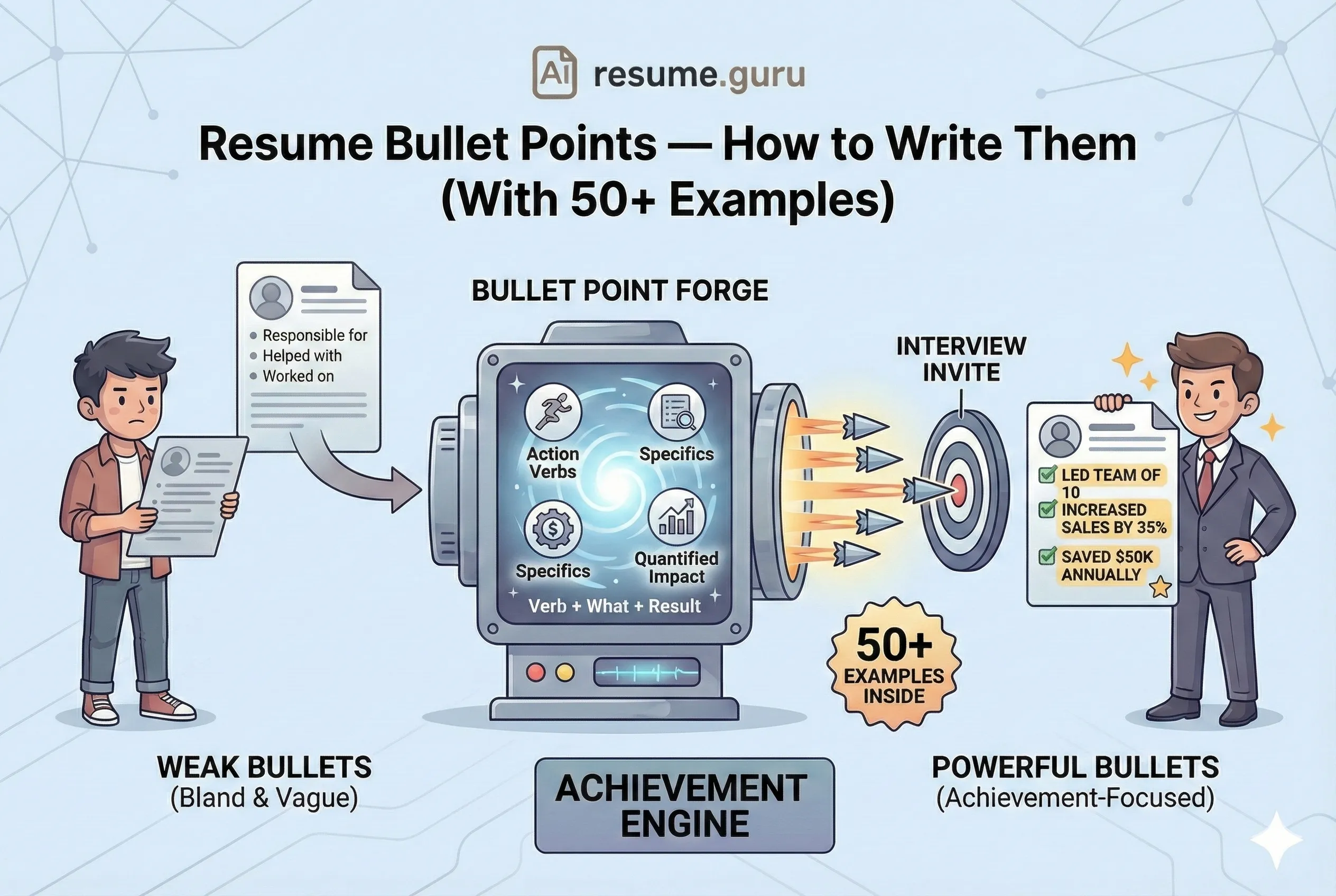
Resume Bullet Points: How to Write Them With 50 Examples
Turn your responsibilities into specific resume bullets. Use 50 role examples, same-facts rewrites and practical ways to show contribution without inventing numbers.