Let’s talk about the job title dilemma.
Your company called you “Level 3 Solutions Associate.” The rest of the world calls that “Customer Success Manager.” You’re applying to jobs titled “Client Relations Specialist.”
Which one goes on your resume?
More likely to get interviewed
When resume title matches the job posting exactly
Source: Jobscan
Matching job titles to keywords matters—it’s one of the biggest factors behind your ATS match score. But there’s a line between clarifying your role and lying about it.
The short answer: you can translate an internal or vague job title into the industry-standard equivalent, but you cannot promote yourself to a level you never held. Keep the employer’s official title verifiable — put the standard version in parentheses beside it — and make sure your bullet points back up whatever title you list.
Here’s how to navigate it.
The Title Rules
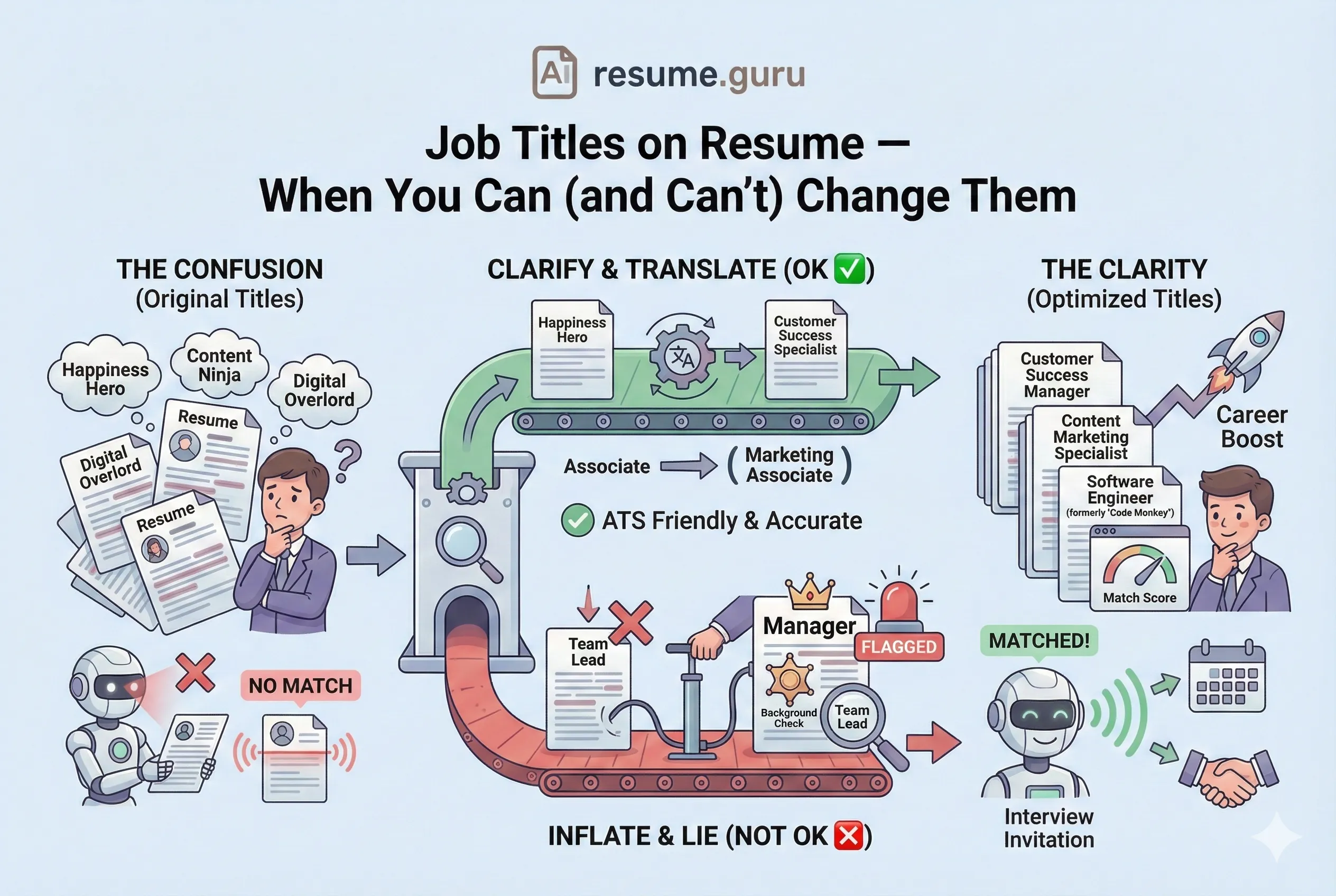
- Clarify confusing or company-specific titles—OK
- Translate to industry-standard language—OK
- Inflate to a higher level you didn’t hold—NOT OK
- Use parentheses when in doubt—safe middle ground
Why Job Titles Matter
Job titles do two things on your resume:
-
ATS Matching: Applicant Tracking Systems search for specific titles. If the job posting says “Marketing Manager” and your resume says “Marketing Lead,” you might not score as highly—and once you understand how an ATS works, it’s clear why an exact title match moves the needle.
-
Human Understanding: Recruiters skim fast. A clear, recognizable title helps them instantly understand your level and function. A title nobody recognizes is a quiet reason a resume isn’t getting interviews.
The Creative Title Problem
Companies love unique job titles: “Growth Hacker,” “Happiness Hero,” “Ninja of User Experience.” These might be fun internally—but recruiters don’t search for ninjas. They search for “UX Designer.”
Title matching is exactly what match-rate tools measure — compare against Jobscan to see how much weight a title carries.
When You Can Change Job Titles
✅ Scenario 1: Translation (Weird Title → Standard Title)
If your company used an unconventional title for a standard role, you can translate it.
| Company Title | Resume Translation |
|---|---|
| Happiness Hero | Customer Support Representative |
| Content Ninja | Content Marketing Specialist |
| Code Monkey | Software Developer |
| Digital Overlord | Digital Marketing Manager |
| Chief Vibes Officer | Office Manager |
Why This Is OK
You’re not claiming a role you didn’t have—you’re describing it in language the industry understands. The responsibilities stay the same, and choosing the standard term is the same discipline that drives a strong resume keywords strategy.
✅ Scenario 2: Clarification (Vague Title → Specific Title)
If your title was generic or vague, you can add context.
Before: “Associate” After: “Marketing Associate” or “Finance Associate”
Before: “Specialist” After: “Technical Support Specialist” or “HR Specialist”
This is standard practice—vague titles help no one.
✅ Scenario 3: Parenthetical Addition
Not sure if your translation is safe? Use parentheses.
Format: Official Title (Clarifying Title)
| Official Title | Resume Format |
|---|---|
| Level 3 Solutions Associate | Level 3 Solutions Associate (Customer Success) |
| Enabler | Enabler (Tour Guide) |
| Squad Lead | Squad Lead (Engineering Team Lead) |
This approach:
- Keeps your official title (background check won’t fail)
- Adds recognizable context (ATS and recruiters understand)
- Stays 100% accurate
When You Can’t Change Job Titles
❌ Scenario 1: Level Inflation
You cannot promote yourself on paper.
| What You Were ❌ | What You Can't Claim |
|---|---|
| Team Lead | Manager |
| Manager | Director |
| Coordinator | Manager |
| Associate | Senior |
| Individual Contributor | Team Lead |
Background Checks Exist
Most employers verify titles with your previous HR department. If they see “Marketing Director” on your resume but your company says “Marketing Coordinator,” you’ll lose the offer—or your job if you’re already hired. Title inflation is one of the resume lies that get caught, and it’s never worth the risk.
❌ Scenario 2: Completely Inventing Roles
You can’t create a title you never held. “I acted like a manager” doesn’t mean you can list “Manager” as your title. What you can clean up instead is the surrounding detail — including how you format dates on your resume.
If you had expanded responsibilities without a title change, show it in your bullet points instead:
“Led 5-person team on special projects while maintaining individual contributor duties”
❌ Scenario 3: Claiming Credentials You Don’t Have
Titles that imply certifications or licenses you don’t have are off-limits:
- “CPA” if you’re not certified
- “Registered Nurse” if you’re not licensed
- “Attorney” without passing the bar
The Responsibility Test
Here’s a simple rule: Your bullet points must support your title.
If you call yourself a “Marketing Manager” but your bullets describe entry-level tasks (scheduling posts, basic copywriting), recruiters will notice the mismatch.
The Proof Rule
Before using a translated title, ask: “Can I confidently describe this work in an interview?” If yes, the title is probably appropriate. If no, you’re inflating.
If the bullets underneath don’t yet carry that weight, write stronger resume bullets before you touch the title.
How to Match Titles to Target Jobs
When applying for a specific role, your job title should help ATS connect the dots—this is one of the highest-leverage moves when tailoring your resume to a job description. You can rewrite your resume around one job posting so the title language lines up automatically, then check how closely your title matches the posting before you hit submit.
- 1
Read the target job posting
Note the exact job title they're hiring for.
- 2
Compare to your experience
Is your past role functionally the same?
- 3
Translate if needed
Adjust to industry-standard language (not level inflation).
- 4
Verify in bullet points
Make sure your accomplishments support the title.
- 5
Prepare your explanation
Be ready to explain any title translation in interviews.
LinkedIn Consistency
Whatever you put on your resume, your LinkedIn should match.
Recruiters will check. If your resume says “Product Manager” and LinkedIn says “Associate Product Manager,” you’ve created doubt.
Pro Tip
Use your LinkedIn headline for positioning: “Marketing Professional | Growth & Content Strategy” lets you be findable without locking you into a specific title. The same thinking applies on your resume—see these resume headline examples for formats that signal level without overclaiming, and run the posting through Skills Finder to surface the exact terms recruiters search for.
Handling Demotions and Lateral Moves
What if your title went down or sideways?
Lateral Moves
If you took a comparable role with a different title, list both titles clearly:
“Product Marketing Manager (Company A), 2022-2023” “Marketing Lead (Company B), 2023-Present”
Demotions or Scope Changes
If you stepped back in title (for any reason), you have options:
-
List the highest title you held: If you were Manager and then moved to Senior IC, you can list “Manager” if it’s accurate for the period.
-
Combine roles: If within same company:
“Project Lead / Senior Analyst, 2020-2024”
-
Focus on bullets: Your accomplishments matter more than the title line.
Common Mistakes to Avoid
Mistake #1: Inflating to Get ATS Matches
Adding “Senior” or “Manager” to boost keyword matches is tempting—but background checks will catch you. It’s not worth the risk.
Mistake #2: Different Titles on Resume vs Applications
Job applications often ask for your “official title as it would appear on an employment verification.” Use your real title there, even if your resume translates it.
Mistake #3: Forgetting to Explain in Interviews
If you translated “Customer Happiness Specialist” to “Customer Success Manager,” be ready to explain why. It’s not a big deal—but getting caught off guard looks bad.
If you’re unsure whether your translated titles read honestly, get an honest resume roast before a recruiter does it for you.
Quick Reference: Can I Change This Title?
| Situation | Can You Change It? |
|---|---|
| Internal → Standard (e.g., “Enabler” → “Tour Guide”) | ✅ Yes |
| Generic → Specific (e.g., “Associate” → “Marketing Associate”) | ✅ Yes |
| Equivalent level → Different title (e.g., “Coordinator” → “Specialist”) | ✅ Usually |
| Your level → Higher level (e.g., “Lead” → “Manager”) | ❌ No |
| Internal only → External credential (e.g., adding “CPA”) | ❌ No |
| Outdated title → Modern equivalent | ✅ Yes, with parentheses |
The Bottom Line
Job titles matter—for ATS, for understanding, and for credibility.
You can translate confusing titles into industry-standard language. You can clarify vague titles with parenthetical context. You can position yourself effectively.
What you can’t do is lie.
Background checks verify titles. Recruiters notice when bullets don’t match titles. And getting exposed as a title inflator can cost you far more than the job you were applying for.
When in doubt, use parentheses. Stay accurate. Let your achievements speak.
Optimize your resume titles
Our AI helps you position yourself accurately—matching job description language without crossing lines.
Start Building FreeRelated Resources
- Extract Keywords from Job Description — Find the right language to match
- ATS Optimization Guide — Full keyword strategy
- LinkedIn Profile Optimization — Keep your profile consistent
- Keyword Scanner Tool — Check your ATS match
- Tailor Your Resume — Align titles and language with one posting
- Resume Examples — See how titles appear in context
Frequently Asked Questions
Can I change job titles on my resume?
You can clarify or translate titles for readability—but you can't inflate them. Changing 'Content Ninja' to 'Content Marketing Specialist' is fine. Changing 'Team Lead' to 'Director' when you weren't one is not.
What if my official title is confusing?
Use the parentheses method: list the original title with the clarifying title in parentheses, like 'Happiness Hero (Customer Support Representative).' This preserves accuracy while improving ATS matching.
Will employers verify my job titles?
Yes—background checks typically verify titles and dates. If the title on your resume doesn't match what HR has on file, it creates a red flag. Be prepared to explain any translation you made.
How do I match my job title to keywords in a job description?
If your actual role matched the target job's responsibilities, you can adjust your title to use industry-standard terminology. Just ensure your bullets clearly support the title you're claiming.
My title got demoted but my responsibilities didn't change. What do I put on my resume?
List the highest accurate title you held, and ensure your bullet points reflect your actual scope of work. Be ready to explain any discrepancy in an interview.
Put this into practice
You have the theory. These take a few minutes and work on the resume you already have.