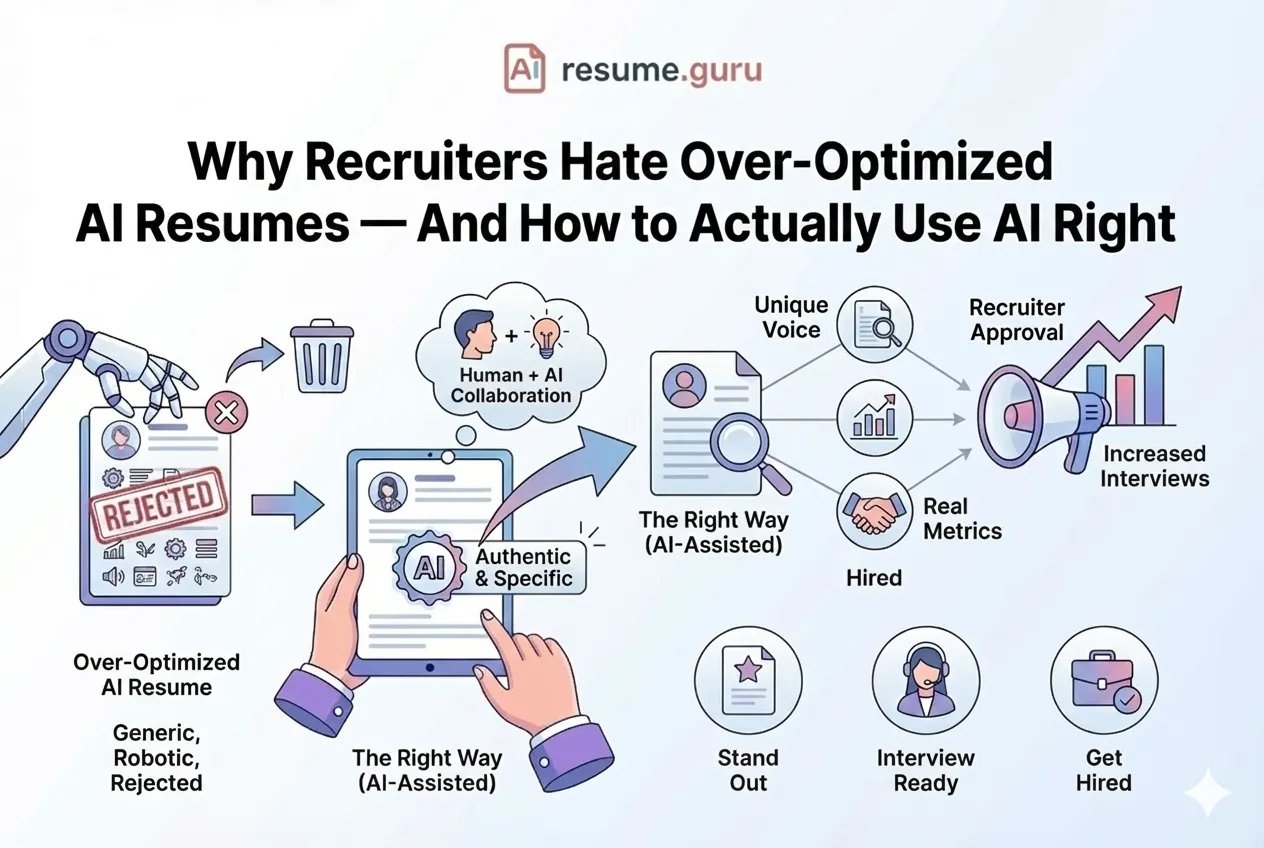
AI can write your resume in 30 seconds.
The question is: should you let it?
Here's the uncomfortable truth that nobody in the resume-builder industry wants to admit: recruiters are starting to hate AI-generated resumes. Not because AI is bad. But because most people use it badly.
They click "generate," accept the output, and submit a resume that sounds like every other AI-generated resume in the pile.
Let's talk about why this backfires — and how to use AI the right way.
The AI Resume Paradox
- 74% of recruiters can spot AI-generated resumes
- 57% are less likely to hire candidates with obvious AI resumes
- The problem isn't AI — it's over-optimization and lost authenticity
- AI should assist, not replace, your unique voice
- The winning formula: AI for structure + Human for substance
- Use AI the right way →
The Signs of Over-Optimization
Recruiters who spot AI resumes
Three-quarters of hiring managers say they can identify AI-generated applications. And more than half are negatively biased against them.
Source: Resume Builder Survey, 2024
What gives AI resumes away? It's not one thing — it's a pattern.
Red Flag #1: The Buzzword Salad
Generic Phrases That Scream 'AI'
- "Results-driven professional with a proven track record"
- "Dynamic self-starter passionate about excellence"
- "Innovative thought leader with strong communication skills"
- "Motivated team player who thrives in fast-paced environments"
These phrases mean nothing. They could describe anyone. And that's exactly why they scream "AI generated."
AI loves buzzwords because they appear in training data frequently. But recruiters have read these phrases thousands of times. They tune them out completely.
Red Flag #2: Lack of Specific Metrics
AI-generated bullets often look like:
❌ "Managed marketing campaigns and drove business growth through strategic initiatives"
Compare to a human-written bullet:
✅ "Led 12 email campaigns (47% open rate), generating $180K in qualified pipeline and 23 closed-won deals"
The first could be any marketer anywhere. The second is your story, with your numbers.
Red Flag #3: Perfect Grammar, Zero Personality
AI writes flawlessly. But it also writes... boringly.
Real humans have quirks, preferences, and voice. We use shortcuts, emphasis, and personality. AI smooths all that away into corporate-speak that reads like a legal document.
I can tell in 3 seconds when someone just hit 'generate' and submitted. The resume is perfect... and completely forgettable. There's no human in it.
Red Flag #4: Mismatched Energy
Here's a subtle one: AI doesn't know you.
If you're a creative designer, your resume shouldn't read like a finance report. If you're an engineer, it shouldn't sound like a marketing pitch.
AI produces generic output that doesn't match the candidate's actual personality or industry voice.
Why Recruiters Push Back
What AI Gets Right
- AI-optimized resumes often pass ATS scanning
- Structure and formatting are typically clean
- Keywords are usually well-placed
- Grammar and spelling are usually perfect
Why Recruiters React Negatively
- No differentiation from other AI resumes
- Implies candidate didn't put in effort
- Raises questions about actual writing ability
- Often contains exaggerations AI 'imagined'
- Generic content = forgettable candidate
The Effort Signal
Here's the psychology: A resume is supposed to represent effort. When a recruiter sees an obviously AI-generated resume, they think:
- "They couldn't be bothered to write about themselves?"
- "If they take shortcuts here, where else will they?"
- "Do they even have the writing skills they'll need in this role?"
Fair or not, that's the perception.
The Trust Issue
AI hallucinations are real. Sometimes AI invents credentials, inflates achievements, or adds skills the candidate doesn't have.
Recruiters know this. An obviously AI resume makes them wonder: "How much of this is even true?"
The Right Way to Use AI
AI isn't the problem. Lazy AI use is the problem.
Here's how to get the benefits of AI without the drawbacks:
- 1
Use AI for structure and format
Let AI suggest section order, bullet point structure, and layout. It's great at understanding what works.
- 2
Generate a first draft, then rewrite
Don't submit AI output directly. Use it as raw material you'll reshape with your voice.
- 3
Add ONLY real metrics
If AI suggests 'increased sales,' replace it with YOUR actual numbers. '47% YoY growth' only works if it's true.
- 4
Read it out loud
Does it sound like you? Would you say this in an interview? If not, rewrite until it does.
- 5
Get a human review
Before submitting, have a friend or mentor read it. Ask: 'Does this sound like me?'
The 60/40 Rule
A good formula:
- AI contribution: 40% — Structure, keyword suggestions, grammar checking
- Your contribution: 60% — Specific achievements, authentic voice, unique stories
The AI is the skeleton. You're the flesh, blood, and personality.
What AI Should Help With
| Use AI For | Do Yourself |
|---|---|
| Keyword extraction from job descriptions | Deciding which achievements to highlight |
| Suggesting action verbs | Adding specific metrics and numbers |
| Grammar and spell checking | Writing in your authentic voice |
| Formatting and structure | Tailoring for specific companies/roles |
| Overcoming writer's block | Final review and personalization |
| ATS optimization basics | Ensuring content is truthful and accurate |
Humanizing AI Output
Got an AI-generated draft? Here's how to humanize it:
Step 1: Kill the Buzzwords
Search your document for:
- "Results-driven"
- "Self-starter"
- "Team player"
- "Passionate about"
- "Proven track record"
- "Strong communication skills"
Delete or replace with specific evidence.
Step 2: Add Your Numbers
Every achievement should have a number attached:
- Percentages (growth, reduction, improvement)
- Dollar amounts (revenue, savings, budget)
- Quantities (team size, projects, customers)
- Timeframes (how fast, how often)
Step 3: Include Your Stories
What's a challenge you overcame? A project you're proud of? A result that surprised even you?
These specific narratives don't fit AI's training data — so they feel human.
Step 4: Read and Adjust Tone
Read your resume out loud. If any sentence feels stiff, corporate, or unlike how you'd actually talk in an interview, rewrite it.
The Interview Test
Ask yourself: "Could I elaborate on this point naturally in an interview?"
If the answer is no — if the bullet is so generic you wouldn't know what to say — it needs to be more specific.
The Winning Formula
The best resumes in 2026 combine:
| AI Contribution | Human Contribution |
|---|---|
| Clean structure | Authentic voice |
| Keyword placement | Specific achievements |
| Grammar perfection | Unique stories |
| ATS optimization | Genuine personality |
| Format suggestions | Role-specific tailoring |
Neither AI alone nor humans alone produce the best results. The combination does.
Checklist: Before You Submit
Is Your Resume Ready?
- Removed generic buzzwords and filler phrases
- Added specific metrics to every achievement
- Read it out loud — sounds like you
- Could discuss every point naturally in an interview
- Tailored for this specific role (not generic)
- Reviewed by a human who knows you
- Content is 100% truthful (no AI hallucinations)
- Demonstrates personality, not just qualifications
Your Move
AI is a tool. Like any tool, the outcome depends on how you use it.
Use AI to handle the tedious parts — structure, keywords, grammar. Then bring your humanity to the parts that matter — your achievements, your voice, your story.
The goal isn't a perfect resume. It's a resume that's perfectly you.
That's what gets interviews. That's what impresses recruiters. That's what leads to offers.
AI power, human touch
Our AI Resume Builder combines intelligent optimization with tools that preserve your authentic voice. Get structure and keywords right, while keeping what makes you uniquely qualified.
Build My ResumeRelated Resources
- How to Quantify Achievements — Add the specifics AI misses
- Action Verbs for Resume — Better than buzzwords
- Resume Lies & Detection — When AI hallucinations become dangerous
- Resume Bullet Point Length — The human touch in formatting
- AI in Resume Writing — The bigger picture
- Resume Examples — See human-written excellence
- Bullet Point Generator — AI assistance done right
- Keyword Scanner — ATS optimization without overdoing it
- Resume Summary Generator — Craft a personalized summary
Frequently Asked Questions
Can recruiters tell if I used AI to write my resume?
According to recent surveys, 74% of recruiters say they can spot AI-generated resumes. Common tells include generic buzzwords, lack of specific metrics, and a 'robotic' tone that lacks personality.
Should I use AI to write my resume?
Yes, but strategically. AI is excellent for structure, keyword optimization, and overcoming writer's block. However, you should heavily edit the output to add your authentic voice, specific achievements, and genuine personality.
What makes an AI resume look 'over-optimized'?
Keyword stuffing, generic phrases like 'results-driven professional,' buzzword salads, lack of specific quantified achievements, and content that could apply to any candidate in any industry.
Will AI-generated resumes pass ATS?
Often yes, but that's only half the battle. Passing ATS gets you to human review, where an obviously AI-generated resume can hurt your chances. The goal is to pass ATS AND impress humans.
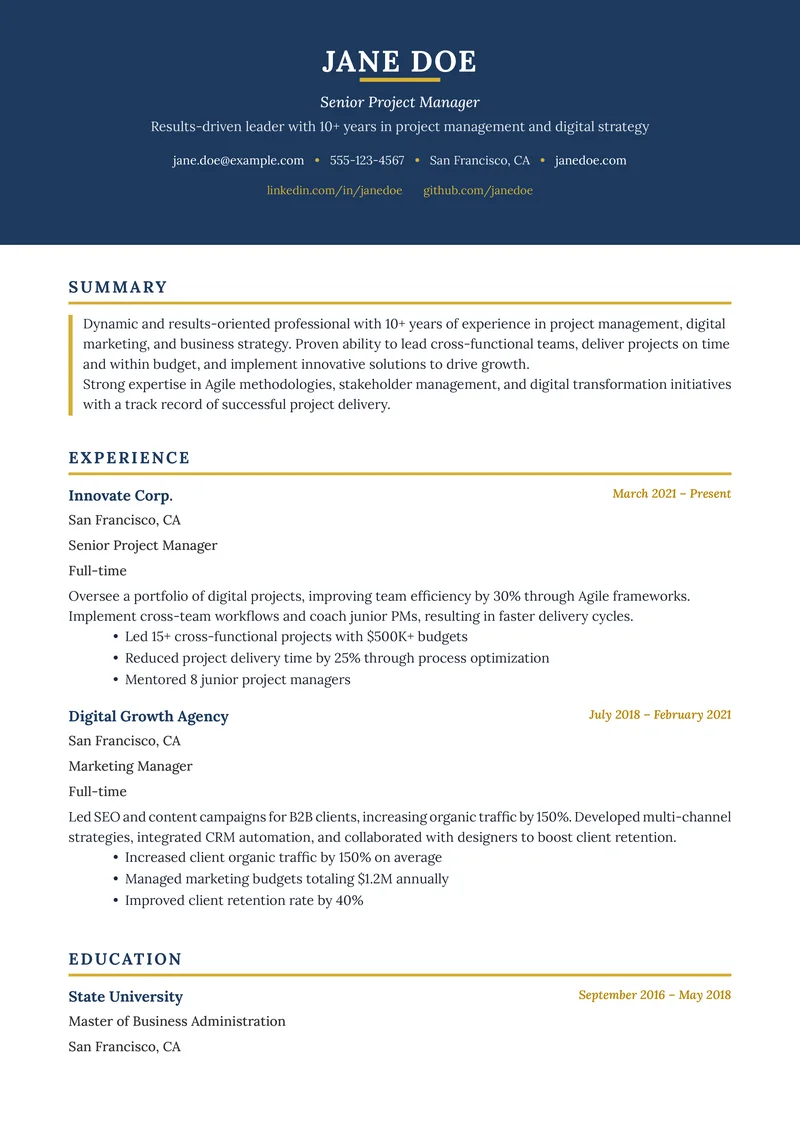
Build Your Perfect Resume
Create an ATS-optimized resume with our AI-powered builder.
No signup required.Start Building FreeExplore Resources
Enjoyed this article?
Share it with your network
