There's a question job seekers have been asking since... well, since resumes existed:
"Should I include references on my resume?"
The short answer for 2026: No.
The longer answer involves understanding why the rules changed, when you do need references, and how to handle this aspect of your job search professionally.
Let's clear up the confusion.
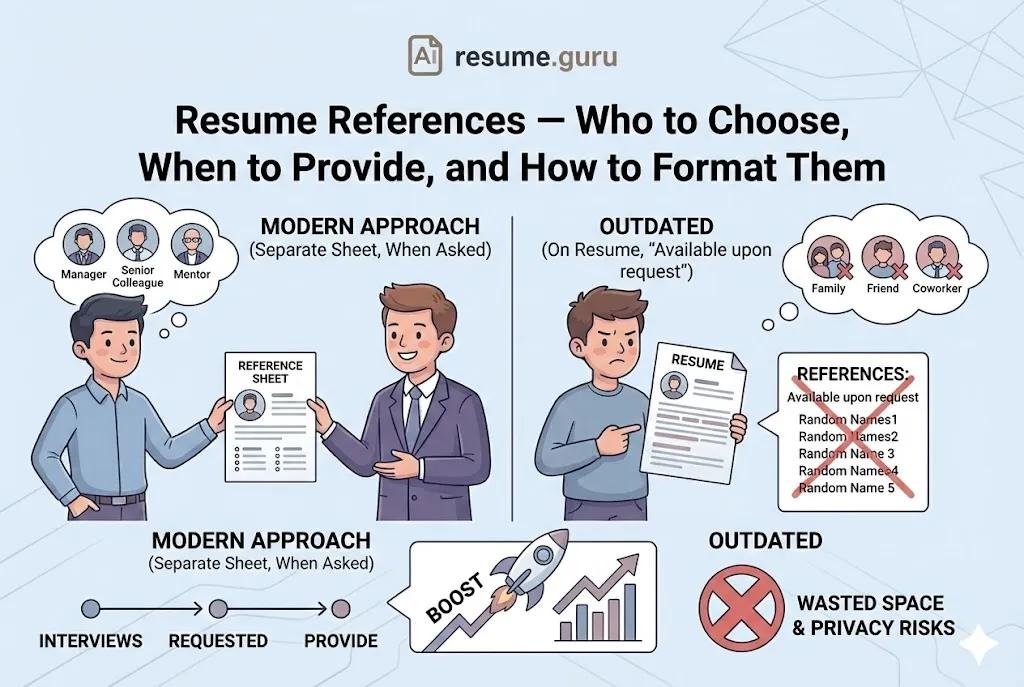
Modern Reference Rules
- Don't include references on your resume
- Don't write "References available upon request" (outdated, wastes space)
- Do prepare a separate reference sheet
- Do provide references only when specifically requested
- Do ask permission before listing anyone
- Build your professional resume →
Why References Don't Belong on Your Resume
Space you should dedicate to references
Every line on your resume should sell your candidacy. References don't — they just list other people's contact info.
Source: Resume best practices
Here's the logic:
- References aren't checked until late in the process — typically after interviews
- Contact information takes up valuable real estate — space better used for achievements
- Employers assume you have references — you don't need to state the obvious
- Privacy concerns — You're sharing others' contact details without knowing who will see them
What About "References Available Upon Request"?
Outdated Phrase
The line "References available upon request" is resume filler from the 1990s. It adds nothing and signals that you're using dated job search advice. Skip it.
Unless the job posting explicitly asks for references, omit them entirely from your resume.
When You Actually Need References
References become important at these stages:
- 1
After successful interviews
Employers typically request references as they move toward making an offer.
- 2
Background check phase
Some companies verify employment history by calling former managers.
- 3
Government or security-clearance roles
These often require references upfront, sometimes on the application itself.
- 4
When explicitly requested
If the job posting says 'include references,' follow instructions.
Creating a Reference Sheet
When the time comes, you'll need a polished reference sheet ready to go.
What to Include
For each reference:
| Element | What to Write |
|---|---|
| Full Name | As they use professionally (Sarah Chen, not Sally C.) |
| Job Title | Their current position |
| Company | Where they currently work |
| Phone Number | Best number to reach them |
| Email Address | Professional email |
| Relationship | "Former Manager at ABC Corp" or "Direct Supervisor (2020-2023)" |
Example Reference Sheet
REFERENCES FOR SARAH CHEN

Jennifer Martinez
Senior Director of Marketing | XYZ Technologies
jennifer.martinez@xyztech.com | (555) 123-4567
Relationship: Direct supervisor (2021-2024)

David Williams
VP of Product | ABC Software
david.williams@abcsoftware.com | (555) 234-5678
Relationship: Cross-functional stakeholder, collaborated on 3 product launches

Michael Brown
Professor of Computer Science | State University
mbrown@stateuniversity.edu | (555) 345-6789
Relationship: Academic advisor (Graduate studies, 2018-2020)
Pro Tip
Design your reference sheet to match your resume — same fonts, same header, same style. This shows attention to detail and creates a cohesive personal brand. Use the same resume template for both documents.
Who Makes a Good Reference?
| ✅ Strong References | ❌ Weak References |
|---|---|
| Former direct manager who supervised your work | Family members (obvious bias) |
| Senior colleague who can speak to your skills | Friends who haven't worked with you professionally |
| Client or stakeholder you impressed | Coworkers who barely interacted with you |
| Professor or academic advisor (for recent grads) | Famous people you briefly met at a conference |
| Mentor who knows your career growth | References from 10+ years ago with little recent context |
The Ideal Mix
Aim for a balanced reference list:
- 1-2 former managers — People who supervised your work directly
- 1 senior colleague or stakeholder — Someone who worked closely with you
- 1 mentor or advisor — Someone who speaks to your character and growth
When the Manager Isn't an Option
Sometimes you can't use your most recent manager:
- You're job searching confidentially (they don't know you're leaving)
- The relationship ended poorly
- The company or manager no longer exists
In these cases:
- Use a senior colleague from that role instead
- Include managers from previous positions
- Be honest if asked: "I'm conducting a confidential search, so my current manager isn't included, but I'm happy to provide alternative references from that role."
How to Ask for a Reference
This is where many people stumble. Don't just list someone without asking.
Always Ask First
Using someone as a reference without permission is unprofessional. They might be caught off guard, give a lukewarm response, or (worst case) say something negative because they weren't prepared.
The Right Way to Ask
Email Template:
Subject: Reference Request
Hi Jennifer,
I hope this message finds you well. I'm currently exploring new opportunities in [field/industry] and am applying for a [Job Title] role at [Company Name].
Given our work together at [Previous Company], I was hoping you might be willing to serve as a professional reference. If contacted, they would likely ask about my [relevant skills/achievements].
I'd be happy to share my updated resume and the job description so you have context. Please let me know if you're comfortable with this — I completely understand if timing doesn't work.
Thank you so much!
[Your Name]
What to Provide Your References
Once they agree:
- Your updated resume
- The job description (or a summary of what you're targeting)
- Specific achievements or projects you'd like them to highlight
- Timeline (when they might expect a call)
Reference Etiquette
Being a Good Reference Requester
- Always ask permission before listing someone
- Give them context (job description, your resume)
- Send a thank-you note after they agree
- Keep them updated on your search progress
- Notify them when they might receive a call
- Thank them again after you get the job
- Offer to reciprocate when they need a reference
Industry Exceptions
Some industries and roles have different reference norms:
Government & Security Clearance
- References often required upfront
- May need to go back 10+ years
- May include personal (non-work) references
Academic Positions
- Reference letters are standard (not just contact info)
- 3-5 letters typical for faculty positions
- Often submitted through a portal like Interfolio
Healthcare
- Credentialing requires extensive references
- May need references from specific supervisory roles
- License and certification verification included
What If You're Early in Your Career?
For Entry-Level Candidates
If you don't have professional work history yet, acceptable references include:
- Professors or academic advisors
- Internship supervisors (even short-term)
- Volunteer organization leaders
- Supervisors from part-time or student jobs
- Coaches or mentors from extracurricular activities
The key is finding people who can speak to your:
- Work ethic
- Reliability
- Communication skills
- Ability to learn and grow
Your Move
References matter — but they're a late-stage concern, not a resume content item.
Your action plan:
- Identify 3-5 potential references
- Ask their permission (now, before you need them)
- Create a polished reference sheet (matching your resume design)
- Keep it ready to send when requested
That's it. No resume space wasted. Professional relationship maintained. References ready when they count.
Build the resume that gets you to the reference stage
Our AI Resume Builder helps you create compelling, interview-winning resumes. Nail the application first — then your references can seal the deal.
Create My ResumeRelated Resources
- Entry-Level Resume Guide — When professional references are limited
- Resume Lies & Detection — Why honesty in your resume matters
- Resume Examples — See proper formatting in action
- Cover Letter Generator — Complete your application package
- Resume Templates — Match your reference sheet to your resume
- LinkedIn Profile Optimization — Another form of professional validation
- LinkedIn Bio Generator — Polish your professional profile
Frequently Asked Questions
Should I put references on my resume?
No. Modern resume practice is to omit references from the resume itself. Prepare a separate reference sheet and provide it only when requested by the employer.
Is 'References available upon request' still used?
No. This phrase is outdated and wastes valuable resume space. Employers already assume you have references — you don't need to state the obvious.
How many references should I have?
Prepare 3-5 professional references. Most employers ask for 3, but having extras ensures you're covered if someone is unavailable.
Can I use a coworker as a reference?
Yes, but prioritize people who supervised your work. A peer reference is acceptable as a secondary option, especially if they can speak to collaboration or specific projects.
Build Your Perfect Resume
Create an ATS-optimized resume with our AI-powered builder.
No signup required.Start Building FreeExplore Resources
Enjoyed this article?
Share it with your network