You ran your resume through an ATS scanner. It says 52%.
Panic sets in. Is that terrible? Should you rewrite everything? Does this mean you'll never get hired?
Take a breath. Let's decode what that number actually means.
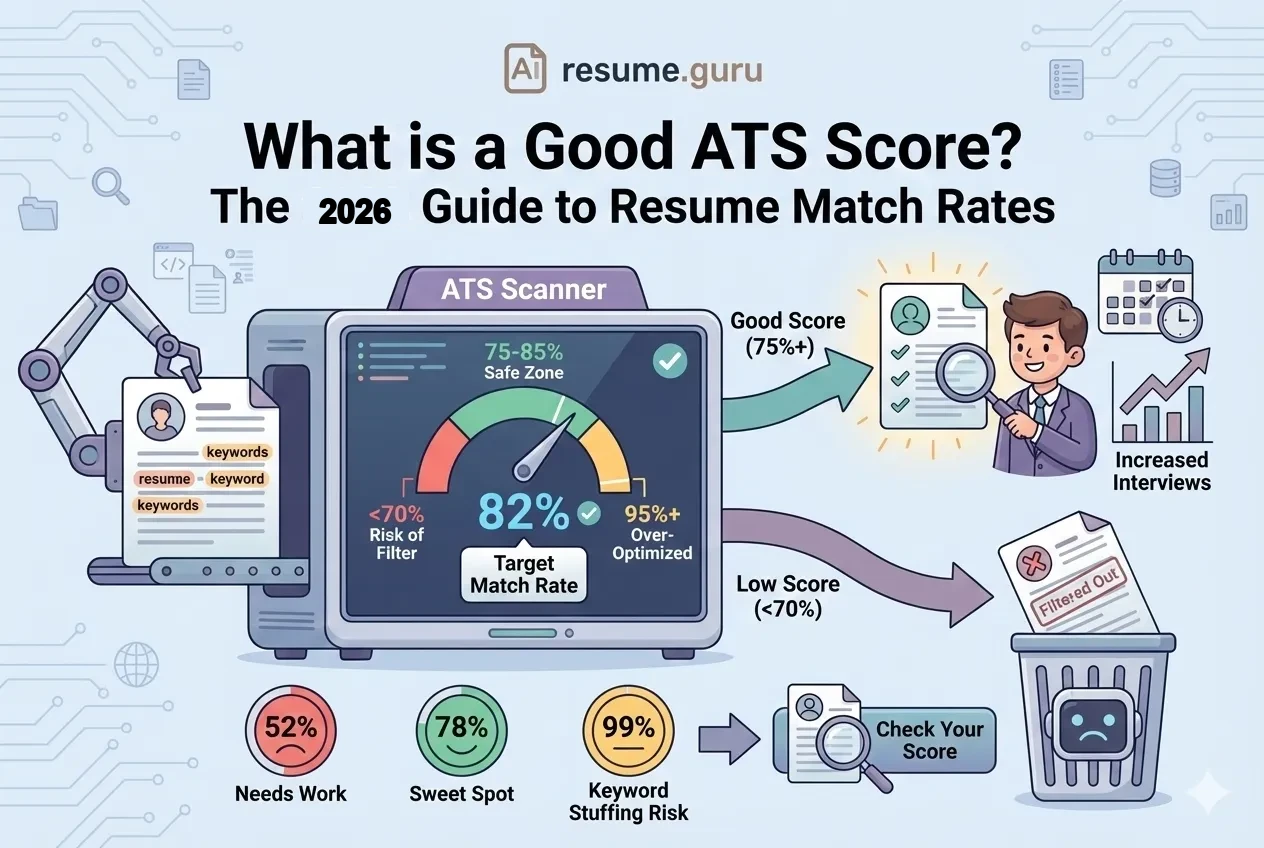
Target match rate
The safe zone where most resumes pass ATS filters and reach human eyes
Source: Jobscan Research, 2024
Here's what nobody tells you about ATS scores: they're not grades. They're match rates. And understanding the difference is the key to not driving yourself crazy.
The Quick Answer
- A "good" ATS score is 75-80% or higher
- 100% is not the goal—it often signals keyword stuffing
- The score measures keyword match, not resume quality
- Each job description creates a different score—there's no universal number
- Check your resume's match rate →
What Is an ATS Score, Really?
An ATS (Applicant Tracking System) score is a match percentage that shows how well your resume aligns with a specific job description.
It's not a grade on your career. It's more like a compatibility score—like those percentages on dating apps.
How ATS Scoring Works
The system compares your resume to the job description and calculates:
- Keyword Matches: Does your resume contain the required skills, tools, and qualifications?
- Title Alignment: Does your job title match what they're hiring for?
- Skills Coverage: Are the "must-have" requirements present?
- Frequency: Do important keywords appear more than once?
The Math Behind the Score
Different ATS platforms calculate differently, but the general formula:
ATS Score = (Keywords Found in Your Resume / Keywords Required in Job Description) × 100
If a job description mentions Python, SQL, and Machine Learning—and your resume only has Python—you're already at 33% for those skills.
The Magic Number: What Score Should You Aim For?
| Score Range | What It Means | Action Needed |
|---|---|---|
| 90%+ | Strong match—may be over-optimized | Review for keyword stuffing |
| 75-89% | ✅ Sweet spot—good chance of passing | You're likely getting through |
| 60-74% | Borderline—depends on competition | Add 3-5 missing keywords |
| Below 60% | Likely filtered out | Major tailoring needed |
Why 75-80% Is the Target
Why 75-80% Works
- High enough to pass most ATS filters
- Low enough to avoid keyword stuffing flags
- Leaves room for natural writing
- Competitive against other applicants
- Sustainable across multiple applications
Why 100% Backfires
- 100% scores often look robotic to humans
- Over-optimization wastes time
- Chasing perfect scores creates anxiety
- Each job has different keywords anyway
The Over-Optimization Trap
A recruiter shared this on LinkedIn: "I've seen resumes with 95% ATS scores that were unreadable by humans. They stuffed every keyword into a wall of text. Those go straight to 'no.'"
The score gets you past the robot. Your actual content gets you past the human.
How ATS Scores Vary by Platform
Here's an uncomfortable truth: there's no universal ATS scoring system. Different scanners give different scores for the same resume.
| Tool | Scoring Method | "Good" Score |
|---|---|---|
| Jobscan | Keyword matching against JD | 75%+ |
| Teal | Comprehensive (format + keywords) | 80%+ |
| Resume Worded | Multiple criteria | "Strong" rating |
| ResumeGuru Scanner | Keyword + skill alignment | 75%+ |
Pro Tip
Don't obsess over matching scores across different tools. They use different algorithms. Pick one scanner, optimize for 75%+, and move on.
What Actually Tanks Your ATS Score
It's not just missing keywords. These silent killers destroy your score before you even start:
1. Wrong File Format
| Format | ATS Compatibility |
|---|---|
| .docx (Word) | ✅ Best compatibility |
| .pdf (text-based) | ✅ Good for most modern ATS |
| .pdf (image-based) | ❌ Cannot be parsed |
| .pages, .odt | ❌ May not parse correctly |
2. Tables, Columns, and Graphics
ATS systems read left-to-right, top-to-bottom. Multi-column layouts confuse them.
What happens: Your carefully designed two-column resume becomes scrambled text in the ATS database.
The fix: Use single-column layout or ensure critical info is in the primary (left) column.
3. Missing the Obvious Keywords
The #1 score killer: not including the exact job title they're hiring for.
More likely to interview
When your resume includes the exact job title from the posting
Source: Jobscan Study
If they're hiring a "Product Marketing Manager," your resume should say "Product Marketing Manager"—not just "Marketing Manager."
4. Acronyms Without Spellings (or Vice Versa)
ATS might search for "SEO" or "Search Engine Optimization"—not both.
The fix: Include both versions: "Search Engine Optimization (SEO)"
The 15-Minute ATS Optimization Process
- 1
Run a baseline scan
Paste your resume and the job description into a keyword scanner. Note your starting score.
- 2
Identify missing 'must-have' keywords
Focus on hard skills, tools, and certifications mentioned multiple times in the JD.
- 3
Add 3-5 missing keywords naturally
Don't stuff. Weave them into your experience bullets and skills section.
- 4
Match the job title
If your title was similar but not exact, add the target title in parentheses or adjust your summary.
- 5
Re-scan and verify
Aim for 75%+. If you're there, stop optimizing and submit.
The Fastest Fix
80% of your ATS score improvement comes from:
- Adding the exact job title
- Including the top 5 skills mentioned in the JD
- Using both acronyms and spelled-out versions
That's 10 minutes of work for most of your score boost. Use our Keyword Scanner to identify what's missing.
Why Your Score Changes Per Job
This confuses a lot of people: You run the same resume against two jobs and get 82% for one, 54% for the other.
That's normal.
The score is relative to that specific job description. Different jobs = different keyword requirements = different scores.
This is why:
- You can't create one "high-scoring" resume for all jobs
- Tailoring for each application matters
- A "Master Resume" approach works best (one comprehensive document you customize)
ATS Score Myths (Debunked)
Myth: White text with hidden keywords boosts your score
This was a trick from 2015. Modern ATS systems detect hidden text and flag it as deceptive. Recruiters can see it too. Result: Instant rejection.
Myth: You need to include every keyword from the JD
You don't need 100% coverage. Focus on the must-have skills listed in the first half of the requirements. Nice-to-haves are less weighted.
Myth: A high ATS score guarantees an interview
The score gets you seen. Your actual experience, achievements, and fit get you the interview. A 95% score with no relevant experience still loses to an 75% score with the right background.
Myth: All ATS systems score resumes the same way
There are 200+ ATS platforms (Workday, Greenhouse, Lever, Taleo...). Each has different algorithms. Your score on one tool doesn't guarantee the same result in the actual company's system.
Real-World Scenarios
Scenario 1: Score of 45%
Diagnosis: Major mismatch. Either wrong job type or significant skills gap.
Action:
- Confirm this role aligns with your background
- If yes, you're missing fundamental keywords—review the JD's core requirements
- Add 5-10 missing keywords across summary, skills, and experience sections
Scenario 2: Score of 68%
Diagnosis: Borderline. You might pass in a small applicant pool, but likely filtered in competitive ones.
Action:
- Add the missing "required" skills
- Match the job title exactly
- Include tools/technologies mentioned in the JD
Scenario 3: Score of 78%
Diagnosis: You're in good shape. Most ATS filters will pass you through.
Action:
- Minor tweaks only—don't over-engineer
- Focus on making your bullets compelling for humans
- Submit with confidence
Scenario 4: Score of 96%
Diagnosis: Possibly over-optimized. Check if your resume still reads naturally.
Action:
- Read it aloud—does it sound like a human wrote it?
- Remove any keyword stuffing
- Ensure achievements are still prominent
How to Check Your ATS Score
Check your resume's keyword match
Paste your resume and a job description into our Keyword Scanner. See your match rate, missing keywords, and exactly where to add them—free.
Scan My ResumeWhat to look for in scanner results:
ATS Scan Checklist
- Match rate of 75% or higher
- Job title appears in your resume
- Top 5 required skills are present
- Both acronyms and full names included
- No major formatting warnings
- Skills section covers technical requirements
The Bottom Line
A good ATS score is 75-80%. That's the target.
But here's what matters more: The score is just a filter to get you seen. Your actual achievements, experience, and how you present them—that's what gets you hired.
Optimize to pass the robot. Then write a resume that impresses the human.
Related Resources
- Resume Optimization Guide — Complete ATS strategy
- Extract Keywords from Job Description — Find the right keywords
- ATS Keywords by Industry — Industry-specific keyword lists
- Action Verbs for Resume — Strengthen your bullets
- Resume Examples — See optimized resumes in action
- Resume Templates — ATS-optimized designs
- AI Resume Builder — Build from scratch with AI
- Resume Builder — Create an optimized resume
- Keyword Scanner — Check your match rate
- Job Matcher — Match your resume to jobs
Frequently Asked Questions
What ATS score do I need to get an interview?
Aim for 75-80%+ match rate. Studies show resumes scoring 75% or higher are significantly more likely to pass ATS filters. However, there's no universal 'passing' score—each company sets its own thresholds.
Is a 100% ATS score good?
Not necessarily. A 100% score often indicates keyword stuffing, which can backfire when humans review your resume. Aim for 75-85%—enough to pass filters while keeping your resume natural and readable.
How do I check my resume's ATS score?
Use resume scanning tools like Jobscan, Teal, or ResumeGuru's Keyword Scanner. These compare your resume against a specific job description and show your match percentage plus missing keywords.
Do all companies use the same ATS score threshold?
No. Each company configures its own ATS differently. Some filter at 70%, others at 90%. The score is relative to the job description—not a universal metric.
Build Your Perfect Resume
Create an ATS-optimized resume with our AI-powered builder.
No signup required.Start Building FreeExplore Resources
Enjoyed this article?
Share it with your network