You’ve got your content dialed in. Skills? Check. Experience? Solid. Now you’re staring at template options and wondering: single column or two columns?
Here’s the thing—this choice matters more than you think. The wrong layout can tank your ATS score. The right one can make recruiters spend an extra 3 seconds on your resume (which, in recruiter math, is basically an eternity).
Let’s break down when each format wins.
TL;DR
- Single-column: Safest for ATS, best for traditional industries and entry-level
- Two-column: More space-efficient, better for experienced pros and modern companies
- The “right” choice depends on your industry, experience level, and target company
- Test with an ATS scanner before sending either format
The 6-Second Reality Check
Recruiter initial scan time
Your layout determines what they see in those 6 seconds
Source: Eye-tracking study, 2018
In those 6 seconds, recruiters follow an F-shaped reading pattern: top-left, across the top, down the left side. Your layout should work with this pattern, not against it. To see how your current layout holds up, score your resume now.
Info
Single-column resumes follow the natural reading flow perfectly. Two-column resumes can work just as well—but only if the most important content is in the dominant column. The same goes for what fills those columns: getting your resume sections and section order right matters as much as the column count.
Single-Column Layout: The Safe Bet
Single-column resumes present information in a clean, top-to-bottom flow. It’s the format hiring managers have seen for decades—and the one most ATS systems are optimized for. It also leaves the header uncluttered, which matters for the hyperlinks in resume PDFs recruiters click first.
Why Single-Column Works
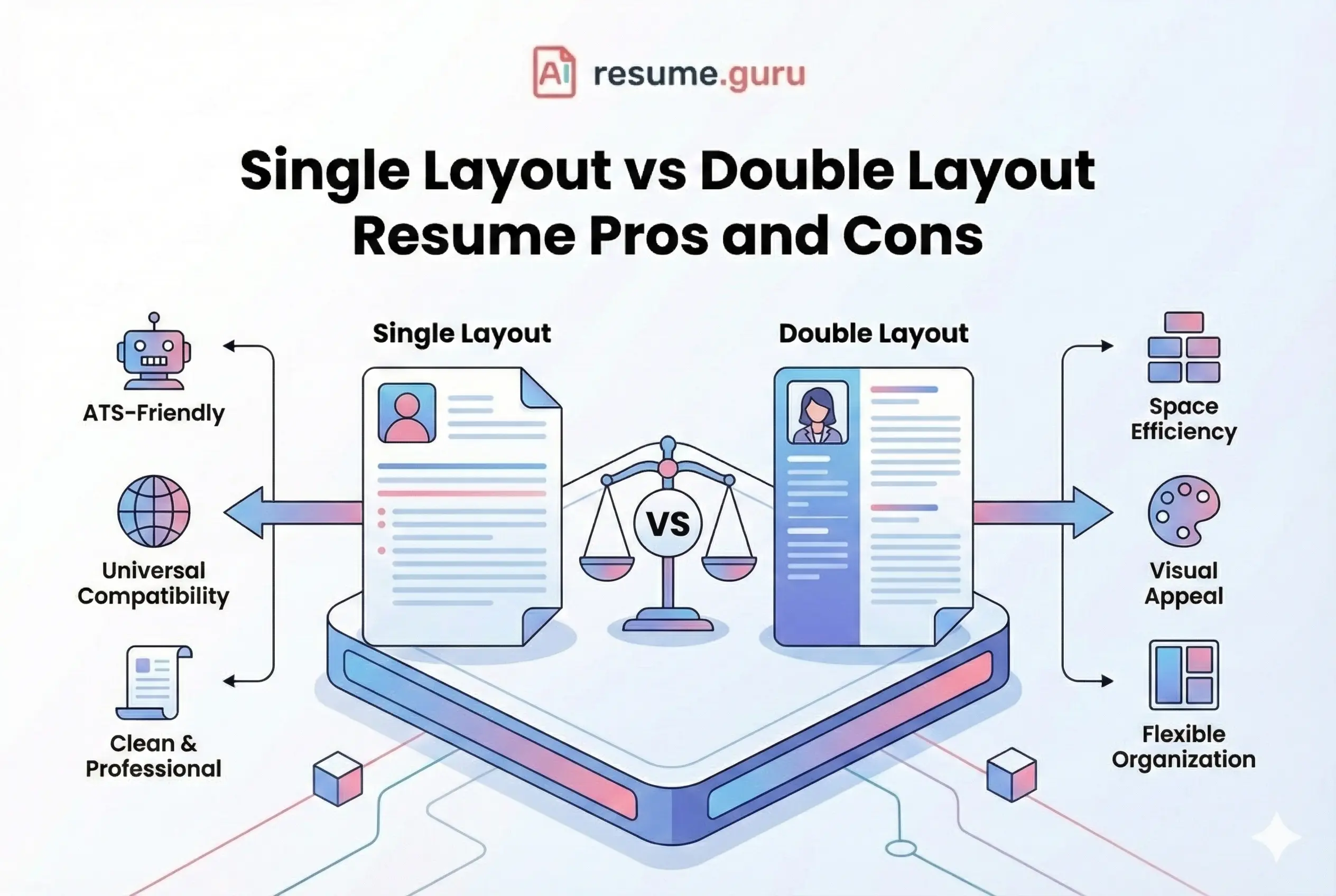
- Maximum ATS compatibility—nearly zero parsing failures
- Universal acceptance across all industries
- Clean, professional appearance that never feels risky
- Natural reading flow matches recruiter scanning patterns
- Easier to maintain and update over time
The Trade-offs
- Less space-efficient—can push content to page two
- May appear generic compared to modern designs
- Forces chronological presentation with little flexibility
- Can feel text-heavy without visual breathing room
When to Choose Single-Column
Single-Column Is Right for You If...
- You're targeting traditional industries (finance, law, government, healthcare)
- You're applying to large corporations with strict ATS systems
- You're entry-level or early-career with limited content
- You want maximum compatibility with zero risk
- The job posting specifically asks for 'traditional' formatting
Two-Column Layout: The Modern Choice
Two-column resumes use space more efficiently by splitting content into a main column (experience, education) and a sidebar (skills, certifications, contact info). When done right, they look polished and professional.
Why Two-Column Works
- Fits more content on one page—ideal for experienced professionals
- Modern, eye-catching design that stands out
- Dedicated sidebar for skills makes scanning easier
- Better organized for roles requiring diverse skill sets
- Popular with startups, tech, and creative industries
The Trade-offs
- Some older ATS systems struggle with column parsing
- May feel inappropriate for conservative industries
- Requires more design care to look professional
- Can look cluttered if overstuffed with content
When to Choose Two-Column
Two-Column Is Right for You If...
- You're in tech, design, marketing, or other modern industries
- You have 5+ years of experience and need space efficiency
- You're applying to startups or mid-size companies
- You want to prominently display technical skills or certifications
- The company culture values modern design and creativity
The ATS Truth Nobody Tells You
Warning
The “two-column resumes fail ATS” advice is outdated—but not entirely wrong.
Here’s the reality:
Modern ATS systems (Greenhouse, Lever, Workday) parse well-designed two-column templates just fine. The issue isn’t columns—it’s how the columns are built. To understand why some layouts trip up the software, it helps to know how an ATS works and how it reads your file in the first place.
What breaks ATS:
- Text boxes and floating elements
- Tables used for layout
- Graphics and images
- Headers and footers with key info
- Unusual fonts or heavy styling
What works fine:
- CSS-based column layouts
- Standard, ATS-friendly fonts (Arial, Calibri, Helvetica)
- Clear section headers
- Consistent formatting
If you want the full picture beyond columns, our guide to an ATS-friendly resume format covers the structural choices that keep your file machine-readable.
Pro Tip
Before sending any resume, run it through an ATS scanner. Our resume builder automatically tests ATS compatibility so you never have to guess, and our keyword scanner shows whether your chosen layout parses cleanly against a real job posting.
Industry-by-Industry Breakdown
| Industry | Recommended Layout | Why |
|---|---|---|
| Tech / Engineering | Either works | Modern companies care more about skills than format |
| Finance / Banking | Single-column | Conservative culture values traditional presentation |
| Design / Creative | Two-column | Visual design skills should show in your resume design |
| Healthcare | Single-column | ATS compliance critical; traditional expectations |
| Marketing | Two-column | Modern, visual-friendly industry |
| Government | Single-column | Strict formatting requirements; often requires specific templates |
| Startups | Two-column | Values modern design and personality |
| Consulting | Single-column | Professional, polished, conservative presentation |
Making the Right Choice: A Decision Framework
Not sure which to pick? Work through these questions — and if you’re weighing a design-first builder for the two-column option, compare against Canva before committing:
- 1
Check the company culture
Visit their website, LinkedIn, and Glassdoor. Modern vibes? Two-column. Corporate traditional? Single.
- 2
Consider your experience level
Under 5 years? Single-column is usually enough. 5+ years with diverse skills? Two-column might serve you better.
- 3
Look at the job posting
Does it mention 'traditional' formatting or specific requirements? Follow them exactly.
- 4
Test with ATS
Whichever you choose, verify it parses correctly before sending.
- 5
When in doubt, go single
If you're truly unsure, single-column has zero downside. Two-column has potential (small) risk.
Common Mistakes to Avoid
Mistake 1: Forcing Content Into Two Columns
If you don’t have enough content, a two-column layout looks sparse and unprofessional. Single-column with good white space beats two-column with empty sections.
Mistake 2: Burying Key Info in the Sidebar
On two-column resumes, the sidebar gets less visual attention. Don’t put your most important experience there—that goes in the main column.
Mistake 3: Using Fancy Templates That Break ATS
That gorgeous Canva template? It might be using text boxes—or special characters that break ATS parsing—that the software can’t read. Always test, or use templates built with ATS in mind.
Mistake 4: Ignoring Mobile Viewing
Recruiters increasingly review resumes on phones. Two-column layouts can be harder to read on small screens—keep your sections clear and scannable.
If you can’t tell which of these your layout commits, roast your resume and let someone else look at the columns.
The Bottom Line
There’s no universally “correct” layout. The best choice depends on three things:
- Your target industry’s expectations
- Your experience level and content volume
- ATS compatibility of your specific template
Single-column is the safe, universally-accepted choice. Two-column is the modern, space-efficient choice—but only with the right template.
Not sure which layout is right for you?
Our resume builder offers both single and two-column templates, all ATS-optimized and professionally designed. Pick the one that fits your story.
Explore TemplatesYour Move
Stop overthinking the layout. Pick one based on the framework above, fill it with compelling content, and test it with ATS.
The layout gets you in the door. Your content gets you the interview.
Ready to build your resume?
Choose from 20+ professionally designed templates—each ATS-optimized and recruiter-approved. No design skills needed.
Start Building FreeRelated Resources
Frequently Asked Questions
Is a two-column resume ATS-friendly?
It depends on the template. Modern ATS systems handle well-designed two-column layouts, but poorly structured ones can cause parsing failures. Test with an ATS scanner before sending.
Which layout do recruiters prefer?
Most recruiters don't have a strong preference—they care about content. However, conservative industries (finance, law, government) tend to favor single-column formats.
Can I use a two-column resume for tech jobs?
Yes! Tech companies often appreciate modern designs. Just ensure your technical skills and experience are prominent and easy to parse.
Should entry-level candidates use single or two-column?
Single-column is usually better for entry-level. You likely don't have enough content to fill two columns effectively, and a sparse two-column layout looks worse than a clean single-column one.
Will a creative resume hurt my ATS score?
Not necessarily. The issue isn't creativity—it's structure. Well-coded two-column templates can be fully ATS-compatible. Avoid graphics, text boxes, and unusual fonts.
Put this into practice
You have the theory. These take a few minutes and work on the resume you already have.