Let’s settle this debate once and for all.
Some career advisors swear by the hobbies section: “It shows personality! Employers want to hire humans!”
Others dismiss it entirely: “Nobody cares that you like hiking. Focus on skills.”
Here’s the thing—they’re both right. And both wrong.
The hobbies section isn’t universally good or bad. It’s a strategic tool. And like any tool, it works brilliantly in the right hands and creates disaster in the wrong ones.
TL;DR
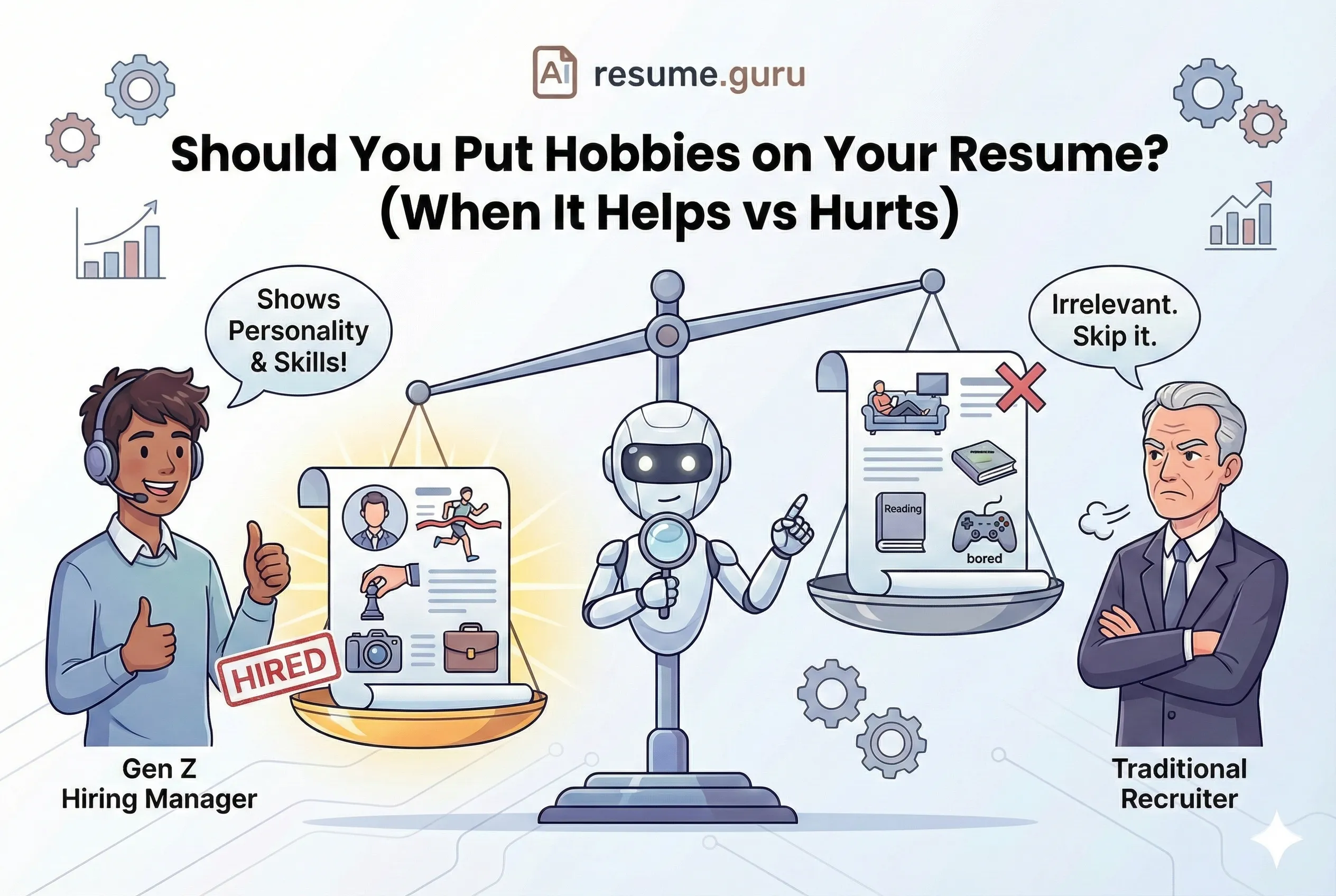
- 57% of Gen Z managers consider hobbies a top 3 resume section
- 79% of traditional recruiters don’t read it at all
- Include hobbies when they demonstrate skills, show culture fit, or fill gaps
- Skip them when space is tight, you’re senior, or they’re generic
- Keep it to 3-5 specific, strategic interests
The Surprising Data Behind Hobbies on Resumes
of Gen Z hiring managers
Rate the hobbies/interests section as a top 3 priority on resumes
Source: Resume Trends Study, 2024
But wait—here’s the twist (and if you want a second opinion on whether yours is earning its space, get your resume roasted):
of traditional recruiters
Say they don't bother reading the hobbies section at all
Source: Recruiter Behavior Survey, 2024
So what gives? Why the massive gap?
Context matters.
- Applying to a Silicon Valley startup run by millennials? Hobbies count.
- Applying to a buttoned-up investment bank? Less so.
- Entry-level with limited experience? Hobbies fill space and show personality.
- Senior executive with 20 years of achievements? Nobody cares that you golf.
The question isn’t “should I include hobbies?” It’s “what’s the strategic value in my specific situation?”
When to Include Hobbies (The Yes Scenarios)
Include hobbies when...
These situations make the hobbies section worth your valuable resume real estate.
1. You’re Entry-Level or a Recent Graduate
When you lack work experience, hobbies serve as proxy evidence of skills and traits.
Captain of the debate team? That’s leadership and communication.
Competitive chess player? Strategic thinking.
Marathon finisher? Discipline and long-term goal achievement.
For a new grad resume, hobbies can be the difference between a half-empty page and a compelling narrative.
2. The Hobby Directly Relates to the Role
| Role | Relevant Hobby |
|---|---|
| Software Engineer | Open-source contributions, hobby coding projects |
| Marketing Manager | Personal blog with followers |
| Sports Brand Manager | Competitive running, cycling |
| Game Developer | Indie game development, speedrunning |
| Financial Analyst | Investment club, personal portfolio management |
When your hobby proves you live and breathe the industry, it’s not fluff—it’s evidence.
3. You’re Targeting Culture-Focused Companies
Startups, creative agencies, and companies that emphasize “culture fit” often care deeply about who you are beyond your skills.
When two candidates have similar skills, I hire the one I’d want to grab a beer with. The hobbies section tells me who that is.
4. You Have Employment Gaps to Address
Strategic hobbies can explain gaps productively:
- Traveled Southeast Asia for 6 months → Cultural awareness, adaptability
- Completed marathons during career break → Discipline, goal-setting, self-improvement
- Volunteered at animal shelter → Compassion, time management, commitment
5. You Want to Create Interview Talking Points
The best hobbies create curiosity. Something unique that makes the interviewer ask, “Wait, tell me more about that.”
“Competitive Scrabble player (ranked top 500 nationally)” is infinitely more interesting than “reading.”
When to Skip Hobbies (The No Scenarios)
Skip hobbies when...
Don’t waste space on interests that don’t serve your candidacy.
1. You’re Experienced (10+ Years)
When you have a decade of achievements, hobbies dilute your message. Your work speaks for itself.
Exception: If a hobby demonstrates executive-level skills (board membership, marathon fundraising, published author).
2. Space Is Tight
If you’re struggling to fit your experience on one page, hobbies go first. Skills and achievements always trump interests. A tighter layout buys back some of that room, so browse ATS-safe templates before you start cutting content.
Use our Resume Score tool to check if you’re prioritizing the right sections.
3. Your Hobbies Are Generic
These hobbies say nothing:
- Reading
- Traveling
- Watching movies
- Listening to music
- Spending time with family
Everyone does these things. They’re not interests—they’re basic human activities.
4. Your Hobbies Are Controversial
Avoid anything that could trigger bias:
- Political activism
- Religious activities
- Extreme sports (risk perception)
- Hunting/firearms (industry-dependent)
- Gambling (even “poker tournaments”)
Fair or not, you don’t know the biases of your reader. Why risk it?
What Makes a “Good” Hobby for Resumes?
The best hobbies pass three tests:
Hobby Quality Check
- Specific (not 'reading' but 'reading about behavioral economics')
- Active (shows initiative, not passive consumption)
- Skill-demonstrating (reveals transferable abilities)
Examples: Generic vs Strategic
| Generic ❌ | Strategic ✅ |
|---|---|
| Reading | Reading: Have completed 52 non-fiction books on business strategy annually since 2020 |
| Photography | Photography: Published in National Geographic Traveler; 15K Instagram following |
| Gaming | Gaming: Raid leader in World of Warcraft, managing 25-person team for competitive events |
| Music | Music: Lead guitarist in local band with 50+ live performances annually |
| Fitness | Marathon running: Completed 12 marathons including Boston; raised $15K for charity |
| Cooking | Cooking: Completed Le Cordon Bleu online certification; host monthly supper clubs for 20+ guests |
See the difference? Strategic hobbies include specifics and implied skills.
How to Format the Hobbies Section
Section Title Options
Use whichever fits your resume’s tone:
- Interests
- Hobbies & Interests
- Personal Interests
- Activities
Avoid: “Fun Facts” (too casual), “Other” (too vague)
Placement
For entry-level resumes: Near the top (after Summary, before or after Skills)
For experienced professionals: At the bottom (if included at all)
Formatting Examples
Simple List:
Interests: Marathon running (12 completed), open-source contributing, competitive chess (1800 ELO)
With Context:
Interests
- Ultramarathon Running: Completed 5 100-mile races; raised $25K for childhood cancer research
- Technical Writing: Maintain blog on software architecture with 5K monthly readers
- Board Games: Host weekly strategy game night; collection of 200+ games
Hobbies That Impress, By Industry
Tech Industry
Do This
- Open-source contributions
- Hackathon participation
- Home automation projects
- Personal tech blog
- Gaming (especially if collaborative or competitive)
- Coding side projects
Finance & Consulting
Do This
- Personal investing/portfolio management
- Economic publications (reading The Economist, WSJ)
- Competitive chess or poker strategy
- Endurance sports (shows discipline)
- Business book clubs
Creative Industries
Do This
- Photography (with portfolio)
- Music (performance or production)
- Video creation (YouTube, TikTok)
- Writing (published work)
- Art with exhibitions
Healthcare
Do This
- Medical mission trips
- First responder/EMT volunteering
- Fitness certifications
- Health-related blogging
- Community health initiatives
The Volunteer Work Loophole
Here’s a power move: frame volunteering as interests.
Volunteer work bridges the gap between hobbies and experience. It’s active, skill-building, and shows values.
increase in hiring chances
For candidates who include volunteer experience on resumes
Source: Deloitte Study
Instead of generic hobbies:
Interests: Hiking, reading, traveling
Try this:
Interests & Involvement:
- Volunteer English tutor for refugee families (3 years, 50+ students)
- Trail maintenance coordinator for local hiking club
- Book club organizer at community center (15+ members)
Same hobbies. But now they demonstrate initiative, consistency, and community impact.
The Interview Strategy
Don’t just list hobbies—prepare stories for each one.
If your resume says “marathon running,” be ready to explain:
- Why you started
- What you’ve learned about discipline and goal-setting
- How training prepared you for high-pressure work situations
The hobbies section is interview ammunition. Use it — and practice interview answers for the ones you chose to leave on the page.
I always ask about an interesting hobby. It tells me if the candidate has passion, commitment, and the ability to talk about something they care about. That translates directly to how they’ll talk about their work.
Quick Decision Flowchart
Not sure if your hobby belongs? Run through this:
- Does it demonstrate a relevant skill? → If yes, include
- Is it specific and active (not passive)? → If yes, consider including
- Would it create interesting interview conversation? → If yes, consider including
- Is it generic (reading, movies, music)? → Skip it
- Could it trigger any negative bias? → Skip it
- Is your resume already full? → Skip it unless it’s exceptional
Your Move
Here’s your action plan:
- Audit your current hobbies section (if you have one)
- Apply the specificity test — can you make each hobby more concrete?
- Check for strategic alignment — does each hobby serve your candidacy?
- Consider the reader — corporate bank vs creative startup?
- If in doubt, cut it — no hobbies is better than bad hobbies
Ready to build a standout resume?
Our AI Resume Builder helps you create a polished resume with the right sections—hobbies included when they matter. Takes 5 minutes.
Build My ResumeRelated Resources
- Entry-Level Resume Guide — Make the most of limited experience
- Volunteer Work on Resume — Turn unpaid work into hired advantage
- Resume Summary Generator — Create compelling summaries that include personality
- AI Resume Builder — Build a complete resume in minutes
- Resume Templates — Professional designs with proper sections
- Skills Finder Tool — Discover high-value skills to highlight
Frequently Asked Questions
Should I include hobbies on my resume in 2026?
It depends. Include them if you're entry-level, have limited experience, applying to culture-focused companies, or your hobby directly relates to the job. Skip them if you're senior-level, space is tight, or your interests are generic or controversial.
What hobbies look good on a resume?
The best hobbies are specific, relevant, and reveal skills. Marathon running shows discipline. Chess shows strategic thinking. Open-source coding shows initiative. Avoid generic interests like 'reading' or 'watching movies.'
How many hobbies should I list?
List 3-5 hobbies maximum. Quality over quantity. Each should serve a purpose—demonstrating a skill, showing cultural fit, or creating a memorable talking point.
Can hobbies ever hurt my resume?
Yes. Avoid controversial topics (politics, religion), potentially dangerous activities, passive activities without specificity, or anything that could trigger unconscious bias. When in doubt, leave it out.
Put this into practice
You have the theory. These take a few minutes and work on the resume you already have.