Numbers don’t lie.
While you’re guessing what works on resumes, there’s hard data on exactly what recruiters do—how long they look, what makes them stop, and why most resumes fail before a human ever sees them.
These aren’t opinions. They’re statistics from studies involving thousands of hiring managers and millions of job applications.
Here’s what the data says about resumes in 2025—and what it means for yours.
The Numbers That Matter Most
- 75% of resumes rejected by ATS before human review
- 7-30 seconds average resume scan time
- 44 days average time-to-hire across industries
- 77% of hiring managers reject for grammar mistakes
- 83% of recruiters prefer tailored resumes
ATS & Screening Statistics
Rejected by ATS
Before reaching a human recruiter
Source: Jobscan Research
The Applicant Tracking System is the first gatekeeper for most applications. Here’s what the data shows:
If you want to know which side of that 75% you’re on, score your resume now before you apply again.
The ATS Reality
| Statistic | Source |
|---|---|
| 75% of resumes are rejected by ATS before human review | Jobscan |
| 83% of companies will use AI for resume screening by end of 2025 | Interview Guys |
| 70-75% of large organizations use ATS | Enhancv |
| Only 8% of recruiters configure ATS for content-based auto-rejection | HR Gazette, 2025 |
What This Means
Three quarters of resumes fail at the first hurdle. The primary reasons: missing keywords, incorrect formatting, and incompatible file types (.pdf vs .docx). Optimization isn’t optional—it’s essential.
The AI Screening Trend
| Statistic | Source |
|---|---|
| 91% of employers use AI somewhere in hiring | Resume Now |
| 70% of employers plan to use AI to screen/reject candidates without human intervention in 2025 | Forbes |
| 56% of hiring managers worry AI filters out qualified candidates | Forbes |
Resume Scan Time Statistics
Average resume review
With initial scans as short as 7 seconds
Source: ResumeGo, 2024
How much attention does your resume actually get? (Enhancv’s own research sits behind some of these numbers; you can also compare against enhancv if you’re weighing builders.)
The Attention Window
| Time Spent | % of Recruiters | Source |
|---|---|---|
| Less than 10 seconds | 1% | Standout CV |
| 30 seconds to 1 minute | 47% | ResumeGo |
| 7-9 seconds (initial scan) | Common | Teal HQ |
| 6 seconds (oft-cited study) | - | 2018 Eye-tracking |
What This Means
You have one page, one glance, to make an impression. The top third of your resume—summary, top bullets, key skills—must communicate your value immediately.
What Recruiters Look At First
| Element | Priority Ranking |
|---|---|
| Job titles | #1 |
| Companies worked at | #2 |
| Education | #3 |
| Skills section | #4 |
| Dates/Duration | #5 |
78% of recruiters rate “skimmability” as very important.
Application & Hiring Statistics
Applications per hire
Average for US SMBs in 2024
Source: High5Test
The competition is fierce. Here’s the funnel:
The Application Funnel
| Stage | Conversion Rate | Source |
|---|---|---|
| Application → Interview | 5% | High5Test |
| Interview → Offer | 36% | High5Test |
| Applications per hire (2024) | ~180 | High5Test |
| Increase in applications since 2021 | +182% | High5Test |
Time-to-Hire
| Metric | Days | Source |
|---|---|---|
| Average time-to-hire (global, 2025) | 44 days | Join Genius |
| Average time-to-hire (2024) | 41 days | SHRM |
| Entry-level positions | ~30 days | Join Genius |
| Top candidates secured within | 10 days | Join Genius |
Speed Matters
Top candidates get hired in 10 days. If your resume isn’t ready when you find the right job, you’ll miss the window.
Resume Formatting & Presentation Statistics
Reject for grammar
Hiring managers consider typos a deal-breaker
Source: Kickresume
First impressions are visual. Then they read. Starting from a clean layout helps—browse ATS-safe templates rather than fighting a design that parses badly.
Formatting Impact
| Statistic | Source |
|---|---|
| 73% of hiring managers reject for poor formatting | High5Test |
| 77% consider grammar mistakes a deal-breaker | Kickresume |
| 58% would reject for typos alone | Various |
What Matters in Presentation
| Element | Impact |
|---|---|
| Standard, readable fonts | Required for ATS |
| Clean section headers | Helps scanning |
| Consistent formatting | Signals professionalism |
| 1-2 pages max | Standard expectation |
| Solid metrics | Memorable |
Tailoring & Customization Statistics
More likely to interview
With a tailored resume vs. generic
Source: Teal HQ
Generic resumes get generic results. The fix is mechanical: tailor your resume to the job posting you’re actually applying to.
The Tailoring Effect
| Statistic | Source |
|---|---|
| 83% of recruiters prefer customized resumes | Resumly |
| 6x more likely to get interview with tailored resume | Teal HQ |
| 31% increase in interview callbacks | Resumly |
| 63% of employers prefer customized applications | Flair HR |
| Tailoring improves ATS pass-through by 40% | Resumly |
What This Means
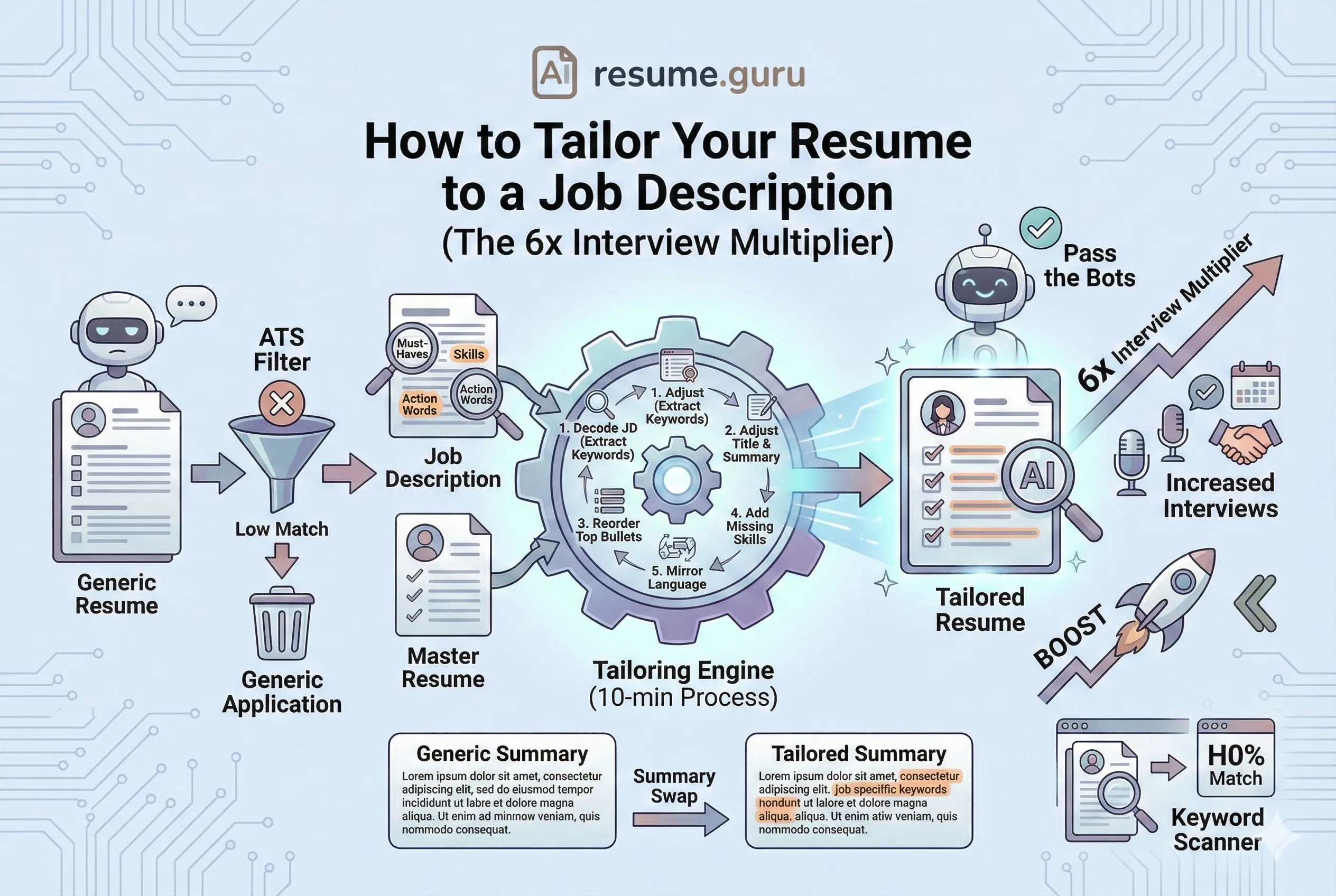
Every application you send should be customized. At minimum: adjust your summary, reorder top bullets, and add missing keywords from the job description.
AI in Resume Writing Statistics
Of job seekers used AI
To write or optimize their resume in 2024
Source: Forbes / PR Newswire
AI is now part of the equation—on both sides.
AI Usage
| Statistic | Source |
|---|---|
| 68% of workers used AI for resume writing | Forbes |
| 75% of candidates use AI tools for applications | PR Newswire |
| 74% of hiring managers encountered AI content | Resume Genius |
| 33.5% can identify AI-generated resume in less than 20 seconds | IEEE USA |
| 25% of recruiters would reject obvious AI resumes | Resume Builder |
The Ethics Dilemma
| Statistic | Source |
|---|---|
| 79% of employers want AI content regulations | PR Newswire |
| 62% reject resumes lacking personal touch | PR Newswire |
| 49% would reject an AI-generated resume | CV Guys |
The Takeaway
Use AI as a tool, not a replacement. Edit heavily, add your voice, and never fabricate. Recruiters are getting better at detection.
Skills & Content Statistics
Prioritize skills over degrees
Employers focusing on practical skills
Source: Resume Genius
What matters on your resume is shifting.
The Skills-First Shift
| Statistic | Source |
|---|---|
| 65% of employers prioritize skills over formal education | Resume Genius |
| Remote/hybrid roles get 60% of applications (but only 20% of postings) | Interview Guys |
| Skills-based hiring is the #1 trend for 2025 | Various |
Content That Works
| Element | Impact |
|---|---|
| Quantified achievements | More memorable |
| Action verbs | More commanding |
| Keywords from job description | ATS aligned |
| Results over duties | Shows value |
What These Statistics Mean for You
- 1
Optimize for ATS first
75% rejection means you must use keywords, standard formatting, and compatible file types.
- 2
Make the top third count
30 seconds max. Your summary, recent title, and top bullets must communicate value instantly.
- 3
Always tailor
6x interview multiplier is too big to ignore. Customize for every serious application.
- 4
Use AI wisely
68% of applicants use it. The differentiation is in the editing, not the generating.
- 5
Zero tolerance for errors
77% reject for grammar mistakes. Proofread, then proofread again.
The Bottom Line
The numbers are clear:
- Most resumes fail at ATS
- Recruiters spend seconds, not minutes
- Tailoring dramatically improves results
- Errors are fatal, formatting matters
- AI is everywhere—use it smartly
These aren’t secrets. They’re data. Use them to your advantage.
Build an optimized resume
AI ResumeGuru's AI-powered builder is designed around these statistics—ATS-optimized templates, keyword analysis, and formats that pass the 30-second test.
Start Building FreeRelated Resources
- Why Resumes Matter — The bigger picture
- Resume Optimization Guide — Beat the ATS
- Resume Trends 2025 — What's changing this year
- Tailoring Resume to Job Description — The 6x multiplier in action
- Keyword Scanner — Check your ATS match score
- Resume Templates — ATS-optimized designs
- All Resume Tools — Free tools for job seekers
Frequently Asked Questions
How long do recruiters spend looking at a resume?
On average, 30 seconds—though initial scans can be as short as 7 seconds. 47% of hiring professionals spend between 30 seconds and 1 minute per resume.
What percentage of resumes get rejected by ATS?
Approximately 75% of resumes are filtered out by ATS before reaching a human reviewer. This is often due to missing keywords, incorrect formatting, or incompatible file types.
How many applications does it take to get hired?
On average, about 180 applications per hire for US small and medium businesses. Only about 5% of applicants convert to interviews, and 36% of interviews lead to offers.
What's the average time to get hired?
The global average time-to-hire is 44 days across industries, though this varies significantly by role and seniority. Entry-level positions average around 30 days.
Do resume typos really matter?
Yes—77% of hiring managers consider a grammar mistake a deal-breaker, and 58% say typos would cause them to reject an otherwise qualified candidate.
Put this into practice
You have the theory. These take a few minutes and work on the resume you already have.