Here’s something nobody tells you:
Your GitHub profile full of half-finished repos? Probably hurting more than helping.
But a single impressive project, presented the right way? That can land interviews when your work history alone wouldn’t.
The game has changed. In 2026, it’s not about how many projects you’ve done—it’s about demonstrating that you can actually ship something that matters.
The short answer: list two or three personal projects and format each one like a job — a title, the stack or role, and bullets that run problem, solution, measurable result. Link a live demo or repo, but write the bullets so they stand alone without the click. Skip tutorial clones and anything you abandoned half-finished.
TL;DR
- Quality > Quantity: 2 great projects beat 10 generic ones
- Focus on projects that solve real problems (not just tutorials)
- Present like work experience: Problem → Solution → Result
- Include links (GitHub, live demo) but make bullet points self-sufficient
- Projects matter most for entry-level; become supplementary with experience
Why Personal Projects Matter (More Than Ever)
of hiring managers
Consider personal projects when evaluating candidates
Source: Developer Hiring Survey, 2024
But here’s the catch: recruiters are getting pickier.
In the AI era, anyone can spin up a basic app in an afternoon. That to-do list tutorial you followed? Hiring managers have seen it a thousand times.
What actually impresses them:
- Real-world problem solving (not just “I followed a course”)
- End-to-end delivery (not just prototypes)
- Technical depth (not just surface implementation)
- Complexity management (error handling, testing, deployment)
I don’t care about another CRUD app. Show me you’ve dealt with edge cases, thought about scale, or solved a problem nobody asked you to solve. That’s what separates candidates.
When Projects Matter Most
Critical: Entry-Level & New Graduates
When you lack work experience, projects ARE your experience. They prove you can apply skills in the real world.
For a new grad resume, a strong projects section can be more valuable than any internship.
Critical: Career Changers
Switching from marketing to data science? Your projects prove you have actual skills, not just Coursera certificates. If you’re pivoting fields, pair this with a deliberate career change resume strategy so your projects do the heavy lifting your job history can’t.
Important: Employment Gaps
Projects during career breaks show you stayed sharp and kept building.
Nice-to-Have: Experienced Professionals
With 10+ years of experience, projects become supplementary—proof of passion, not necessity. Link to your portfolio or GitHub rather than taking resume space.
The Projects That Impress (vs The Ones That Don’t)
| Forgettable ❌ | Impressive ✅ |
|---|---|
| To-do list app (tutorial follow-along) | Task manager with team collaboration, real-time updates, and calendar sync—serving 50+ active users |
| Weather app (API practice) | ML-powered weather alerting system that texts you when conditions match your preferences |
| Twitter clone (...) | Sentiment analysis bot that tracks Twitter mentions of specific topics and generates weekly reports |
| Calculator app | Browser extension that calculates compound returns on stock prices as you browse Yahoo Finance |
| Unfinished repos on GitHub | Live deployed project with documentation, tests, and an actual README |
The pattern? Generic → Specific & Problem-Solving.
The Anatomy of a Strong Project Entry
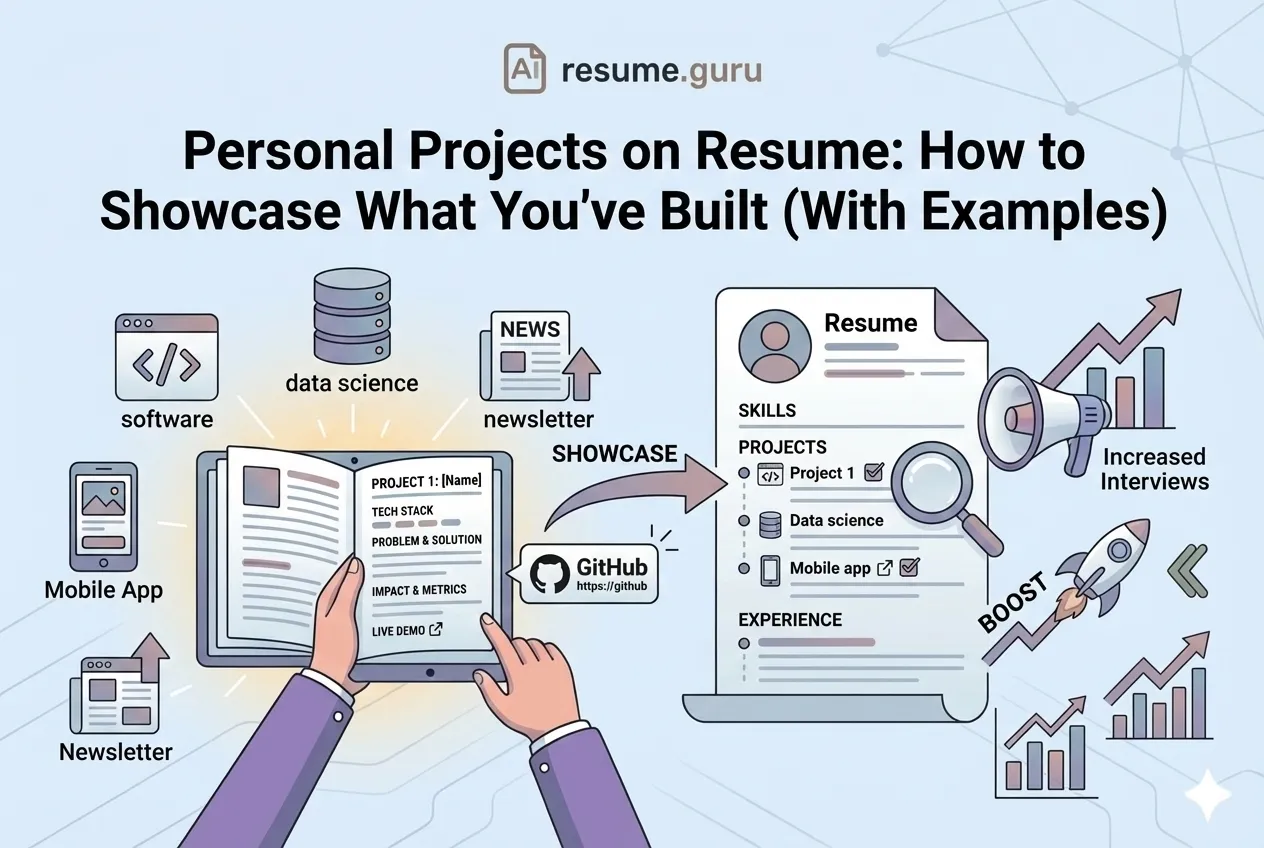
Format projects like work experience—not just a list of technologies.
The PAR Formula (Problem → Action → Result)
[Project Name] | [Technologies Used]
• [What you built and why]
• [Technical achievement or challenge overcome]
• [Measurable impact or outcome]
• [Link to code/demo]
Example: Before & After
Weak Project Entry
Personal Website
Built a personal website using React and Node.js.
Strong Project Entry
Developer Portfolio Site | Next.js, TypeScript, Tailwind, Vercel
- Designed and deployed responsive portfolio with blog, project showcase, and contact form
- Implemented server-side rendering achieving 98/100 Lighthouse performance score
- Receives 2,000+ monthly visitors and generated 3 freelance inquiries
- Live: [myportfolio.dev] | GitHub: [github.com/user/portfolio]
See how the strong version includes:
- Specific scope (not just “personal website”)
- Technical achievement (performance score)
- Measurable outcome (visitors, inquiries)
- Proof (links)
The “result” line is what most people skip—yet quantifying your achievements is exactly what turns a project from a hobby into evidence a recruiter can trust.
Project Entry Examples by Domain
Each example below follows the same shape: what you built, the stack, and a measurable result. If you’re wondering whether your own projects belong on the page at all, our guide to job titles on resume covers the same honesty test.
Software Engineering
Do This
Real-Time Collaboration Tool | React, Socket.io, MongoDB, Docker
- Built full-stack collaborative document editor supporting simultaneous editing by 10+ users
- Implemented conflict resolution algorithm reducing data merge issues by 95%
- Deployed via Docker on AWS EC2, handling 500+ concurrent websocket connections
- [GitHub] | [Live Demo]
Data Science / ML
Do This
Job Market Salary Predictor | Python, scikit-learn, Flask, Tableau
- Scraped and processed 50K job listings to build salary prediction model (R² = 0.87)
- Created interactive Tableau dashboard visualizing compensation trends by region and skill
- Published methodology on Medium, gaining 5K views and 200+ claps
- [GitHub] | [Dashboard] | [Article]
Product / UX Design
Do This
Fitness App Redesign Concept | Figma, Maze, UserTesting
- Redesigned Nike Training Club onboarding flow with focus on new user retention
- Conducted 15 user interviews and 50+ Maze usability tests
- Proposed flow increased task completion rate by 34% in A/B prototype testing
- [Figma Prototype] | [Case Study]
Marketing / Content
Do This
Newsletter Growth Experiment | ConvertKit, Canva, Google Analytics
- Launched weekly career advice newsletter from 0 to 2,500 subscribers in 6 months
- Maintained 45% open rate (3x industry average) through segmentation strategy
- Generated $4,200 in sponsorship revenue from targeted audience
- [Subscribe Link] | [Open Rate Screenshot]
How to Write Project Bullet Points
Use this hierarchy:
- 1
Start with the 'what'
Built a [thing] that [does X]
- 2
Add technical complexity
Implemented/Designed/Engineered [challenging aspect]
- 3
Show measurable impact
Resulting in [X users / Y% improvement / Z outcome]
- 4
Include proof
GitHub, live demo, or specific deliverable
Bullet Point Templates
- Built [tool/app] that [solves problem], used by [X users/organizations]
- Designed [system component] achieving [performance metric]
- Automated [process] reducing [time/effort] by [X%]
- Deployed [application] on [platform] handling [scale metric]
These follow the same structure as the rest of your resume, so it’s worth reviewing how to write strong resume bullet points before you draft each line. If you’re staring at a blank page, our bullet generator can turn a plain project description into a quantified, ready-to-paste bullet.
Common Mistakes (And How to Fix Them)
Mistake 1: Listing Technologies Without Context
❌ “Built a website with React, Node.js, MongoDB, Express, Redux, GraphQL, Docker…”
Nobody cares about your tech stack if they don’t know what you built.
✅ Lead with what you built and why, then mention technologies. Save the raw stack for your dedicated technical skills section, where ATS keyword matching actually rewards it.
Mistake 2: No Quantified Outcomes
❌ “Created a budget tracking app”
What happened after you created it?
✅ “Created a budget tracking app with 200+ active users and 4.8/5.0 App Store rating”
Mistake 3: Including Unfinished Projects
❌ Linking to a GitHub repo with no README, no tests, and last commit 2 years ago.
Recruiters WILL click that link. Make sure it’s polished.
✅ Either finish the project or leave it off your resume entirely.
Mistake 4: Too Many Projects
❌ Listing 10 projects to seem productive.
Dilution kills impact.
✅ Choose 2-4 of your best projects. Quality over quantity.
Where to Place Projects on Your Resume
It depends on your experience level, and where Projects falls relative to your other resume sections changes how much weight a recruiter gives it:
Entry-Level / Career Changers
┌────────────────────────────────────┐
│  CONTACT INFO                      │
├────────────────────────────────────┤
│  SUMMARY                           │
├────────────────────────────────────┤
│  SKILLS                            │
├────────────────────────────────────┤
│  PROJECTS  ← Prominent position    │
│  (2-4 detailed entries)            │
├────────────────────────────────────┤
│  EDUCATION                         │
├────────────────────────────────────┤
│  WORK EXPERIENCE (if any)          │
└────────────────────────────────────┘
Experienced Professionals
┌────────────────────────────────────┐
│  CONTACT INFO                      │
├────────────────────────────────────┤
│  SUMMARY                           │
├────────────────────────────────────┤
│  WORK EXPERIENCE (detailed)        │
├────────────────────────────────────┤
│  SKILLS                            │
├────────────────────────────────────┤
│  PROJECTS (brief/linked)           │
│  or PORTFOLIO LINK                 │
├────────────────────────────────────┤
│  EDUCATION                         │
└────────────────────────────────────┘
The GitHub Strategy
Your resume mentions a project. The recruiter clicks the link. What do they see?
GitHub Repo Audit
- Clear, professional README with project description
- Getting Started / Installation instructions
- Screenshots or GIFs showing the project in action
- Live demo link (if applicable)
- Clean commit history (no 'fixed typo' x50)
- Some form of testing (even if basic)
- Recent activity (or clear 'completed' status)
A polished GitHub repo is worth more than a hundred resume words. If your work is not code — design, writing, analysis — publish your projects as a personal site you can link from one line instead, so the recruiter still has somewhere to click.
What If You Don’t Have Projects?
No impressive projects yet? Build one. Here’s how:
Project Ideas That Impress
| Skill Area | Project Idea |
|---|---|
| Backend | API that solves a personal problem (expense tracking, productivity) |
| Frontend | Interactive data visualization of something you’re interested in |
| Full-Stack | Tool that automates something tedious in your life |
| Data Science | Analysis of a dataset you’re genuinely curious about |
| DevOps | Self-hosted application with CI/CD pipeline |
| Design | Redesign of an app you use daily (with UX research) |
The best projects solve real problems you actually have.
The best side projects I see come from genuine frustration. ‘I was annoyed that X didn’t exist, so I built it.’ That’s the story that lands interviews.
For Senior Professionals: The Portfolio Approach
If you have 10+ years of experience, individual project entries might not make sense.
Instead:
Personal Projects: Full-stack development and open-source contributions.
Portfolio: [mysite.com] | GitHub: [github.com/username]
Let your portfolio speak for itself. Your resume should focus on professional achievements—our AI resume builder makes it easy to add a clean, linked projects line without crowding out your work history. If you don’t have a site yet, you can publish your resume as a site and point that one link at it.
The Interview Payoff
Here’s why good projects are interview gold:
- “Walk me through something you’ve built” → You have prepared, polished stories
- “Show me code you’re proud of” → Your GitHub is ready
- “How do you approach problems?” → Your project demonstrates it
Projects turn abstract skills into concrete evidence. Before the call, it helps to practice interview answers for the project you’re proudest of.
Your Next Move
Audit your current project section:
- Cut generic tutorial projects — They’re not helping
- Expand winners — Add metrics, outcomes, links
- Polish your GitHub — Those repos ARE your resume extension
- If you have nothing? — Start building something real today
Ready to showcase your projects professionally?
Our AI Resume Builder creates a polished resume with dedicated projects sections. Perfect for developers and career changers.
Build My ResumeRelated Resources
- Entry-Level Resume Guide — Projects for new grads
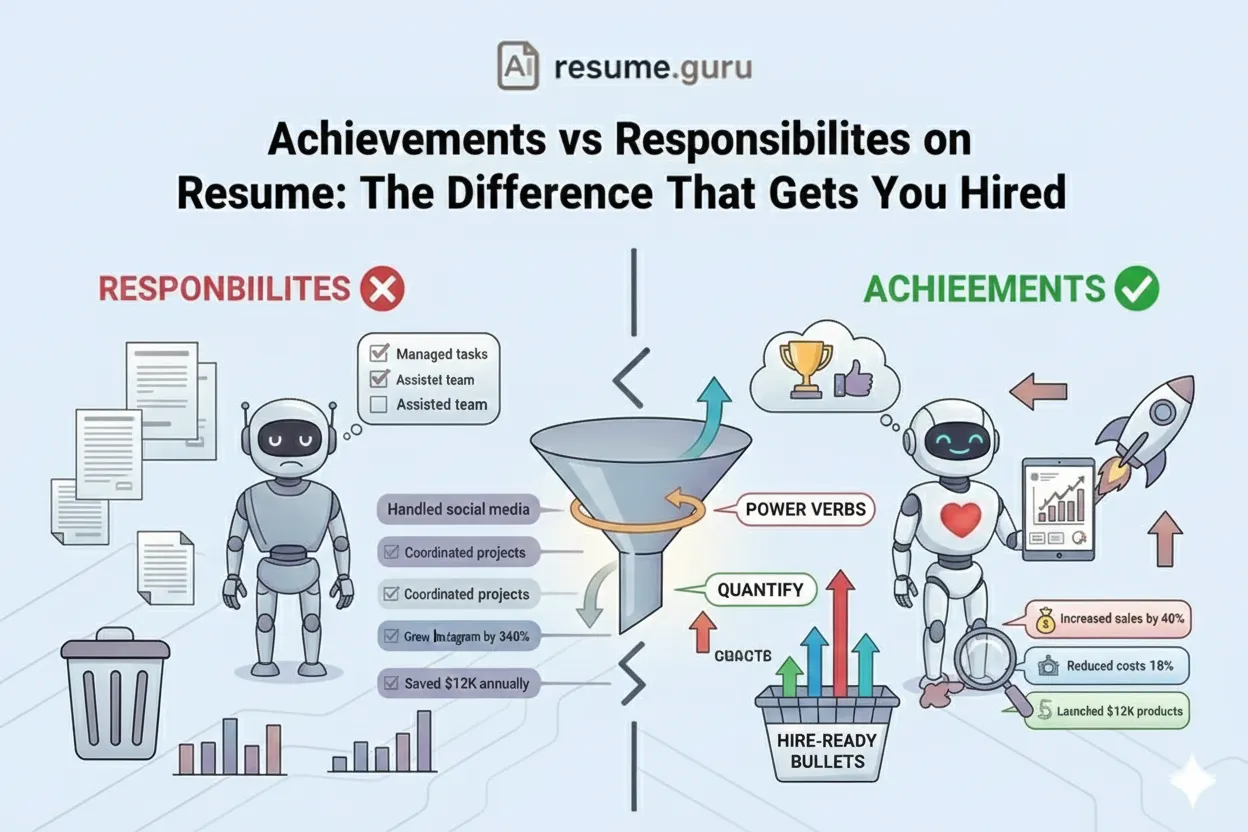
- Achievements vs Responsibilities — Quantify your project impact
- LinkedIn Bio Generator — Showcase projects on your profile
- AI Bullet Generator — Turn project descriptions into polished bullets
- Resume Examples — See projects in context
- Resume Templates — Layouts with project sections
- Resume to Website — Turn your projects into a linkable portfolio site
Frequently Asked Questions
Should I put personal projects on my resume?
Yes—especially if you're early-career, transitioning fields, or have gaps in employment. Personal projects prove initiative, skills application, and the ability to ship. For senior roles, they're supplementary but still valuable.
Where should I put projects on my resume?
For entry-level or developers: create a dedicated 'Projects' section after Skills and before (or instead of) Work Experience. For senior professionals: place after Work Experience or link to a portfolio.
How many projects should I include?
2-4 high-quality projects beats 10 mediocre ones. Choose projects that demonstrate relevant skills, solve real problems, and have measurable outcomes.
Do to-do apps and tutorial projects count?
Barely. Generic tutorial projects (to-do apps, weather apps) don't impress anymore. Hiring managers want to see projects that solve real problems with production-level thinking. Put your own spin on common projects or build something unique.
Put this into practice
You have the theory. These take a few minutes and work on the resume you already have.