"Seeking a challenging position where I can utilize my skills and grow with a dynamic company."
If that's on your resume, delete it right now. It's the #1 sign of an outdated application.
But here's where it gets confusing: Some people say objectives are dead. Others say summaries are unnecessary. Who's right?
More interview callbacks
Resumes with tailored summaries vs. no summary
Source: ResumeGo Study
The answer depends on exactly one thing: your experience level.
The Quick Answer
- Have 1+ years of relevant experience? → Use a Summary
- Entry-level with zero experience? → Use a Career Objective
- Changing careers entirely? → Use a Summary (emphasizing transferable skills)
- Not sure? → When in doubt, summary wins
What's the Actual Difference?
Let's get the definitions straight:
| Resume Summary | Resume Objective |
|---|---|
| Focuses on what you OFFER | Focuses on what you WANT |
| Highlights achievements & skills | States career goals |
| 2-4 sentences, metrics included | 1-2 sentences, goal-focused |
| Best for: Experienced professionals | Best for: Entry-level, career changers |
| Example: 'Marketing Manager with 8 years...' | Example: 'Recent graduate seeking...' |
The Core Philosophy
Summary = "Here's what I bring to the table" (employer-focused)
Objective = "Here's what I want" (candidate-focused)
Guess which one recruiters prefer?
Why Summaries Win
Recruiters spend 6-7 seconds on your resume. They're asking: "Can this person do the job?"
A summary answers that immediately. An objective makes them work to figure it out.
I skip resumes that start with 'Seeking a position...' It tells me what YOU want, not what you can do for ME.
When to Use a Professional Summary
Use a summary if you check ANY of these boxes:
Use a Summary If You...
- Have 1+ years of relevant work experience
- Can quantify at least one achievement
- Have skills directly matching the job
- Are staying in the same industry
- Have a clear professional identity (e.g., 'Software Engineer')
What Makes a Great Summary
The Summary Formula
[Job Title] + [Years of Experience] + [Top 2-3 Skills/Achievements] + [What You're Looking For]
Summary Examples by Experience Level
Mid-Level Professional (3-7 years):
"Results-driven Marketing Manager with 5+ years building brand strategies for B2B SaaS companies. Increased qualified leads by 150% through content marketing and SEO optimization. HubSpot and Google Analytics certified. Seeking to drive growth at a mission-driven technology company."
Senior Professional (8+ years):
"Senior Software Engineer with 10 years developing scalable distributed systems. Led architecture redesign that reduced infrastructure costs by $2M annually at [Company]. Expert in Python, AWS, and Kubernetes. Passionate about mentoring teams and building products that matter."
Technical Specialist:
"Data Scientist specializing in machine learning and predictive analytics. Built recommendation engine serving 5M+ daily users at [Company]. Published researcher in NLP with 500+ citations. Proficient in Python, TensorFlow, and BigQuery."
The No-Fluff Test
Read your summary and remove any phrase that could apply to literally everyone ("hard-working," "detail-oriented," "team player"). If it's not specific to you, cut it.
When to Use a Career Objective
Objectives aren't dead—they're just misused. Here's when they make sense:
Use an Objective If You...
- Are a student or recent graduate with minimal experience
- Are making a major career change (different industry entirely)
- Are re-entering the workforce after a long gap
- Are targeting a very specific role at a specific company
- Have no quantifiable achievements to highlight
The Modern Objective Formula
Old objectives focused on what YOU want:
"Seeking a challenging entry-level position..." ❌
Modern objectives focus on VALUE:
"Recent CS graduate with Python projects and internship experience seeking to contribute as a Junior Developer at [Company]..." ✅
The Modern Objective Formula
[Your Status/Background] + [Relevant Skills/Experience] + [Value You'll Provide] + [Target Role]
Objective Examples That Actually Work
Recent Graduate:
"Computer Science graduate from UCLA with internship experience in full-stack development. Built 5 web applications using React and Node.js. Seeking Junior Software Engineer role to contribute to innovative product development at a growth-stage startup."
Career Changer:
"Former high school teacher with 8 years developing curriculum and mentoring students. Completed Google UX Design Certificate. Seeking UX Design role to apply instructional design expertise and user-focused thinking to create intuitive digital experiences."
Returning to Workforce:
"Marketing professional returning after 3-year career pause, bringing 7 years of brand management experience with Fortune 500 companies. Certified in digital marketing. Seeking Marketing Manager role to leverage strategic planning skills in a collaborative environment."
Objectives That Get Ignored
- "Seeking a challenging role where I can learn and grow..." (Too vague)
- "Looking for a position that utilizes my skills..." (Which skills?)
- "Seeking opportunity to work with a dynamic team..." (Everyone says this)
- "Entry-level professional seeking to start my career..." (What value do you bring?)
The common thread? All self-focused, zero value proposition.
The "Hybrid" Approach: Best of Both
Can't decide? There's a third option: The Value Statement.
This combines the goal-orientation of an objective with the achievement-focus of a summary.
Format:
"[Career stage/identity] seeking [specific role] to [action verb] + [value you'll bring]. Proven [relevant skill/achievement] with experience in [relevant area]."
Example:
"Detail-oriented Finance graduate seeking Entry-Level Analyst role to support data-driven investment decisions. Built financial models for 3 case competitions, winning regional finals. Proficient in Excel modeling and Python for data analysis."
This works because it:
- States what you want (objective element)
- Immediately proves why you're qualified (summary element)
- Includes specific, quantifiable experience
Side-by-Side Comparison: Same Person, Different Approaches
Let's see how the same candidate would write each:
Candidate: Recent marketing graduate with internship + strong project work
| Objective Approach | Summary Approach |
|---|---|
| Focuses on: What they want | Focuses on: What they've done |
| 'Recent marketing graduate seeking Digital Marketing role to develop skills and contribute to brand growth campaigns.' | 'Marketing graduate with internship experience managing social campaigns for 50K+ audiences. Increased engagement by 35% through A/B testing. Google Analytics certified.' |
Which is better? The summary—but only because this person has quantifiable experience. If they had zero experience, the objective approach (mentioning specific skills and value) would be appropriate.
Industry-Specific Recommendations
| Industry | Recommendation | Why |
|---|---|---|
| Technology | Summary | Employers want proof of technical skills |
| Finance | Summary | Results and metrics matter most |
| Creative/Design | Summary or Skip | Portfolio speaks louder than words |
| Healthcare | Summary | Certifications + experience are expected |
| Entry-Level/Internship | Objective | Limited experience to summarize |
| Academia | Neither | CV format with research focus instead |
| Government | Summary | Must match exact job requirements |
Quick Decision Flowchart
START HERE
    │
    ▼
Do you have 1+ years of relevant experience?
    │
    ├── YES → Use a SUMMARY
    │         (Focus on achievements + skills)
    │
    └── NO → Are you changing careers?
              │
              ├── YES → Use a SUMMARY
              │         (Focus on transferable skills)
              │
              └── NO → Are you entry-level?
                        │
                        ├── YES → Use an OBJECTIVE
                        │         (Focus on value + goals)
                        │
                        └── NO → Use a SUMMARY
                                 (or skip entirely)
Common Mistakes to Avoid
Mistake 1: Using 'I' Statements
Wrong: "I am a dedicated professional who wants to..."
Right: "Dedicated marketing professional with 5 years..."
Resume writing omits "I" and uses sentence fragments. It's understood you're talking about yourself.
Mistake 2: Generic Buzzwords Without Proof
Wrong: "Results-oriented team player with excellent communication skills"
Right: "Grew team revenue by 40% while managing 5 direct reports"
Buzzwords mean nothing without evidence.
Mistake 3: Writing Novel-Length Summaries
Wrong: 8-sentence paragraph covering your entire career
Right: 2-4 punchy sentences with specific achievements
If it's more than 4 lines, it's too long. Recruiters will skip it.
Mistake 4: Not Tailoring to the Job
Wrong: Same summary for every application
Right: Summary customized with keywords from the job description
A tailored summary can boost your ATS match rate by 20-30%.
Templates You Can Use Right Now
Summary Template (Experienced Professional)
[Title] with [X years] of experience in [industry/specialty].
[Key achievement with metric]. [Second achievement or skill].
Seeking to [value you'll bring] at [target company type].
Summary Template (Career Changer)
[Previous role] transitioning to [new field], bringing [X years]
of [transferable skill]. [Relevant achievement that applies].
[Certification or training in new field]. Seeking [target role]
to apply [specific value].
Objective Template (Entry-Level)
[Degree/Status] with [relevant skill/experience] seeking [specific
role]. [Project or achievement that demonstrates capability].
Proficient in [relevant tools]. Eager to contribute to [specific
value proposition].
Generate your summary in seconds
Our AI Resume Summary Generator creates tailored summaries based on your experience and target role—no writer's block required.
Generate My SummaryThe Bottom Line
Summary wins 90% of the time. It's what recruiters expect and what ATS systems prefer for keyword matching.
Objectives work only when:
- You have no experience to summarize
- You're making a drastic career change
- You're targeting a specific company/role
Whatever you choose, make it specific, make it achievement-focused, and make it about the value you bring—not what you want to get.
Related Resources
- Professional Summary Examples by Industry — 30+ examples
- Resume Objective Examples — Entry-level focused
- Entry-Level Resume Guide — Complete guide for new grads
- Action Verbs for Resume — Power up your bullets
- Resume Examples — See summaries in context
- Resume Templates — Professional designs
- AI Resume Builder — Build your resume with AI
- Resume Builder — Create your resume
- Resume Summary Generator — AI-powered summaries
- Skills Finder — Discover skills to highlight
Frequently Asked Questions
Should I use a resume summary or objective in 2026?
Use a summary if you have 1+ years of relevant experience. Use an objective only if you're entry-level with no experience, making a major career change, or targeting a specific company. Summaries are preferred by 90%+ of recruiters.
Is the resume objective statement dead?
Mostly, yes. Traditional objectives like 'Seeking a challenging position...' are outdated. However, modern career objectives that focus on value (not wants) still work for entry-level and career changers.
How long should a resume summary be?
2-4 sentences or 50-75 words. It should fit in 3-4 lines on your resume. Any longer and recruiters will skip it.
Can I skip the summary/objective entirely?
Yes, if your most recent experience clearly matches the job. However, a strong summary gives recruiters instant context and improves ATS keyword matching.
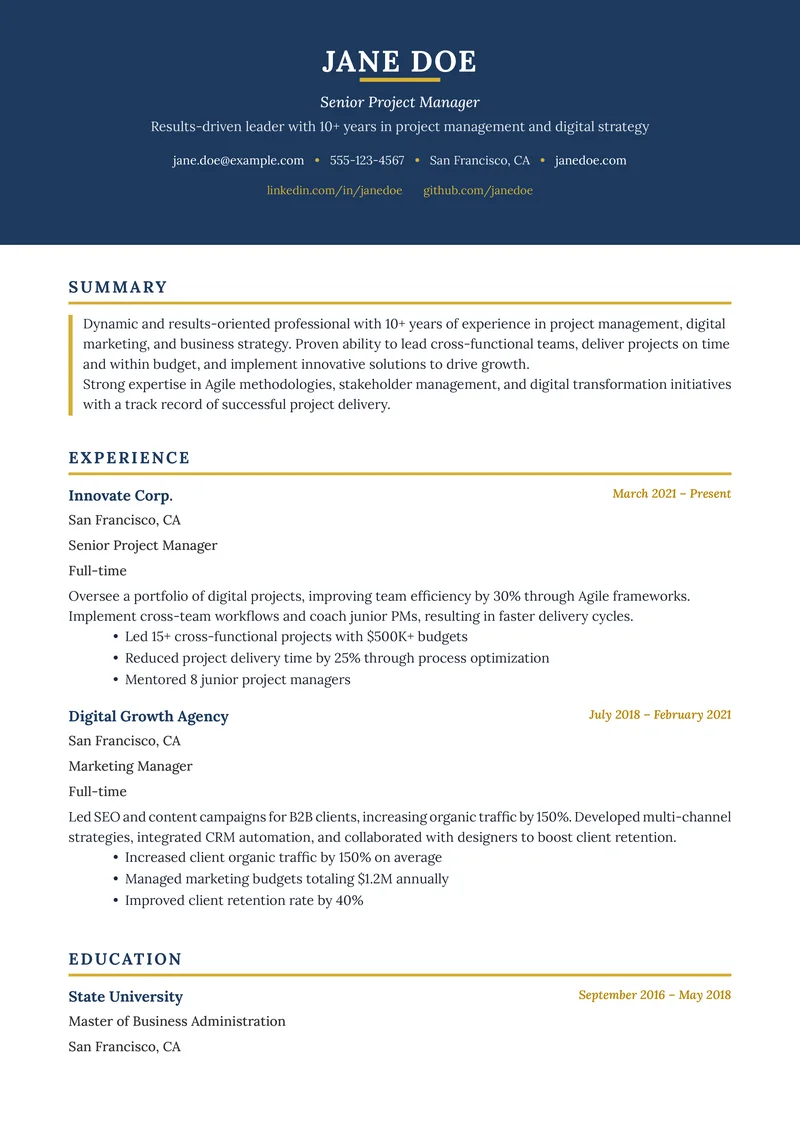
Build Your Perfect Resume
Create an ATS-optimized resume with our AI-powered builder.
No signup required.Start Building FreeExplore Resources
Enjoyed this article?
Share it with your network